Analgesic effect of watching TV during venipuncture
- PMID: 16920758
- PMCID: PMC2082989
- DOI: 10.1136/adc.2006.097246
Analgesic effect of watching TV during venipuncture
Abstract
Aims: To assess the analgesic effect of passive or active distraction during venipuncture in children.
Methods: We studied 69 children aged 7-12 years undergoing venipuncture. The children were randomly divided into three groups: a control group (C) without any distraction procedure, a group (M) in which mothers performed active distraction, and a TV group (TV) in which passive distraction (a TV cartoon) was used. Both mothers and children scored pain after the procedure.
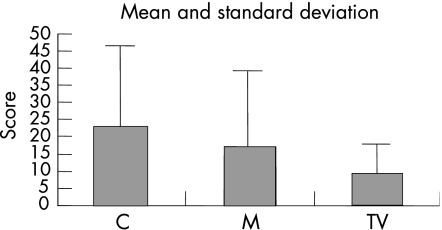
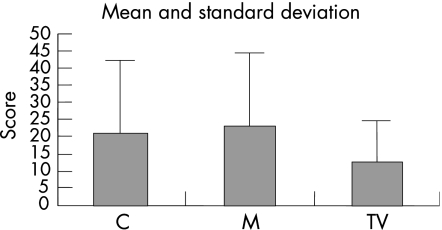
Results: Main pain levels rated by the children were 23.04 (standard deviation (SD) 24.57), 17.39 (SD 21.36), and 8.91 (SD 8.65) for the C, M, and TV groups, respectively. Main pain levels rated by mothers were 21.30 (SD 19.9), 23.04 (SD 18.39), and 12.17 (SD 12.14) for the C, M, and TV groups, respectively. Scores assigned by mothers and children indicated that procedures performed during TV watching were less painful (p<0.05) than control or procedures performed during active distraction.
Conclusion: TV watching was more effective than active distraction. This was due either to the emotional participation of the mothers in the active procedure or to the distracting power of television.
Conflict of interest statement
Competing interests: None declared.
References
-
- Bellieni C V, Bagnoli F, Buonocore G. Alone no more: pain in premature children. Ethics Med 200319(1)5–9. - PubMed
-
- Cohen L L, Blount R L, Panopoulos G. Nurse coaching and cartoon distraction: an effective and practical intervention to reduce child, parent, and nurse distress during immunizations. J Pediatr Psychol 199722355–370. - PubMed
-
- Cassidy K ‐ L, Reid G J, McGrath P J.et al Watch needle, watch TV: audiovisual distraction in preschool immunization. Pain Med 20023108–118. - PubMed
-
- Manimala R, Blount R L, Cohen L L. The effects of parental reassurance versus distraction on child distress and coping during immunizations. Child Health Care 200029161–177.
-
- Vessey J A, Carlson K L, McGill J. Use of distraction with children during an acute pain procedure. Nurs Res 199443369–372. - PubMed
Publication types
MeSH terms
LinkOut - more resources
Full Text Sources
Medical