


Exo-oligosaccharides of Rhizobium sp. strain NGR234 are required for symbiosis with various legumes
- PMID: 16923883
- PMCID: PMC1595362
- DOI: 10.1128/JB.00365-06
Exo-oligosaccharides of Rhizobium sp. strain NGR234 are required for symbiosis with various legumes
Erratum in
-
Correction for Staehelin et al., "Exo-Oligosaccharides of Rhizobium sp. Strain NGR234 Are Required for Symbiosis with Various Legumes".J Bacteriol. 2025 Sep 18;207(9):e0015725. doi: 10.1128/jb.00157-25. Epub 2025 Aug 20. J Bacteriol. 2025. PMID: 40833097 Free PMC article. No abstract available.
Abstract
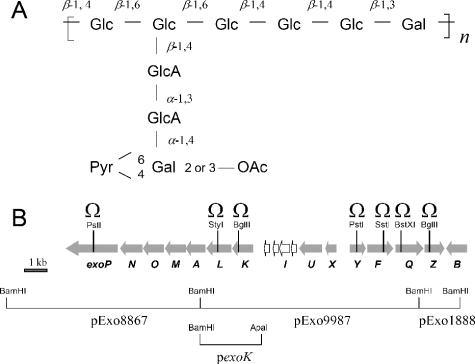
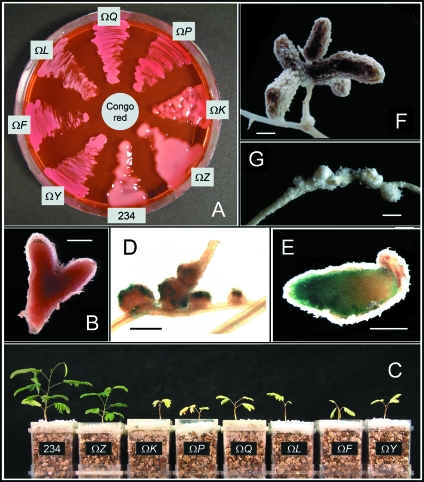
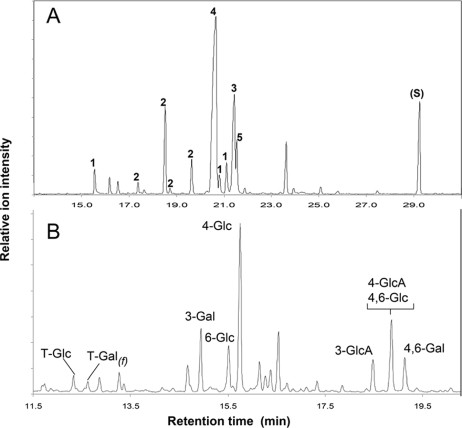
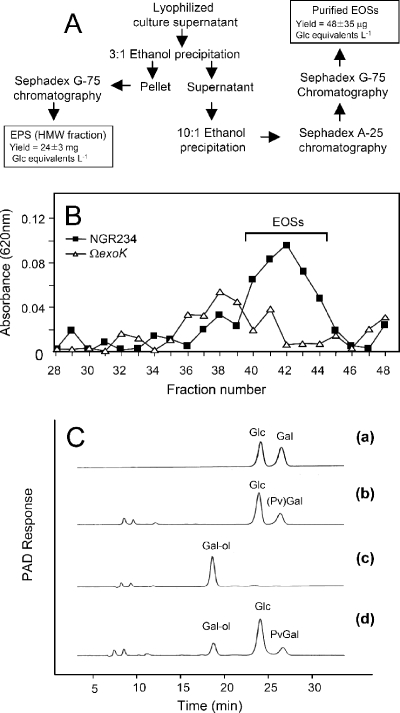
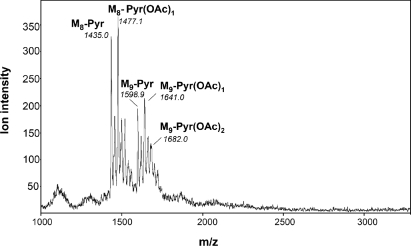
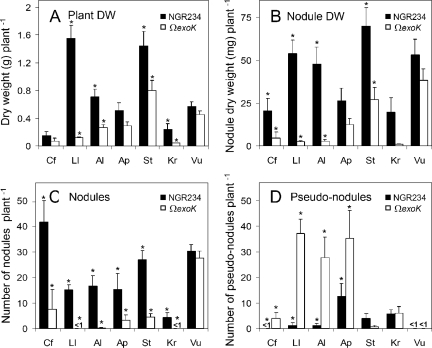
Rhizobia are nitrogen-fixing bacteria that establish endosymbiotic associations with legumes. Nodule formation depends on various bacterial carbohydrates, including lipopolysaccharides, K-antigens, and exopolysaccharides (EPS). An acidic EPS from Rhizobium sp. strain NGR234 consists of glucosyl (Glc), galactosyl (Gal), glucuronosyl (GlcA), and 4,6-pyruvylated galactosyl (PvGal) residues with beta-1,3, beta-1,4, beta-1,6, alpha-1,3, and alpha-1,4 glycoside linkages. Here we examined the role of NGR234 genes in the synthesis of EPS. Deletions within the exoF, exoL, exoP, exoQ, and exoY genes suppressed accumulation of EPS in bacterial supernatants, a finding that was confirmed by chemical analyses. The data suggest that the repeating subunits of EPS are assembled by an ExoQ/ExoP/ExoF-dependent mechanism, which is related to the Wzy polymerization system of group 1 capsular polysaccharides in Escherichia coli. Mutation of exoK (NGROmegaexoK), which encodes a putative glycanase, resulted in the absence of low-molecular-weight forms of EPS. Analysis of the extracellular carbohydrates revealed that NGROmegaexoK is unable to accumulate exo-oligosaccharides (EOSs), which are O-acetylated nonasaccharide subunits of EPS having the formula Gal(Glc)5(GlcA)2PvGal. When used as inoculants, both the exo-deficient mutants and NGROmegaexoK were unable to form nitrogen-fixing nodules on some hosts (e.g., Albizia lebbeck and Leucaena leucocephala), but they were able to form nitrogen-fixing nodules on other hosts (e.g., Vigna unguiculata). EOSs of the parent strain were biologically active at very low levels (yield in culture supernatants, approximately 50 microg per liter). Thus, NGR234 produces symbiotically active EOSs by enzymatic degradation of EPS, using the extracellular endo-beta-1,4-glycanase encoded by exoK (glycoside hydrolase family 16). We propose that the derived EOSs (and not EPS) are bacterial components that play a crucial role in nodule formation in various legumes.
Figures
References
-
- Becker, A., and A. Pühler. 1998. Production of exopolysaccharides, p. 97-118. In H. P. Spaink, Á. Kondorosi, and P. J. J. Hooykaas (ed.), The Rhizobiaceae. Kluwer Academic Publishers, Dordrecht, The Netherlands.
-
- Becker, A., N. Fraysse, and L. Sharypova. 2005. Recent advances in studies on structure and symbiosis-related function of rhizobial K-antigens and lipopolysaccharides. Mol. Plant-Microbe Interact. 9:899-905. - PubMed
-
- Broughton, W. J., and C. K. John. 1979. Rhizobia in tropical legumes. III. Experimentation and supply in Malaysia 1927-1976, p. 113-136. In W. J. Broughton, C. K. John, B. Lim, and C. Rajova (ed.), Soil microbiology and plant nutrition. University of Malaysia, Kuala Lumpur, Malaysia.
-
- Chen, H., M. Batley, J. W. Redmond, and B. G. Rolfe. 1985. Alteration of the effective nodulation properties of a fast-growing broad host-range Rhizobium due to changes in exopolysaccharide synthesis. J. Plant Physiol. 120:331-349.
Publication types
MeSH terms
Substances
Grants and funding
LinkOut - more resources
Full Text Sources
Other Literature Sources
