. 2006 Sep;188(17):6326-34.
doi: 10.1128/JB.00554-06.

Detection and quantification of superoxide formed within the periplasm of Escherichia coli

Affiliations

Detection and quantification of superoxide formed within the periplasm of Escherichia coli

Sergei Korshunov et al. J Bacteriol. 2006 Sep.

Abstract

Many gram-negative bacteria harbor a copper/zinc-containing superoxide dismutase (CuZnSOD) in their periplasms. In pathogenic bacteria, one role of this enzyme may be to protect periplasmic biomolecules from superoxide that is released by host phagocytic cells. However, the enzyme is also present in many nonpathogens and/or free-living bacteria, including Escherichia coli. In this study we were able to detect superoxide being released into the medium from growing cultures of E. coli. Exponential-phase cells do not normally synthesize CuZnSOD, which is specifically induced in stationary phase. However, the engineered expression of CuZnSOD in growing cells eliminated superoxide release, confirming that this superoxide was formed within the periplasm. The rate of periplasmic superoxide production was surprisingly high and approximated the estimated rate of cytoplasmic superoxide formation when both were normalized to the volume of the compartment. The rate increased in proportion to oxygen concentration, suggesting that the superoxide is generated by the adventitious oxidation of an electron carrier. Mutations that eliminated menaquinone synthesis eradicated the superoxide formation, while mutations in genes encoding respiratory complexes affected it only insofar as they are likely to affect the redox state of menaquinone. We infer that the adventitious autoxidation of dihydromenaquinone in the cytoplasmic membrane releases a steady flux of superoxide into the periplasm of E. coli. This endogenous superoxide may create oxidative stress in that compartment and be a primary substrate of CuZnSOD.


Figures
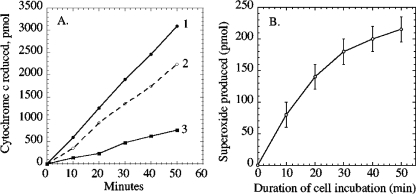
FIG. 1.
FIG. 1.
Detection of extracellular superoxide released by exponentially growing cultures of the wild-type strain AN387. (A) Total reduction of extracellular cytochrome c in the absence (line 1) and presence (line 2) of exogenous superoxide dismutase. Line 3 indicates the calculated release of superoxide. The superoxide formed by the excreted metabolite of panel B has been subtracted from the overall rate of superoxide-mediated cytochrome c reduction. (B) Superoxide formation by an excreted metabolite. At time zero, the wild-type strain AN387 was suspended in fresh medium.
FIG. 2.
FIG. 2.
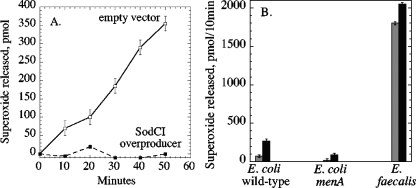
Time courses of superoxide release. (A) Expression of periplasmic superoxide dismutase blocks the release of superoxide. Open squares, AN387 pCKR101 (empty vector). Filled squares, AN387 psodCI (overexpressing sodC). (B) Effect of oxygen concentration upon periplasmic superoxide production by wild-type (AN387) and menA (SSK1) E. coli strains and by a wild-type (OG1RF) E. faecalis strain. Gray bars reflect superoxide formation in air-saturated medium, and black bars reflect superoxide formation when 100% oxygen was bubbled through the medium.
FIG. 3.
FIG. 3.
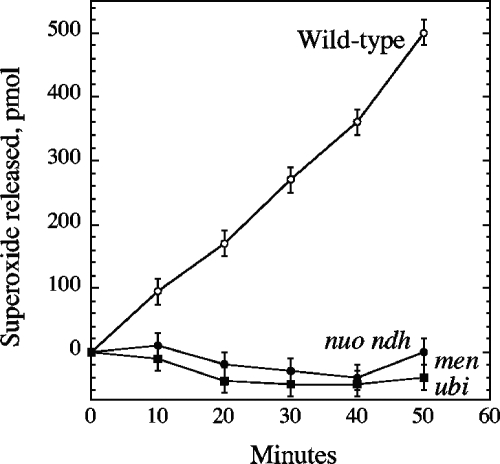
Superoxide is not released from cells that lack respiratory NADH dehydrogenases (strain ALN21, the nuo ndh mutant) or quinones (strain SSK3, the menA ubiCA mutant). See the text for growth conditions.
FIG. 4.
FIG. 4.
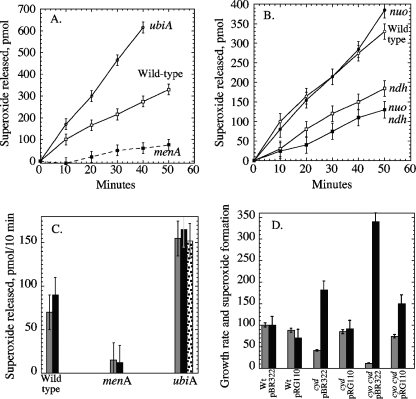
Effects of the deletion and overexpression of different components of the respiratory chain on superoxide release. (A) AN387 (wild type), SSK1 (menA), and SSK2 (ubiCA) were precultured aerobically and then assayed for superoxide release. (B) The congenic strains AN387 (wild type), JI301 (nuo), SLC22 (ndh), and ALN21 (nuo ndh) were precultured aerobically and then assayed for superoxide release. (C) The rates of superoxide formation were compared among the wild-type (AN387), menA (SSK1), and ubiCA (SSK2) strains that contained only a vector (pBR322 [striped bars]) or a plasmid overexpressing ndh (pMW01 [black bars]). The stippled bar shows results for the ubiCA ndh double mutant without a plasmid. (D) The rates of growth (gray bars) and of superoxide formation (black bars) were compared among cyd (SSK4) and cyo cyd (SSK12) mutants and normalized to that of the wild-type (Wt) strain. Strains contained either an empty vector or plasmid pRG110 overexpressing the cyoABCD operon. Data are shown from a single typical experiment, so that rates of growth and of superoxide formation are from a common culture; error bars reflect the range of variation from multiple time points.
FIG. 5.
FIG. 5.
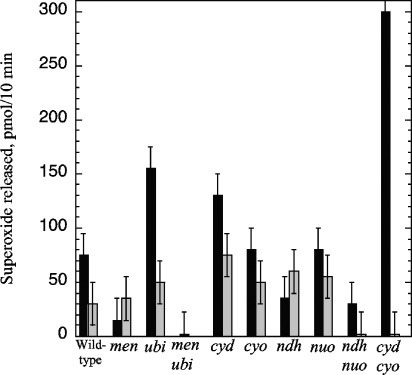
Superoxide release by stationary-phase cells depends upon respiration but does not require menaquinone. Black bars, superoxide release by exponential-phase cells; gray bars, superoxide release by stationary-phase cells immediately upon resuspension in glucose medium. The sodC mutant AS454 and the respiratory mutants SSK3, SSK9, SSK18, SSK19, SSK20, SSK21, SSK22, SSK23, and SSK24 were used. Note that no superoxide was detected in the medium of sodC+ derivatives of any of these stationary-phase cells.

References

    1. Au, D. C.-T., and R. B. Gennis. 1987. Cloning of the cyo locus encoding the cytochrome o terminal oxidase complex of Escherichia coli. J. Bacteriol. 169:3237-3242. - PMC - PubMed
    1. Benov, L. T., and I. Fridovich. 1994. Escherichia coli expresses a copper- and zinc-containing superoxide dismutase. J. Biol. Chem. 269:25310-25314. - PubMed
    1. Blattner, F. R., G. Plunkett III, C. A. Bloch, N. T. Perna, V. Burland, M. Riley, J. Collado-Vides, J. D. Glasner, C. K. Rode, G. F. Mayhew, J. Gregor, N. W. Davis, H. A. Kirkpatrick, M. A. Goeden, D. J. Rose, B. Mau, and Y. Shao. 1997. The complete genome sequence of Escherichia coli K-12. Science 277:1453-1474. - PubMed
    1. Bolivar, F., R. L. Rodriguez, P. J. Green, M. C. Betlach, H. L. Heyneker, H. W. Boyer, J. H. Crosa, and S. Falkow. 1977. Construction and characterization of new cloning vehicles. I. Ampicillin-resistant derivatives of plasmid pMB9. Gene 2:95-113. - PubMed
    1. Calhoun, M. W., and R. B. Gennis. 1993. Demonstration of separate genetic loci encoding distinct membrane-bound respiratory NADH dehydrogenases in Escherichia coli. J. Bacteriol. 175:3013-3019. - PMC - PubMed

Publication types

MeSH terms