. 2006 Nov;26(21):7871-9.
doi: 10.1128/MCB.00573-06. Epub 2006 Aug 21.

The Yng1p plant homeodomain finger is a methyl-histone binding module that recognizes lysine 4-methylated histone H3

Affiliations

The Yng1p plant homeodomain finger is a methyl-histone binding module that recognizes lysine 4-methylated histone H3

David G E Martin et al. Mol Cell Biol. 2006 Nov.

Abstract

The ING (inhibitor of growth) protein family includes a group of homologous nuclear proteins that share a highly conserved plant homeodomain (PHD) finger domain at their carboxyl termini. Members of this family are found in multiprotein complexes that posttranslationally modify histones, suggesting that these proteins serve a general role in permitting various enzymatic activities to interact with nucleosomes. There are three members of the ING family in Saccharomyces cerevisiae: Yng1p, Yng2p, and Pho23p. Yng1p is a component of the NuA3 histone acetyltransferase complex and is required for the interaction of NuA3 with chromatin. To gain insight into the function of the ING proteins, we made use of a genetic strategy to identify genes required for the binding of Yng1p to histones. Using the toxicity of YNG1 overexpression as a tool, we showed that Yng1p interacts with the amino-terminal tail of histone H3 and that this interaction can be disrupted by loss of lysine 4 methylation within this tail. Additionally, we mapped the region of Yng1p required for overexpression of toxicity to the PHD finger, showed that this region capable of binding lysine 4-methylated histone H3 in vitro, and demonstrated that mutations of the PHD finger that abolish binding in vitro are no longer toxic in vivo. These results identify a novel function for the Yng1p PHD finger in promoting stabilization of the NuA3 complex at chromatin through recognition of histone H3 lysine 4 methylation.


Figures

FIG. 1.
FIG. 1.
Yng1p interacts with the histone H3 tail in vivo. (A) Chromatin pull-down assays were performed on strains YDM126, YDM127, and YDM138, and the resulting samples were subjected to Western blotting with peroxidase antiperoxidase (Htb1TAP) or anti-HA antibodies (Sas3HA). (B and C) Tenfold serial dilutions of yeast strains YLH101 (B) or FY2162 transformed with pHHT2 or phht2Δ3-29 (C) containing the indicated plasmids were plated on synthetic complete medium lacking uracil containing either dextrose or galactose as a carbon source and incubated at 30°C for 3 days. (D) Normalized amounts of whole-cell extracts from the indicated strains (FY2162 transformed with pHHT2 or phht2Δ3-29) transformed with pGALYNG1HA and grown on galactose were subjected to Western blotting with immunodetection for HA. +, present; −, absent.
FIG. 2.
FIG. 2.
Yng1p toxicity is rescued by loss of the COMPASS histone methyltransferase complex. Tenfold serial dilutions of yeast strains YLH101, YLH211, and YLH209 (A) and YLH101, YLH206, YLH220, YLH203, YLH204, YLH298, and YLH205 (B) containing the indicated plasmids were plated on synthetic complete medium lacking uracil containing either dextrose or galactose as a carbon source and incubated at 30°C for 3 days.
FIG. 3.
FIG. 3.
The interaction of Yng1p with histone H3 is dependent on lysine 4. (A) Tenfold serial dilutions of yeast strain FY2162 transformed with pHHT2, phht2K4R, or phht2K36R containing the indicated plasmids were plated on synthetic complete medium lacking uracil containing either dextrose or galactose as a carbon source and incubated at 30°C for 3 days. (B) Normalized amounts of whole-cell extracts from the indicated strains (FY2162 transformed with pHHT2 or phht2K4R) transformed with pGALYNG1HA and grown on galactose were subjected to Western blotting with immunodetection for HA.
FIG. 4.
FIG. 4.
The Yng1p PHD finger is required for histone binding. (A) Chromatin pull-down assays were performed on strains YDM126, YDM127, YDM137, YDM153, and YLH363, and the resulting samples were subjected to Western blotting with peroxidase antiperoxidase (Htb1TAP) or anti-HA antibodies (Sas3HA). (B) Tenfold serial dilutions of yeast strain YLH101 containing the indicated plasmids were plated on synthetic complete medium lacking leucine containing either dextrose or galactose as a carbon source and incubated at 30°C for 3 days. (C) Normalized amounts of whole-cell extracts from wild-type yeast strains (YLH101) carrying a pGALYNG1HA (lane 1) or pGALYNG1ΔPHDHA (lane 2) plasmid and grown on galactose were subjected to Western blotting for HA. +, present; −, absent.
FIG. 5.
FIG. 5.
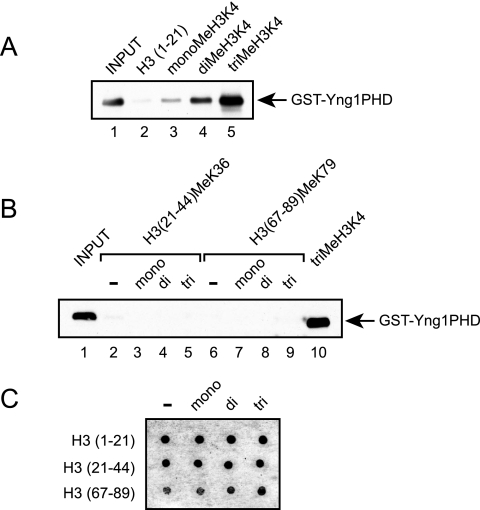
The Yng1p PHD finger binds lysine 4-methylated histone H3. (A and B) Histone peptide binding assays were performed with the indicated biotinylated peptides and purified GST-Yng1PHD. Shown are Western blots of peptide-bound GST-Yng1PHD protein with GST antibodies. Input lanes represent 10% of the GST protein used in the pull-down assays. (C) Five hundred nanograms of biotinylated histone peptides was spotted onto membranes and immunodetected with antibiotin antibodies. −, absent.
FIG. 6.
FIG. 6.
The toxicity of YNG1 overexpression correlates with the level of Yng1p-triMeH3K4 binding. (A) Schematic representation of Yng1p (open bar), the Yng1 PHD finger (black bar), the coordinating cysteines and histidine residues of the PHD finger (underlined), and the residues subjected to mutation (highlighted). (B) Histone peptide binding assays were performed with the indicated biotinylated peptides and purified wild-type and mutant versions of GST-Yng1PHD. Shown are Western blots of peptide-bound GST-Yng1PHD proteins with GST antibodies. Input lanes represent 10% of the GST protein used in the pull-down assays. (C) Tenfold serial dilutions of yeast strain YLH101 containing the indicated plasmids were plated on synthetic complete medium lacking uracil containing either dextrose or galactose as a carbon source and incubated at 30°C for 3 days. (D) Normalized amounts of whole-cell extract from a wild-type yeast strain (YLH101) carrying plasmids expressing the indicated HA-tagged versions of Yng1p from a GAL1 promoter and grown on galactose were subjected to Western blotting for HA.

References

    1. Aasland, R., T. J. Gibson, and A. F. Stewart. 1995. The PHD finger: implications for chromatin-mediated transcriptional regulation. Trends Biochem. Sci. 20:56-59. - PubMed
    1. Ausubel, F. M. 1987. Current protocols in molecular biology. Wiley-Interscience, New York, N.Y.
    1. Bordoli, L., S. Husser, U. Luthi, M. Netsch, H. Osmani, and R. Eckner. 2001. Functional analysis of the p300 acetyltransferase domain: the PHD finger of p300 but not of CBP is dispensable for enzymatic activity. Nucleic Acids Res. 29:4462-4471. - PMC - PubMed
    1. Carrozza, M. J., B. Li, L. Florens, T. Suganuma, S. K. Swanson, K. K. Lee, W. J. Shia, S. Anderson, J. Yates, M. P. Washburn, and J. L. Workman. 2005. Histone H3 methylation by Set2 directs deacetylation of coding regions by Rpd3S to suppress spurious intragenic transcription. Cell 123:581-592. - PubMed
    1. Choy, J. S., B. T. Tobe, J. H. Huh, and S. J. Kron. 2001. Yng2p-dependent NuA4 histone H4 acetylation activity is required for mitotic and meiotic progression. J. Biol. Chem. 276:43653-43662. - PubMed

Publication types

MeSH terms