Review
. 2006 Dec 15;108(13):3983-91.
doi: 10.1182/blood-2006-06-026518. Epub 2006 Aug 22.

Proteomic approaches to dissect platelet function: Half the story

Affiliations
Review

Proteomic approaches to dissect platelet function: Half the story

Dmitri V Gnatenko et al. Blood. .

Abstract

Platelets play critical roles in diverse hemostatic and pathologic disorders and are broadly implicated in various biological processes that include inflammation, wound healing, and thrombosis. Recent progress in high-throughput mRNA and protein profiling techniques has advanced our understanding of the biological functions of platelets. Platelet proteomics has been adopted to decode the complex processes that underlie platelet function by identifying novel platelet-expressed proteins, dissecting mechanisms of signal or metabolic pathways, and analyzing functional changes of the platelet proteome in normal and pathologic states. The integration of transcriptomics and proteomics, coupled with progress in bioinformatics, provides novel tools for dissecting platelet biology. In this review, we focus on current advances in platelet proteomic studies, with emphasis on the importance of parallel transcriptomic studies to optimally dissect platelet function. Applications of these global profiling approaches to investigate platelet genetic diseases and platelet-related disorders are also addressed.


Figures

Figure 1.
Figure 1.
Schema outlining a general approach to platelet proteomic analysis. An ideal experiment generally incorporates platelet subfractionation methods with sophisticated mass spectrometric techniques and computational analyses to elucidate platelet biological functions.
Figure 2.
Figure 2.
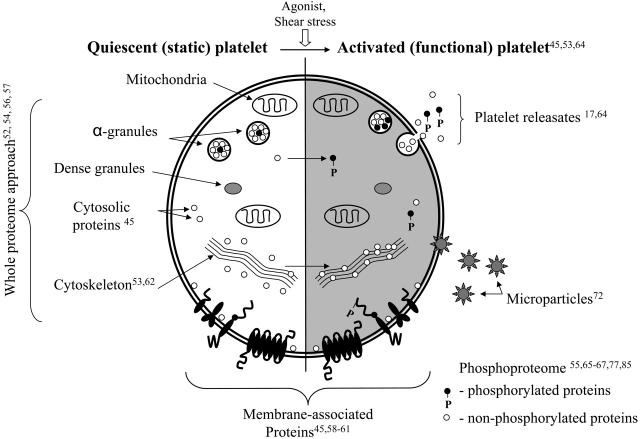
Schema of platelet ultrastructure integrated with proteomic studies. The unshaded panel delineates the proteomic studies involving quiescent platelets. The shaded panel represents those studies focusing on activation-dependent platelet end points (eg, microparticles, exosome/releasates). Superscript numbers refer to references.
Figure 3.
Figure 3.
In silico gene rank–intensity plots from a first-generation platelet gene chip. Normalized data from individual microarray analyses obtained from 3 distinct leukocyte samples (A-C), 5 normal platelet samples (D-H), and 6 essential thrombocythemic platelet samples (I-N) were analyzed by one-way ANOVA using parametric testing to identify a 432-member gene list. (top) Relative expression of the platelet-restricted genes (n = 389). (bottom) Expression intensity of the leukocyte-restricted genes (n = 43). Note the clear difference in the expression patterns between the 2 groups (leukocyte vs platelet).
Figure 4.
Figure 4.
Integration of platelet transcript and protein profiling to study human diseases. The combination of proteomic and transcriptomic technologies can be applied for comparative studies between normal and diseased platelets, ultimately leading to novel diagnostic assays or to the identification of novel therapeutic targets. Potential applications include treatment of not only single-gene platelet disorders but also the broader subset of patients with platelet-related cardiovascular or cerebrovascular disease. The box summarizes current limitations and progress achieved to date.

References

    1. Stenberg PE, Hill RL. Platelets and megakaryocytes. In: Lee G, Foerster J, Lukens J, eds. Wintrobe's Clinical Hematology. Philadelphia, PA: Lippincott Williams & Wilkins; 1999: 615-660.
    1. Newman PJ, Gorski J, White GC 2nd, Gidwitz S, Cretney CJ, Aster RH. Enzymatic amplification of platelet-specific messenger RNA using the polymerase chain reaction. J Clin Invest. 1988;82: 739-743. - PMC - PubMed
    1. Kieffer N, Guichard J, Farcet JP, Vainchenker W, Breton-Gorius J. Biosynthesis of major platelet proteins in human blood platelets. Eur J Biochem. 1987;164: 189-195. - PubMed
    1. Weyrich AS, Dixon DA, Pabla R, et al. Signal-dependent translation of a regulatory protein, Bcl-3, in activated human platelets. Proc Natl Acad Sci U S A. 1998;95: 5556-5561. - PMC - PubMed
    1. Denis MM, Tolley ND, Bunting M, et al. Escaping the nuclear confines: signal-dependent pre-mRNA splicing in anucleate platelets. Cell. 2005; 122: 379-391. - PMC - PubMed

Publication types