. 2006 Sep;74(9):5408-13.
doi: 10.1128/IAI.01840-05.

Nucleotide sequence analysis of the enteropathogenic Escherichia coli adherence factor plasmid pMAR7

Affiliations

Nucleotide sequence analysis of the enteropathogenic Escherichia coli adherence factor plasmid pMAR7

Carl Brinkley et al. Infect Immun. 2006 Sep.

Abstract

The complete nucleotide sequence was determined for pMAR7, an enteropathogenic Escherichia coli (EPEC) adherence factor (EAF) plasmid that contains genes encoding a type IV attachment pilus (Bfp) and the global virulence regulator per. Prototypic EAF plasmid pMAR7 is self-transmissible, unlike the smaller EAF plasmid pB171, which has no genes encoding conjugative functions. The tra locus, a highly conserved 33-kb segment found in pMAR7, is similar to the tra (conjugation) region of the F plasmid. ISEc13 copies flanking the pMAR7 tra region could potentially mobilize or delete the tra genes. Hybridization of 134 EPEC strains showed that a complete tra region is present only in strains of the EPEC1 clonal group. This study confirms EPEC's potential for dissemination of virulence attributes by horizontal transfer of the EAF plasmid.


Figures
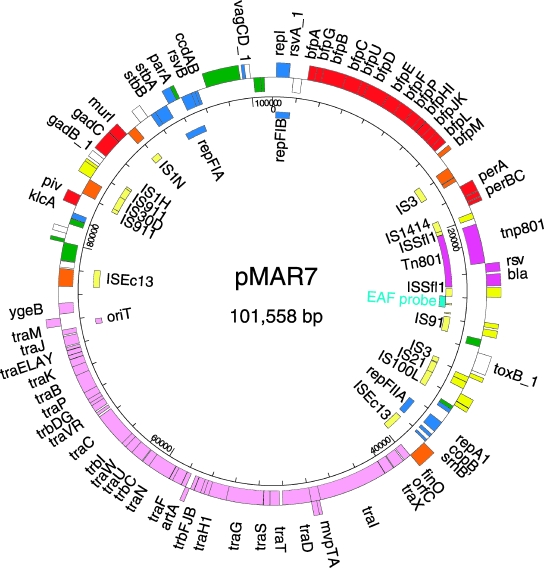
FIG. 1.
FIG. 1.
Map of pMAR7. Outer circle, ORFs, and their orientations color coded by functional category: red, known or putative virulence-associated proteins; pink, conjugal DNA transfer; yellow, IS-related or transposase fragments; orange, intact IS or transposase; blue, plasmid replication, maintenance, or other DNA metabolic functions; green, conserved hypothetical; purple, Tn801 insertion associated; white, pseudogenes. The inner circle shows the scale in base pairs. Individual gene descriptions are available online (see Table S1 in the supplemental material) or in the ERIC-BRC ASAP database (https://ericbrc.org/asap). The three replication regions, oriT, and the EAF probe are indicated. The figure was generated using the program Genvision (DNASTAR, Madison, WI).
FIG. 2.
FIG. 2.
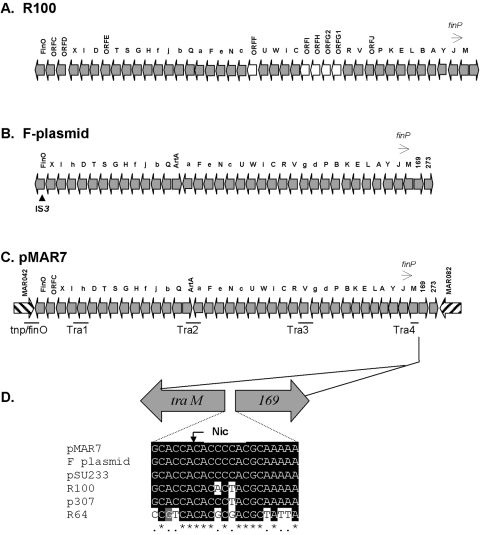
Transfer operons of the pMAR7, R100, and F plasmids. The transfer operons of plasmid R100 (A) plasmid F (B), and pMAR7 (C) are compared. Orientation of the ORFs is that in pMAR7. Transcription proceeds from right to left; tra genes are in uppercase, trb genes are in lowercase, and antisense RNA finP is indicated above the lines. ORFs are not to scale. (D) Comparison of putative oriT region of conjugative plasmids aligned at nic site (arrow) according to Frost et al. (7). Sequences were aligned by CLUSTAL W and highlighted by Boxshade. Source or reference for sequences: pMAR7 (the present study); R100 (NC_002134), F (NC_002483), R64 (AB027308), p307 (X06534), pSU233 (X55896).
FIG. 3.
FIG. 3.
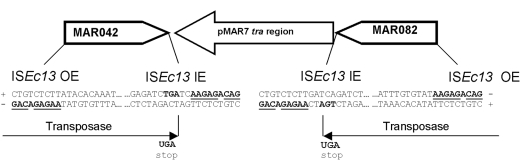
ISEc13 flanking tra region of pMAR7. The outer end (OE) 19-bp terminal inverted repeat begins 165 bp upstream of the ORF (MAR042 and MAR082). The transposase TGA stop codon is within the 19-bp inner end (IE).
FIG. 4.
FIG. 4.
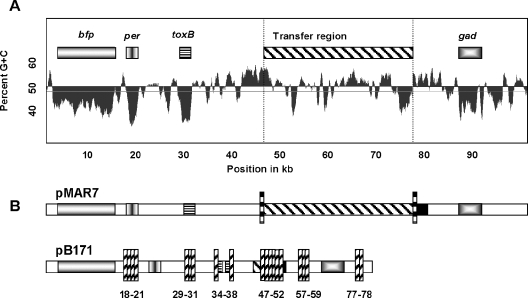
(A) G+C content of pMAR7. The G+C percentage (sliding window) is plotted against the sequence position. Regions with low G+C content, bfp, per, toxB, gad, and the transfer region are indicated. The scale is in kilobases. (B) Comparison of pMAR7 and pB171. Marked pMAR7 segments are aligned with the G+C content diagram, and homologous pB171 regions are indicated with similar patterns. IS elements flanking the tra genes are indicated with vertical checked bars. pB171-specific ORFs are indicated by vertical hash bars with ORF numbers below the bar. The toxB fragments and flanking IS3 ORFs in pB171 are ORFs 34 to 38.

References

    1. Anthony, K. G., W. A. Klimke, J. Manchak, and L. S. Frost. 1999. Comparison of proteins involved in pilus synthesis and mating pair stabilization from the related plasmids F and R100-1: insights into the mechanism of conjugation. J. Bacteriol. 181:5149-5159. - PMC - PubMed
    1. Baldini, M. M., J. B. Kaper, M. M. Levine, D. C. Candy, and H. W. Moon. 1983. Plasmid-mediated adhesion in enteropathogenic Escherichia coli. J. Pediatr. Gastroenterol. Nutr. 2:534-538. - PubMed
    1. Bieber, D., S. W. Ramer, C.-Y. Wu, W. J. Murray, T. Tobe, R. Fernandez, and G. K. Schoolnik. 1998. Type IV pili, transient bacterial aggregates, and virulence of enteropathogenic Escherichia coli. Science 280:2114-2118. - PubMed
    1. Blank, T. E., H. Zhong, A. L. Bell, T. S. Whittam, and M. S. Donnenberg. 2000. Molecular variation among type IV pilin (bfpA) genes from diverse enteropathogenic Escherichia coli strains. Infect. Immun. 68:7028-7038. - PMC - PubMed
    1. Burland, V., Y. Shao, N. T. Perna, G. Plunkett, H. J. Sofia, and F. R. Blattner. 1998. The complete DNA sequence and analysis of the large virulence plasmid of Escherichia coli O157:H7. Nucleic Acids Res. 26:4196-4204. - PMC - PubMed

Publication types

Substances

LinkOut - more resources