Urinary incontinence: common problem among women over 45
- PMID: 16926957
- PMCID: PMC1479575
Urinary incontinence: common problem among women over 45
Abstract
Objective: To examine age-specific prevalence and correlates of urinary incontinence (UI) among community-dwelling women.
Design: A questionnaire survey used a modified Dillman method.
Setting: Two family practice clinics in Hamilton, Ont.
Participants: Questionnaires were mailed to 1082 women 45 years old and older. Ninety women were disqualified; 606 recipients responded.
Main outcome measures: Self-reported prevalence of UI and potential risk factors.
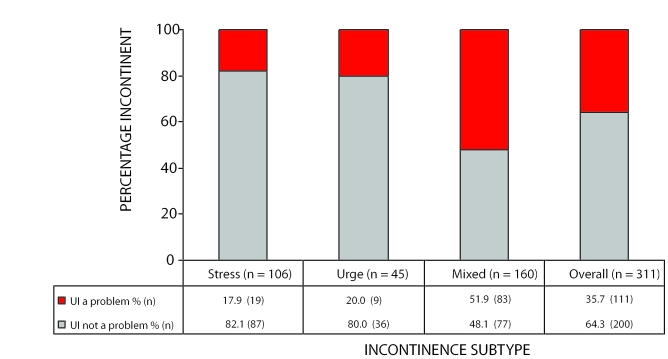
Results: Overall response rate was 61% (606/992); 51% (311/606; 95% confidence interval 47.3% to 55.3%) reported an episode of UI during the last month. Of the 311 women reporting UI, 35.7% perceived it as a problem, 27% had had it for less than a year, 41.9% had had it for 1 to 4 years, and 31.1% had had it for 5 years or longer. Three kinds of UI were reported: 34% (106/311) reported stress UI, 14.5% (45/311) reported urge UI, and 51.4% (160/311) reported a mixed pattern. In multivariate analysis, the overall prevalence of incontinence increased significantly with "usually having a cough," "being troubled by swollen ankles," "giving birth," "ever smoking cigarettes," and "being troubled by headaches." Stress UI was associated with "usually having a cough" and "ever smoking cigarettes." Urge UI was associated with "having troubles with constipation" and "swollen ankles." Mixed incontinence was associated with "get sick more than other people," "usually having a cough," "taken hormones for menopause," and body mass index in the 50th to 75th percentile or greater. Age was not significantly associated with prevalence of UI or any of its subtypes. Only 40% of incontinent women indicated they had discussed urine loss with their physicians; 70% of these women felt satisfied with physicians' responses.
Conclusion: Incontinence occurs in more than half of community-dwelling women 45 years old and older. Almost one of five women in the community reported UI that affected normal activities. Treating the effect of incontinence will require further understanding of women's coping skills and self-perceptions. Prevalence does not appear to increase with age.
OBJECTIF: Déterminer la prévalence en fonction de l’âge et les corrélats de l’incontinence urinaire (IU) chez des femmes de 45 ans et plus vivant dans leur milieu naturel.
TYPE D’ÉTUDE: Enquête par questionnaire utilisant une modification de la méthode de Dillman.
CONTEXTE: Deux cliniques de médecine familiale d’Hamilton, Ontario.
PARTICIPANTS: Sur 1082 questionnaires postés à des femmes de 45 ans et plus, 90 ont été retournés non livrés et 606 réponses ont été obtenues.
PRINCIPALES MESURES EFFECTUÉES: Auto-évaluation de la prévalence de l’IU et des facteurs de risque potentiels.
RÉSULTATS: Le taux de réponse global était de 61,1% (606/992); 51% des répondantes (311/992; intervalle de confiance à 95% : 47,3% à 55,3%) rapportaient un épisode d’IU durant le dernier mois; parmi celles-ci, 37,7% considéraient que c’était un problème, 27% en souffraient depuis moins d’un an, 41,9% depuis un à quatre ans et 35,1% depuis au moins 5 ans. Trois types d’IU étaient observés : IU d’effort (106/311 : 34%), incontinence impérieuse (45/311 : 14,5%) et IU mixte (160/311 : 51,4%). L’analyse multifactorielle révélait une augmentation significative de la prévalence de l’incontinence chez celles qui disaient avoir «une toux habituelle», «de l’œdème aux chevilles», «des céphalées» et «avoir déjà accouché ou fumé». Une association existait entre l’IU d’effort et le fait de tousser régulièrement et d’avoir déjà fumé. L’incontinence impérieuse était plus fréquente en présence de constipation ou d’œdème des chevilles. L’incontinence mixte était plus fréquente chez celles qui disaient «être plus souvent malade que les autres», «prendre des hormones pour la ménopause» et chez celles dont l’indice de masse corporelle se situait au-delà du 50e centile. Il n’y avait pas de relation significative entre l’âge et la prévalence de l’IU, quel que soit le type. Seulement 40% des femmes incontinentes déclaraient en avoir discuté avec leur médecin et 70% d’entre elles étaient satisfaites des réponses obtenues.
CONCLUSION: Plus de la moitié des femmes de 45 ans ou plus vivant dans leur milieu naturel présentent de l’incontinence. Près de 20% disent que cela gène leurs activités quotidiennes. La prise en charge des effets de l’IU exigera une meilleure connaissance de l’image que les femmes ont d’elles-mêmes et des stratégies qu’elles développent pour ce problème. La prévalence ne semble pas augmenter avec l’âge.
Conflict of interest statement
Competing interests: This work was supported by a grant from the Father Sean O’Sullivan Research Foundation of St Joseph’s Healthcare in Hamilton, Ont.
Figures

References
-
- Nygaard IE, Lemke JH. Urinary incontinence in rural older women: prevalence, incidence and remission. J Am Geriatr Soc. 1996;44:1049–1054. - PubMed
-
- Sommer P, Bauer T, Nielsen KK, Kristensen ES, Hermann GG, Steven K, et al. Voiding patterns and prevalence of incontinence in women. A questionnaire survey. Br J Urol. 1990;66:12–15. - PubMed
-
- Simeonova Z, Bengtsson C. Prevalence of urinary incontinence among women at a Swedish primary health care centre. Scand J Prim Health Care. 1990;8:203–206. - PubMed
-
- Brown JS, Grady D, Ouslander JG, Herzog AR, Varner RE, Posner SF. Prevalence of urinary incontinence and associated risk factors in postmenopausal women. Heart and Estrogen/Progestin Replacement Study (HERS) Research Group. Obstet Gynecol. 1999;94(1):66–70. - PubMed
-
- Wagner TH, Hu TW. Economic costs of urinary incontinence in 1995. Urology. 1998;51:355–361. - PubMed
Publication types
MeSH terms
LinkOut - more resources
Full Text Sources
Medical