Review
. 2006;34(15):4206-15.
doi: 10.1093/nar/gkl460. Epub 2006 Aug 25.

DExD/H box RNA helicases: multifunctional proteins with important roles in transcriptional regulation

Affiliations
Review

DExD/H box RNA helicases: multifunctional proteins with important roles in transcriptional regulation

Frances V Fuller-Pace. Nucleic Acids Res. 2006.

Abstract

The DExD/H box family of proteins includes a large number of proteins that play important roles in RNA metabolism. Members of this family have been shown to act as RNA helicases or unwindases, using the energy from ATP hydrolysis to unwind RNA structures or dissociate RNA-protein complexes in cellular processes that require modulation of RNA structures. However, it is clear that several members of this family are multifunctional and, in addition to acting as RNA helicases in processes such as pre-mRNA processing, play important roles in transcriptional regulation. In this review I shall concentrate on RNA helicase A (Dhx9), DP103 (Ddx20), p68 (Ddx5) and p72 (Ddx17), proteins for which there is a strong body of evidence showing that they play important roles in transcription, often as coactivators or corepressors through their interaction with key components of the transcriptional machinery, such as CREB-binding protein, p300, RNA polymerase II and histone deacetylases.


Figures

Figure 1
Figure 1
A schematic alignment of the human homologues of the DExD/H box proteins considered in this review, highlighting the different lengths of the divergent N- and C-terminal domains. The conserved helicase cores [in yellow for DExH and light blue for DEAD (DEVD in the case of Ddx21)] are shown, with the conserved motifs within them numbered (I–VI) and highlighted in dark blue. The number of amino acids in the helicase cores and the N- and C-terminal domains are indicated for each protein. The functions of the conserved motifs are as follows: Motifs Q, I, II and VI are required for ATP binding and hydrolysis; motifs Ia, Ib, III, IV and V are thought to be involved in RNA binding. These are described more fully in the contribution by Linder (2,3). The accession numbers for these proteins are Dhx9- Q08211, Ddx20- Q9UH16, Ddx5- P17844, Ddx17- Q92841, Ddx21- Q9NR30 and Ddx54- Q8TDD1.
Figure 2
Figure 2
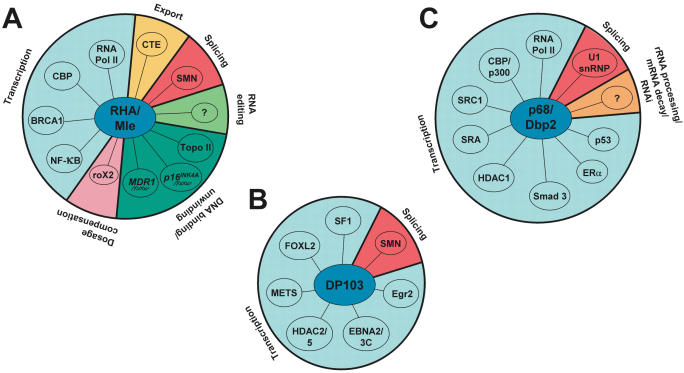
Proteins interacting with (A) RHA/Mle, (B) DP103 and (C) p68/Dbp2, and the cellular processes in which they are involved, as examples to illustrate the multifunctional properties of the DExD/H box proteins discussed in this review. RHA has also been shown to interact with the promoters of the MDR1 and p16INK4A genes; therefore these are also indicated.
Figure 3
Figure 3
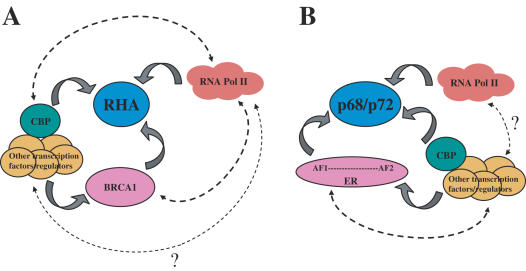
Models for mechanisms by which DExD/H box proteins, such as RHA and p68/p72, could recruit components of the transcription machinery to promoters or stabilize transcription initiation by acting as adaptor molecules or bridging factors, as suggested by the literature. Solid arrows indicate interactions documented in the literature; heavy dashed arrows are bridging roles suggested from the known interactions; faint dashed arrows with query marks are implied recruiting or bridging roles. (A) RHA through its interaction with CBP, RNA Pol II and BRCA1 has been suggested to act as a bridge between CBP and RNA Pol II and between BRCA1 and RNA Pol II. Since BRCA1 also interacts with other transcriptional regulators its interaction with RHA could facilitate in recruitment of RNA Pol II and other factors to the initiation complex or stabilize the initiation complex. (B) p68/p72 is known to interact with the AF1 domain of ERα and p68 has been shown to interact with CBP and RNA Pol II, leading to the suggestion that p68/p72 may act as bridges between the ERα AF1 domain and transcription factors interacting with the AF2 domain of ERα. p68/p72 could thus also enhance transcriptional activity by recruiting RNA Pol II to the initiation complex or by stabilizing the complex.

References

    1. Linder P., Lasko P.F., Leroy P., Nielsen P.J., Nishi K., Schnier J., Slominski P.P. Birth of the D-E-A-D box. Nature. 1989;337:121–122. - PubMed
    1. Tanner N.K., Linder P. DExD/H box RNA helicases: from generic motors to specific dissociation functions. Mol. Cell. 2001;8:251–262. - PubMed
    1. Linder P. Nucleic Acids Res. 2006. DEAD-box proteins: a family affair- active and passive players in RNP remodelling. doi:10.1093/nar/gkl468. - PMC - PubMed
    1. Gorbalenya A.E., Koonin E.V. Helicases: amino acid sequence comparisons and structure–function relationships. Curr. Opin. Struct. Biol. 1993;3:419–429.
    1. Jankowsky E., Gross C.H., Shuman S., Pyle A.M. Active disruption of an RNA–protein interaction by a DExH/D RNA helicase. Science. 2001;291:121–125. - PubMed

Publication types