. 2006 Sep 5;103(36):13485-90.
doi: 10.1073/pnas.0605993103. Epub 2006 Aug 28.

Dopamine targets cycling B cells independent of receptors/transporter for oxidative attack: Implications for non-Hodgkin's lymphoma

Affiliations

Dopamine targets cycling B cells independent of receptors/transporter for oxidative attack: Implications for non-Hodgkin's lymphoma

Elizabeth J Meredith et al. Proc Natl Acad Sci U S A. .

Abstract

Human B lymphocytes and derived lines from a spectrum of B cell malignancy were studied for expression of dopaminergic pathway components and for their cytostatic response to the catecholamine and related, potentially therapeutic compounds. Proliferating normal lymphocytes and dividing malignant clones rapidly arrested on exposure to dopamine in the low (</=10 muM) micromolar range. The antiparkinsonian drugs l-DOPA and apomorphine (particularly) were similarly antiproliferative. With the exception of D4, dopamine receptors D1-D5 were variably expressed among normal and neoplastic B cell populations, as was the dopamine transporter. Transcripts for D1 and D2 were frequently found, whereas D3 and D5 revealed restricted expression; dopamine transporter was detected in most cases. Nevertheless, pharmacological analysis disclosed that dopamine targeted cycling B cells independent of these structures. Rather, oxidative stress constituted the primary mechanism: the catecholamine's actions being mimicked by hydrogen peroxide and reversed by exogenous catalase, and evidence for the intracellular redox protein thioredoxin contributing protection. Among proliferating clones, growth arrest was accompanied by cell death in populations deplete in antiapoptotic Bcl-2: resting lymphocytes escaping low micromolar dopamine toxicity. Dysregulated bcl-2 expression, although preventing oxidative-induced caspase-dependent apoptosis, by itself conferred only minor protection against dopamine cytostasis. The selective impact of dopamine on lymphocytes that are in active cycle indicates an axis for therapeutic intervention not only in B cell neoplasia but also in lymphoproliferative disturbances generally. Rational tailoring of drug delivery systems already in development for Parkinson's disease could provide ideal vehicles for carrying the oxidative hit directly to the target populations.


Conflict of interest statement

Conflict of interest statement: No conflicts declared.

Figures
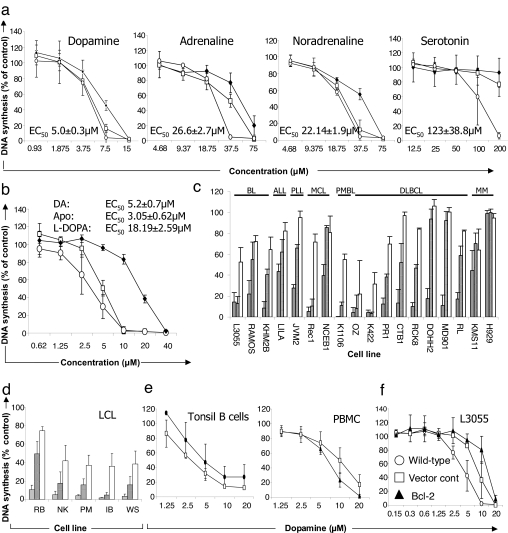
Fig. 1.
Fig. 1.
Antiproliferative effects of monoamines and related compounds against human malignant B cell lines and proliferating normal lymphocytes. Cells at 5 × 10⁴ per milliliter (unless indicated) were incubated (for 24 h unless indicated), and proliferation was assessed by [3H]thymidine incorporation over the last 4 h. Data are presented as cpm (percentage of control) with mean ± SD from three separate experiments. (a) Effect of monoamines against L3055 BL cells at 105 per milliliter (♦), 5 × 10⁴ per milliliter (□), or 2.5 × 10⁴ per milliliter (○). EC50 values are indicated for cells at 2.5 × 10⁴ per milliliter. (b) Effects of DA (□) l-DOPA (♦), and apomorphine (○) against L3055 cells with EC50 values. (c) Effect of 5 μM (open bars), 10 μM (hatched bars), or 20 μM (shaded bars) DA on proliferation of malignant B cell lines. (d) As for c, but against LCL cells at 2.5 × 10⁴ per milliliter. (e) Effect of DA on normal proliferating lymphocytes (measured on day 3). PBMC were stimulated with phytohemagglutinin (10 μg/ml; ▴) or phorbol 12-myristate 13-acetate (2 ng/ml) plus ionomycin (1 μg/ml; □). Tonsillar B cells were stimulated with phorbol 12-myristate 13-acetate plus ionomycin (□) or soluble CD40L (1 μg/ml; ▴). (f) Effect of overexpressing Bcl-2 in L3055 cells. Apo, apomorphine; ALL, acute lymphocytic leukemia; PLL, prolymphocytic leukemia; MCL, mantle cell lymphoma; PMBL, primary mediastinal B cell lymphoma; DLBCL, diffuse large B cell lymphoma; MM, multiple myeloma.
Fig. 2.
Fig. 2.
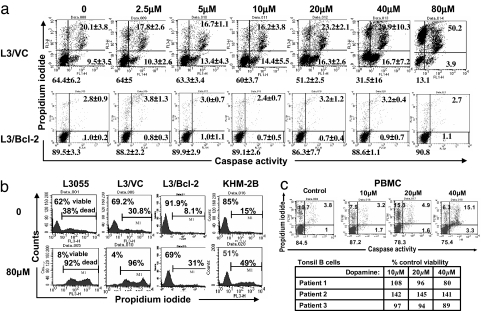
Apoptosis and viability of L3055 cells in response to DA. (a) L3055 cells containing empty transfection vector (L3/VC) or containing the bcl-2 gene (L3/Bcl-2) were seeded at 2.5 × 10⁵ per milliliter and treated with or without DA at the concentrations indicated for 6 h. Cells were dual-stained with PI and caspase substrate phiphilux and analyzed by flow cytometry. Dot plots are representative of three experiments showing the percentage of viable (caspaselo/PIlo), early apoptotic (caspasehi/PIlo), late apoptotic (caspasehi/PIhi), and necrotic (caspaselo/PIhi) cells. (b) Viability of (wild-type) WTL3055, L3/VC, L3/Bcl-2, or KHM-2B (2.5 × 10⁵ per milliliter) cells in response to prolonged (24-h) DA exposure as assessed by PI staining. (c) Viability of resting PBMC or tonsil B cells (5 × 10⁵ per milliliter) in response to DA for 24 h assessed as in a. (Upper) PBMC. (Lower) Percentage (of control) viable cells (caspaselo/PIlo) for B cells from three individual tonsils.
Fig. 3.
Fig. 3.
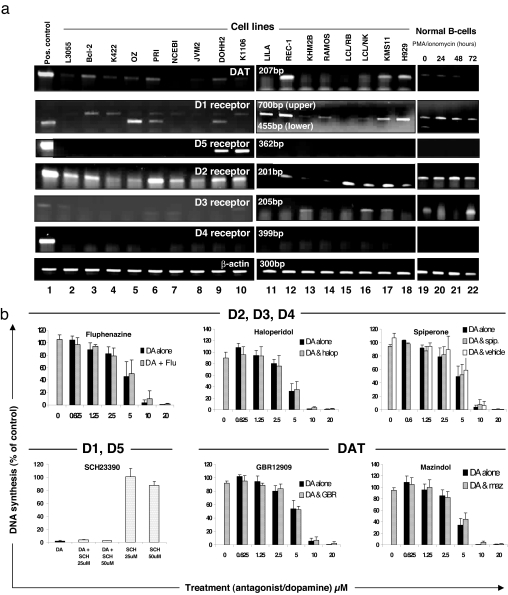
Human B cells variously express mRNA for the DAT, D1-like DA receptors (D1 and D5), or D2-like DA receptors (D2, D3, or D4), but antiproliferative effects of DA are not reversed by pharmacological blockade of these targets. (a) RT-PCR analysis of mRNA expression in positive controls (lane 1, see Materials and Methods), malignant B cell lines (lanes 2–14 and 17–18), LCL (lanes 15 and 16), normal tonsillar B cells quiescent and freshly isolated (lane 19) or after phorbol 12-myristrate 12-acetate plus ionomycin stimulation for 24, 48, or 72,h (lanes 20–22). Water was included in every RT-PCR as negative control with no bands observed (data not shown). β-Actin was run as a loading control for all samples. Images are representative of RT-PCR carried out on three separate RNA preparations. (b) L3055 cells seeded at 5 × 10⁴ per milliliter were preincubated with D2-like DA receptor antagonists (1.5 μM fluphenazine, 3 μM haloperidol, or 2 μM spiperone), the D1-like DA receptor antagonist SCH23390, or DAT antagonists (1 μM GBR12909 or 4 μM mazindol) for 30 min before addition of DA. Cells were incubated for 24 h, and DNA synthesis was assessed as in Fig. 1. Data are presented as percentage of control (mean ± SD from three independent experiments).
Fig. 4.
Fig. 4.
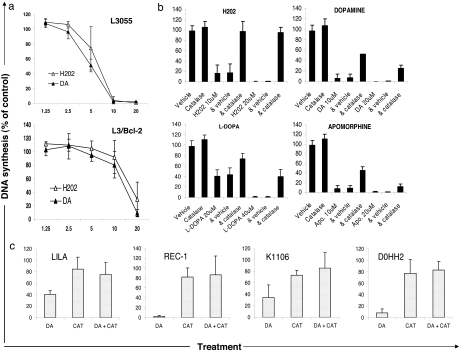
Antiproliferative effects of DA are largely mediated by oxidative stress. (a) Effect on DNA synthesis (as in Fig. 1) of hydrogen peroxide (H2O2) compared with DA against L3055 cells and L3/Bcl-2 transfectants. (b) Cells were preincubated with catalase (1,000 units/ml) for 30 min before addition of H2O2, DA, l-DOPA, or apomorphine as indicated. (c) As in b, but with DA at 10 μM.

References

    1. Ansell S., Armitage J. Mayo Clin. Proc. 2005;80:1087–1097. - PubMed
    1. Traulle C., Coiffier B. Future Oncol. 2005;1:297–306. - PubMed
    1. Maher E., Fine H. Semin. Oncol. 1999;26:346–356. - PubMed
    1. Navarro W. H., Kaplan L. D. Blood. 2006;107:13–20. - PubMed
    1. Spina M., Simonelli C., Talamini R., Tirelli U. J. Clin. Oncol. 2005;23:8132–8133. - PubMed

Publication types

MeSH terms

LinkOut - more resources