


A functional SNP in the promoter of the SERPINH1 gene increases risk of preterm premature rupture of membranes in African Americans
- PMID: 16938879
- PMCID: PMC1557384
- DOI: 10.1073/pnas.0603676103
A functional SNP in the promoter of the SERPINH1 gene increases risk of preterm premature rupture of membranes in African Americans
Erratum in
- Proc Natl Acad Sci U S A. 2006 Dec 12;103(50):19212
Abstract
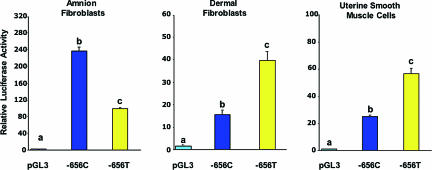
Prematurity is more prevalent in African Americans than in European Americans. We investigated the contribution of a functional SNP in the promoter of the SERPINH1 gene, enriched among those of African ancestry, to preterm premature rupture of membranes (PPROM), the leading identifiable cause of preterm birth. SERPINH1 encodes heat-shock protein 47, a chaperone essential for collagen synthesis. The SERPINH1 -656 minor T allele had a greater frequency in African populations and African Americans than in European Americans (7.4% [corrected] vs. 4.1%). The -656 T allele displayed significantly reduced promoter activity compared to the major -656 C allele in amnion fibroblasts, which lay down the fibrillar collagen that gives tensile strength to the amnion. An initial case-control study demonstrated that the -656 T allele is significantly more frequent in African-American neonates (P < 0.0009) born from pregnancies complicated by PPROM compared with controls (odds ratio of 3.22, 95% confidence interval 1.50, 7.22). There was no significant difference in ancestry among cases and controls using a dihybrid model based on 29 ancestry-informative markers. Adjusting the results of the case-control study for admixture still yielded a statistically significant association between the -656 T allele and PPROM (P < 0.002). A follow-up case-control study gave similar results. The combined case-control findings showed a highly significant (P < 0.0000045) association between the -656 T allele and PPROM. The SERPINH1 -656 T allele is the first example of an ancestry-informative marker associated with preterm birth in African Americans.
Conflict of interest statement
Conflict of interest statement: No conflicts declared.
Figures
Comment in
-
Impaired collagen chaperone results in preterm PROM.Proc Natl Acad Sci U S A. 2006 Sep 5;103(36):13267-8. doi: 10.1073/pnas.0606017103. Epub 2006 Aug 28. Proc Natl Acad Sci U S A. 2006. PMID: 16938862 Free PMC article. No abstract available.
References
-
- Kempe A., Wise P. H., Barkan S. E., Sappenfield W. M., Sachs B., Gortmaker S. L., Sobol A. M., First L. R., Pursley D., Rinehart H., et al. N. Engl. J. Med. 1992;327:969–973. - PubMed
-
- Meis P. J., Goldenberg R. L., Mercer B. M., Iams J. D., Moawad A. H., Miodovnik M., Menard M. K., Caritis S. N., Thurnau G. R., Dombrowski M. P., et al. Am. J. Perinatol. 2000;17:41–45. - PubMed
-
- Wang X., Zuckerman B., Pearson C., Kaufman G., Chen C., Wang G., Niu T., Wise P. H., Bauchner H., Xu X. J. Am. Med. Assoc. 2002;287:195–202. - PubMed
-
- Macones G. A., Parry S., Elkousy M., Clothier B., Ural S. H., Strauss J. F., III Am. J. Obstet. Gynecol. 2004;190:1504–1508. - PubMed
Publication types
MeSH terms
Substances
Grants and funding
LinkOut - more resources
Full Text Sources
Other Literature Sources
Molecular Biology Databases
Miscellaneous
