. 2006 Sep 6;128(35):11713-9.
doi: 10.1021/ja062137g.

Transfer of structural elements from compact to extended states in unsolvated ubiquitin

Affiliations

Transfer of structural elements from compact to extended states in unsolvated ubiquitin

Stormy L Koeniger et al. J Am Chem Soc. .

Abstract

Multidimensional ion mobility spectrometry techniques (IMS-IMS and IMS-IMS-IMS) combined with mass spectrometry are used to study structural transitions of ubiquitin ions in the gas phase. It is possible to select and activate narrow distributions of compact and partially folded conformation types and examine new distributions of structures that are formed. Different compact conformations unfold, producing a range of new partially folded states and three resolvable peaks associated with elongated conformers. Under gentle activation conditions, the final populations of the three elongated forms depend on the initial structures of the selected ions. This requires that some memory of the compact state (most likely secondary structure) is preserved along the unfolding pathway. Activation of selected, partially folded intermediates (formed from specific compact states) leads to elongated state populations that are consistent with the initial selected compact form-evidence that intermediates not only retain elements of initial structure but also are capable of transmitting structure to final states.


Figures
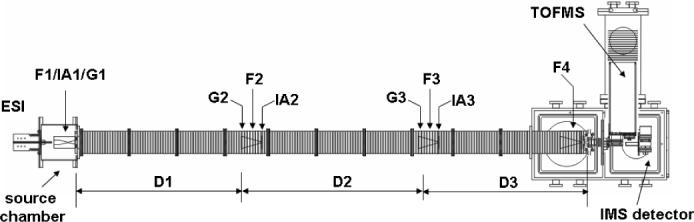
Figure 1
Figure 1
Schematic diagram of the experimental apparatus used for multi-dimensional ion mobility measurements. A combination of ion gates (G1-G3), ion funnels (F1-F4), and ion activation regions (IA1-IA3) are incorporated into the drift tube assembly. See text for details.
Figure 2
Figure 2
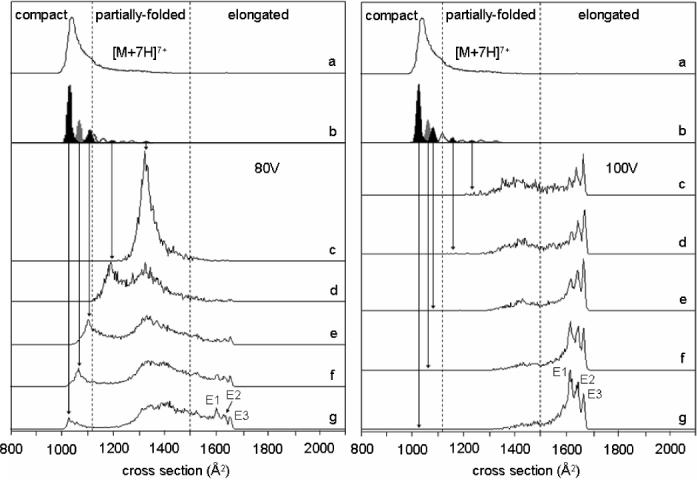
Ion mobility distributions of ubiquitin [M+7H]7+ ions showing the initial distribution of ions formed by ESI (a) and nine narrow distributions of mobility-selected ions obtained by gating a 100 μs pulse of ions into D2 at various delay times (b). Activation of the selected-ion distributions (shaded) at IA2 with a voltage of 80 V (left) and 100 V (right) produces distributions (c) through (g). The cross sections of the selected ions activated at 80 V were 1329 (c), 1196 (d), 1101 (e), 1063 (f), and 1025 Å2 (g); and for 100 V, were 1234 (c), 1158 (d), 1082 (e), 1063 (f), and 1025 Å2 (g). The selection at 1063 Å2 (shaded gray) shows a transition in the relative abundance of the three resolved elongated states (E1-E3) at 80 V and 100 V. These distributions are obtained from nested tD(tF) datasets by integration of a narrow range of m/z values for the [M+7H]7+ of ubiquitin. Dashed lines delineate the region in cross section for each conformer type. See text for discussion.
Figure 3
Figure 3
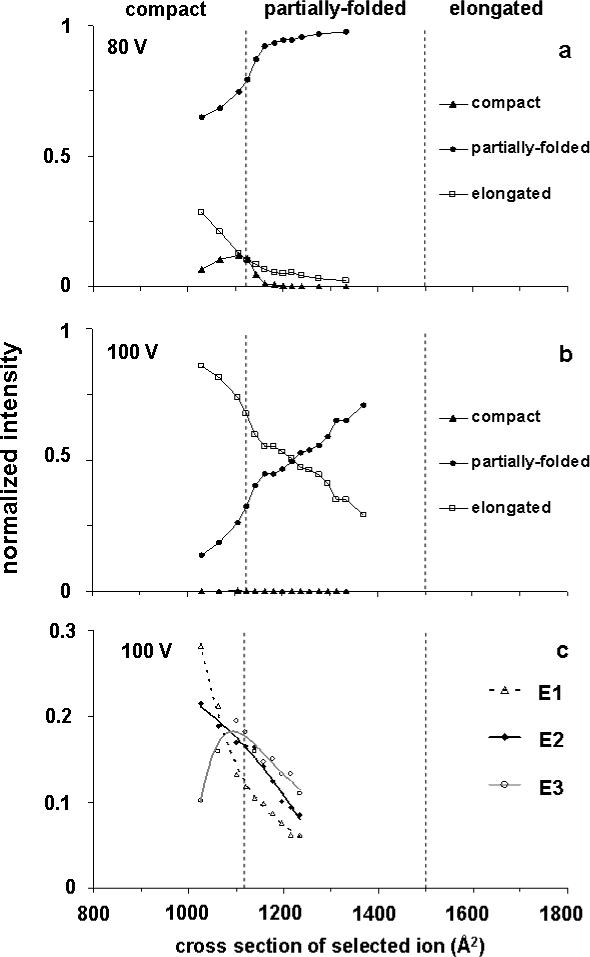
Relative populations of conformer types formed by activation of mobility-selected [M+7H]7+ ubiquitin ions as a function of the selected-ion cross section. Populations represent the distributions shown in Figure 2 upon activation with 80 V (a) and 100 V (b). Relative populations of specific elongated structures (E1-E3) with respect to the total population are also shown (c). Dashed lines delineate the region in cross section for each conformer type.
Figure 4
Figure 4
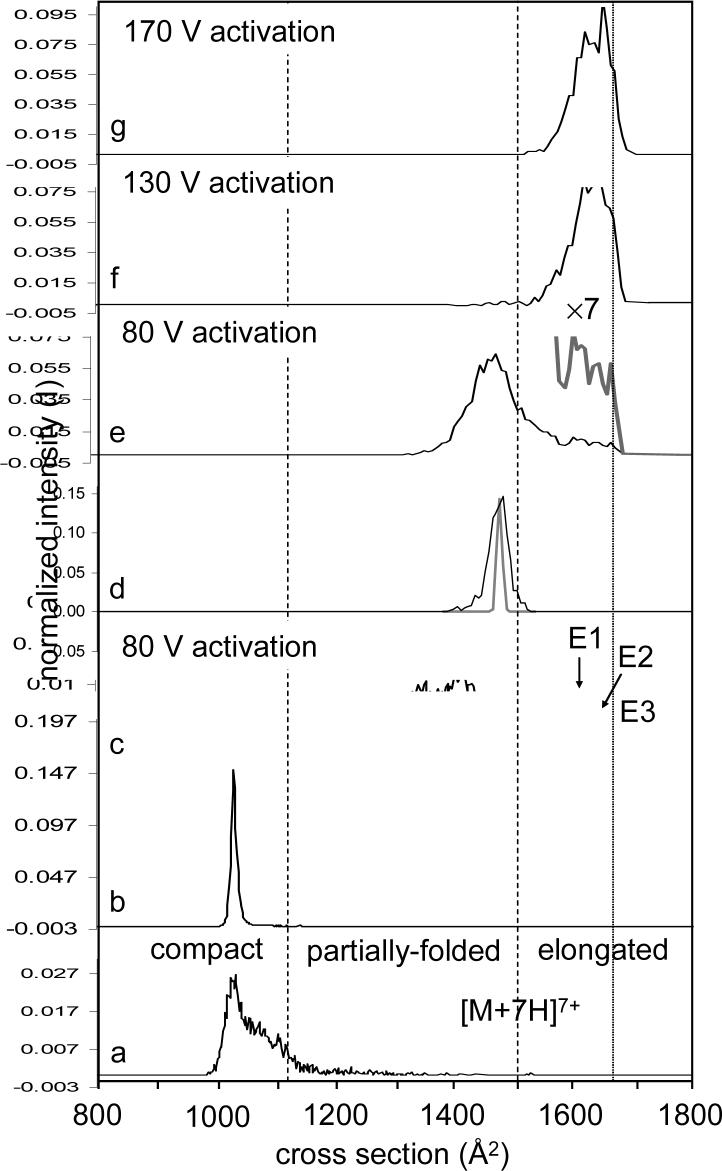
Ion mobility distributions of ubiquitin [M+7H]7+ ions obtained in IMS-IMS-IMS/MS experiments. Distribution a is the initial distribution consisting of primarily compact conformers. Upon selection of a narrow distribution of compact ions at G2 (100 μs), distribution b is obtained. Activation of the selected compact ions at IA2 produces distribution c. A second selection of an intermediate within the partially-folded structures performed at G3 (150 μs) is shown in d with the diffusion limited peak width of the selected ion (gray line). Upon activation of the partially-folded structures at IA3, distribution e is produced consisting of a broader distribution of partially-folded structures and a smaller distribution of elongated states (gray line). Distributions f and g are obtained upon higher-energy activation of the partially-folded structures shown in d. These distributions are obtained from nested tD(tF) datasets by integration of a narrow range of m/z values for the [M+7H]7+ of ubiquitin. See text for discussion.

References

    1. Kuwajima K. Proteins: Struct., Funct., and Genet. 1989;6:87–103. - PubMed
    2. Evans PA, Radford SE. Curr. Opin. Struct. Biol. 1994;4:100–106.
    3. Bryngelson JD, Onuchic JN, Socci ND, Wolynes PG. Proteins: Struct., Funct., and Genet. 1995;21:167–195. - PubMed
    4. Dill KA, Bromberg S, Yue KZ, Fiebig KM, Yee DP, Thomas PD, Chan HS. Protein Science. 1995;4:561–602. - PMC - PubMed
    5. Bryson JW, Betz SF, Lu HS, Suich DJ, Zhou HX, Oneil KT, Degrado WF. Science. 1995;270:935–941. - PubMed
    1. Karas M, Hillenkamp F. Anal. Chem. 1988;60:2299. - PubMed
    2. Tanaka K, Waki H, Ido Y, Akita S, Yoshida Y, Yoshida T. Rapid Commun. Mass Spectrom. 1988;2:151–153.
    3. Fenn JB, Mann M, Meng CK, Wong SF, Whitehouse CM. Science. 1989;246:64–71. - PubMed
    1. Katta A, Chait BT. J. Am. Chem. Soc. 1993;115:6317–6321.
    1. Zhang ZQ, Smith DL. Protein Sci. 1993;2:522–531. - PMC - PubMed
    1. Miranker A, Robinson CV, Radford SE, Aplin RT, Dobson CM. Science. 1993;262:896–900. - PubMed
    2. Hooke SD, Eyles SJ, Miranker A, Radford SE, Robinson CV, Dobson CM. J. Am. Chem. Soc. 1995;117:7548–7549.
    3. Chung EW, Nettleton EJ, Morgan CJ, Gross M, Miranker A, Radford SE, Dobson CM, Robinson CV. Protein Sci. 1997;6:1316–1324. - PMC - PubMed

Publication types