. 2006 Aug 30:6:74.
doi: 10.1186/1471-2180-6-74.

Phylogenetic evidence for inter-typic recombination in the emergence of human enterovirus 71 subgenotypes

Affiliations

Phylogenetic evidence for inter-typic recombination in the emergence of human enterovirus 71 subgenotypes

Chan Yoke-Fun et al. BMC Microbiol. .

Abstract

Background: Human enterovirus 71 (EV-71) is a common causative agent of hand, foot and mouth disease (HFMD). In recent years, the virus has caused several outbreaks with high numbers of deaths and severe neurological complications. Several new EV-71 subgenotypes were identified from these outbreaks. The mechanisms that contributed to the emergence of these subgenotypes are unknown.

Results: Six EV-71 isolates from an outbreak in Malaysia, in 1997, were sequenced completely. These isolates were identified as EV-71 subgenotypes, B3, B4 and C2. A phylogenetic tree that correlated well with the present enterovirus classification scheme was established using these full genome sequences and all other available full genome sequences of EV-71 and human enterovirus A (HEV-A). Using the 5' UTR, P2 and P3 genomic regions, however, isolates of EV-71 subgenotypes B3 and C4 segregated away from other EV-71 subgenotypes into a cluster together with coxsackievirus A16 (CV-A16/G10) and EV-71 subgenotype C2 clustered with CV-A8. Results from the similarity plot analyses supported the clustering of these isolates with other HEV-A. In contrast, at the same genomic regions, a CV-A16 isolate, Tainan5079, clustered with EV-71. This suggests that amongst EV-71 and CV-A16, only the structural genes were conserved. The 3' end of the virus genome varied and consisted of sequences highly similar to various HEV-A viruses. Numerous recombination crossover breakpoints were identified within the non-structural genes of some of these newer EV-71 subgenotypes.

Conclusion: Phylogenetic evidence obtained from analyses of the full genome sequence supports the possible occurrence of inter-typic recombination involving EV-71 and various HEV-A, including CV-A16, the most common causal agent of HFMD. It is suggested that these recombination events played important roles in the emergence of the various EV-71 subgenotypes.


Figures
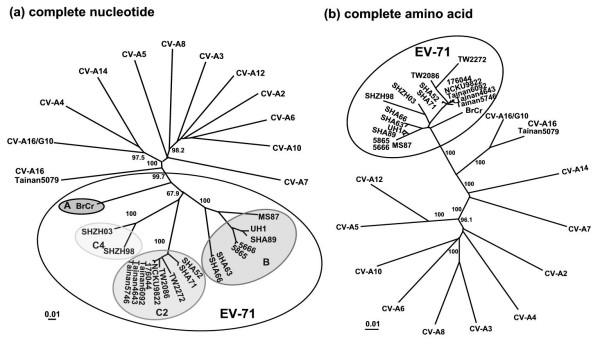
Figure 1
Figure 1
Phylogenetic relationships amongst HEV-A isolates. The neighbour-joining tree was established from alignments of the full genome nucleotide (a) and amino acid sequences (b). The percentage of bootstrap replicates supporting the trees are indicated at the nodes. The branch lengths are proportional to the genetic distances corrected using Kimura-two-parameter substitution model.
Figure 2
Figure 2
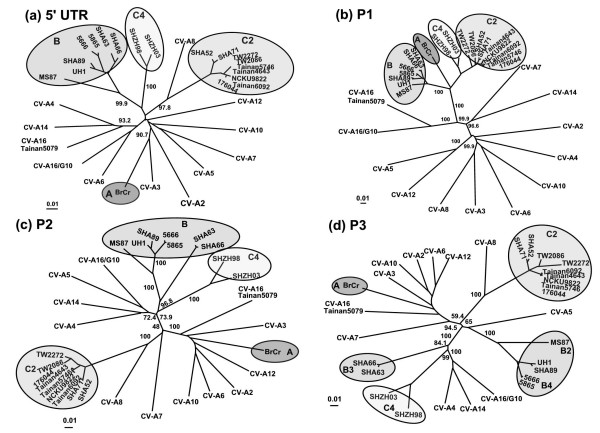
Unrooted phylogenetic trees showing the relationships amongst HEV-A isolates using the different genomic regions. The neighbour-joining trees were constructed from alignment of the 5' UTR (a), P1 (b), P2 (c) and P3 genomic region (d), respectively. The percentage of bootstrap replicates supporting the trees are indicated at the nodes. The branch lengths are proportional to the genetic distances corrected using Kimura-two-parameter substitution model.
Figure 3
Figure 3
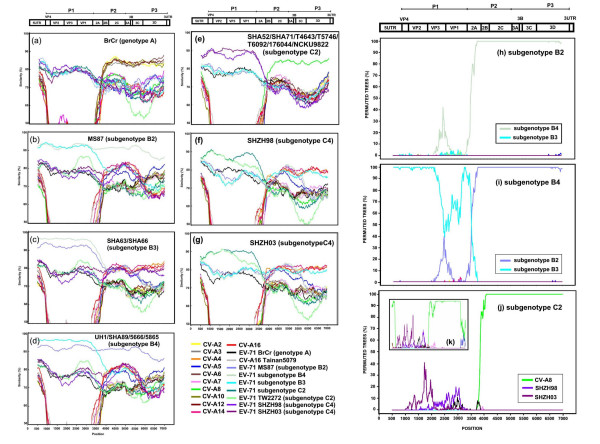
Emergence of EV-71 subgenotypes by recombination with other HEV-A viruses. Similarity plot analyses were performed using the full genome sequence of all EV-71 genotypes and subgenotypes. The sequences were queried against all other available HEV-A viruses. The nucleotide sequence of BrCr, genotype A (a), nucleotide sequence of MS87, subgenotype B2 (b), consensus nucleotide sequence of subgenotype B3 (c), consensus nucleotide sequence of subgenotype B4 (d), consensus nucleotide sequence of subgenotype C2 (e) SHZH98, subgenotype C4 (f) and SHZH03, subgenotype C4 (g) were used in the similarity plot analyses. Results from the bootscan analyses indicate the likelihood of clustering of subgenotype B2 isolate, MS87 (h), subgenotype B4 (i) and subgenotype C2 (j) isolates with their respective potential parental isolates. A sliding window of 1000 nucleotides was moved in increments of 20 nucleotides at a time. All gaps were stripped and the sequences were corrected for multiple substitutions. A transition to tranversion ratio of ten was used and 50% consensus files were used to exclude the poorly conserved sites. The subgenotype C2 isolates (k) were also queried against other HEV-A viruses using a window size of 400 nucleotides in increments of 20 nucleotides per slide. Bootstrap values of > 70% were used to indicate robust support for the tree topology [43]. The different HEV-A viruses and EV-71 genotypes are represented by the different line colors.
Figure 4
Figure 4
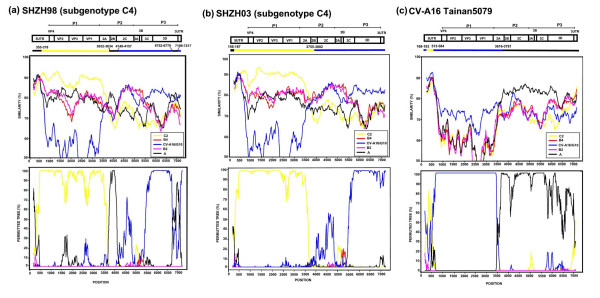
Identification of recombinant sequences in the genome of EV-71 subgenotype C4 and CV-A16 Tainan 5079. The organization of the EV-71 genome, the respective crossover breakpoints and potential parental sequences are shown. The upper panel shows results of a pairwise comparison between SHZH98 (a), SHZH03 (b) and CV-A16 Tainan 5079 (c) genome sequences against the consensus sequences of EV-71 genotypes A, B2, B4, C2, and CV-A16/G10. The lower panel shows results from the bootscan analysis which illustrates the likelihood of clustering of the putative recombinants with respect to the parental virus. A window size of 400 nucleotides in increments of 20 nucleotides at a time was used. Positions containing gaps were excluded from the comparison.

References

    1. Poyry T, Kinnunen L, Hyypia T, Brown B, Horsnell C, Hovi T, Stanway G. Genetic and phylogenetic clustering of enteroviruses. J Gen Virol. 1996;77:1699–1717. - PubMed
    1. Melnick JL. Enteroviruses: polioviruses, coxsackieviruses, echoviruses and newer enteroviruses. In: Fields BN, Knipe DM, Howley PM, Chanock RM, Melnick JL, Moath TP, Roizman B, Straus SE, editor. Fields Virology. 3. Philadelphia: Lippincott-Raven Publishers; 1996. pp. 655–711.
    1. AbuBakar S, Chee HY, Al-Kobaisi MF, Xiaoshan J, Chua KB, Lam SK. Identification of enterovirus 71 isolates from an outbreak of hand, foot and mouth disease (HFMD) with fatal cases of encephalomyelitis in Malaysia. Virus Res. 1999;61:1–9. doi: 10.1016/S0168-1702(99)00019-2. - DOI - PubMed
    1. Wu TN, Tsai SF, Li SF, Lee TF, Huang TM, Wang ML, Hsu KH, Shen CY. Sentinel surveillance for enterovirus 71, Taiwan, 1998. Emerg Infect Dis. 1999;5:458–460. - PMC - PubMed
    1. Lum LCS, Wong KT, Lam SK, Chua KB, Goh AYT, Lim WL, Ong BB, Paul G, AbuBakar S, Lambert M. Fatal enterovirus 71 encephalomyelitis. J Pediatr. 1998;133:795–798. doi: 10.1016/S0022-3476(98)70155-6. - DOI - PubMed

Publication types

Substances