Review
. 2006 Sep 29;361(1473):1635-46.
doi: 10.1098/rstb.2006.1884.

Plasticity of functional connectivity in the adult spinal cord

Affiliations
Review

Plasticity of functional connectivity in the adult spinal cord

L L Cai et al. Philos Trans R Soc Lond B Biol Sci. .

Abstract

This paper emphasizes several characteristics of the neural control of locomotion that provide opportunities for developing strategies to maximize the recovery of postural and locomotor functions after a spinal cord injury (SCI). The major points of this paper are: (i) the circuitry that controls standing and stepping is extremely malleable and reflects a continuously varying combination of neurons that are activated when executing stereotypical movements; (ii) the connectivity between neurons is more accurately perceived as a functional rather than as an anatomical phenomenon; (iii) the functional connectivity that controls standing and stepping reflects the physiological state of a given assembly of synapses, where the probability of these synaptic events is not deterministic; (iv) rather, this probability can be modulated by other factors such as pharmacological agents, epidural stimulation and/or motor training; (v) the variability observed in the kinematics of consecutive steps reflects a fundamental feature of the neural control system and (vi) machine-learning theories elucidate the need to accommodate variability in developing strategies designed to enhance motor performance by motor training using robotic devices after an SCI.


Figures
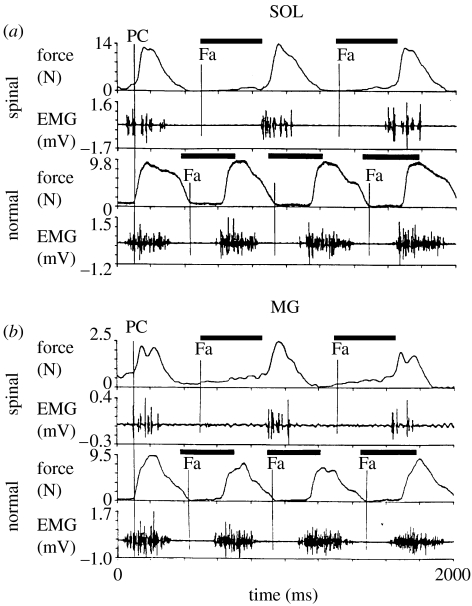
Figure 1
Figure 1
Force and EMG records from the (a) soleus (sol) and (b) medial gastrocnemius (MG) muscles of a normal, intact cat and an adult spinal cat during stepping on a treadmill at 0.8 m s−1. Bold bars indicate the period of contralateral support. Compared with normal, the spinal cat exhibited a longer cycle period, a steeper decline in force beginning at mid-support, a delay in the onset of flexion at the ankle (Fa), lower peak EMG forces, and clonus in the EMG and force records of both muscles. PC, paw contact (taken from Lovely et al. 1990).
Figure 2
Figure 2
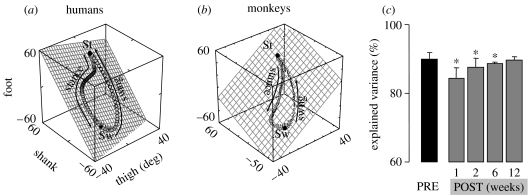
Coupling in the generation of limb movements during walking in humans and monkeys. (a) When plotted in a three-dimensional space, the angular oscillation of thigh, shank and foot segment with respect to the direction of gravity, i.e. elevation angles, covaries close to a plane, both during (a) human and (b) monkey locomotion. The gait loop evolves in the counterclockwise direction. The onset of stance (St) and swing (Sw) are indicated. (c) The degree of coupling among limb movements is evaluated by applying a principal component (PC) analysis on the elevation angles of hindlimb segments (thigh, shank and foot). Mean (s.d.) values of the variance explained by the first PC during treadmill locomotion performed pre-lesion (PRE) and 1, 2, 6 and 12 weeks after a unilateral lesion to the thoracic dorsolateral column (POST) is shown for three monkeys. Asterisks indicate significant difference between pre- and post-lesion values. The high variance accounted for by the first PC reflects the high degree of coupling in the neuronal systems that generate the oscillation of the limbs during stepping both in intact and spinal cord-injured animals (adapted from Courtine et al. 2005a).
Figure 3
Figure 3
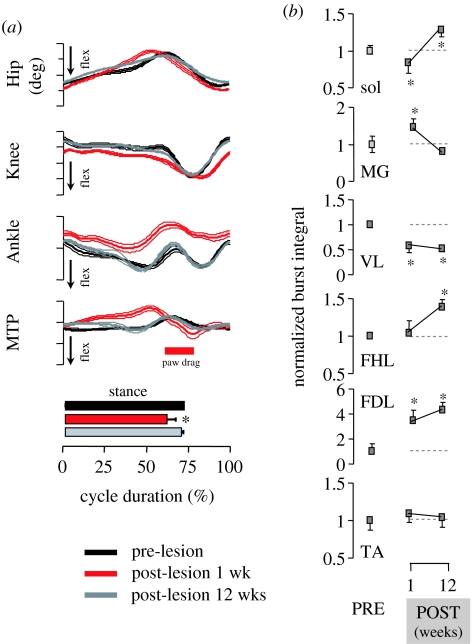
(a) Mean (s.d.) waveforms of each joint angle for the hindlimb ipsilateral to the lesion side recorded during treadmill locomotion (0.45 m s−1) before (pre-lesion) and 1 and 12 weeks after (post-lesion) a unilateral interruption of the lateral CST in the thoracic spinal cord of adult Rhesus monkeys (n=2). The horizontal bars at the bottom indicate the mean (s.d.) value of the stance phase duration. (b) Mean (s.d.) values of EMG burst integrals for all recorded muscles. Sol, soleus; MG, medial gastrocnemius; VL, vastus lateralis; FHL, flexor hallucis longus; EDL, extensor digitorum longus; TA, tibialis anterior. Values are normalized to the pre-lesion baseline (dashed lines) computed as the mean value of muscle activity during pre-lesion locomotion. Asterisks indicate significant difference between pre- and post-lesion values (adapted from Courtine et al. 2005b).
Figure 4
Figure 4
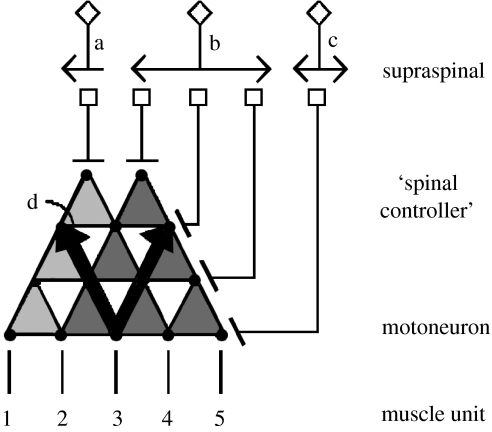
Cartoon depicting several features of the sensorimotor control of movement. The cartoon illustrates the possibility of a supraspinal control centre with neurons projecting to control level neurons (‘spinal controllers’ of movements of differing complexities) that would project to a group of synergistic motor pools, muscles and muscle units. In cases illustrated by the projection of neuron a or neuron b, specific control of a small group of motor units might be unnecessary in executing a generalized motor programme to control stepping. The numbers 1–5 denote five muscle units. The dots embedded in the triangles represent individual neurons. Activation of neuron a would result in muscle units 1–4 being recruited. Neuron b would recruit muscle units 2–5, whereas neuron c would recruit only muscle unit 5. On the other hand, there can be even more selective control of motor units as illustrated with neuron c. At least for some muscle groups in some species, there may be direct supraspinal connections to some motor pools as well as the more generalized command neurons that exert more general control signals among motor pools. Two sets of divergent triangles are illustrated to point out the flexibility in modulating the set of muscles that may be recruited for a given movement. One can also view the upright triangles in the reverse direction (see arrows projecting upward, labelled as d), symbolizing a single sensory receptor projecting rostrally and diverging markedly, thus illustrating a single sensory receptor that could provide excitatory or inhibitory input to a large number of neurons within the spinal cord. This sensory information, in turn, may further diverge or even converge to specific supraspinal locations. The diverging circuits that enable different levels of control of multiple muscles also provide a means of detailed conscious control of fine movements, while also providing mechanisms for executing more general and predictable tasks, even when they are considerably complex.
Figure 5
Figure 5
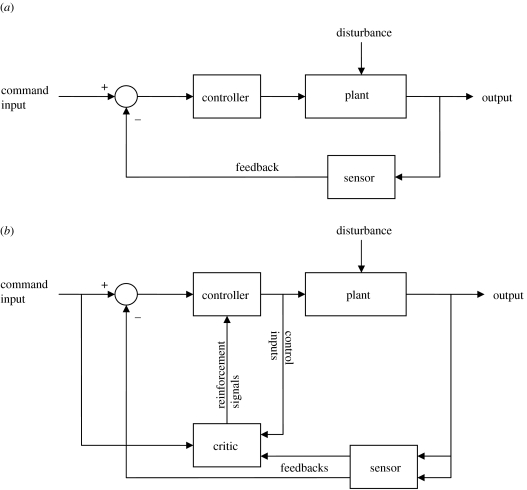
(a) Block diagram for a simple mechanical controller. In neuromuscular systems, the controller would be the motor neurons, the plant would be the muscles and the sensor would be all the proprioceptive feedbacks to the motor neurons. The information provided by the sensor is a negative feedback (denoted by the − sign) and is used to minimize the error between the output of the plant and the command input, a positive input (denoted by the + sign), the command input. In controls, the disturbance generally refers to unmodelled dynamics of the plant. However, in neuromuscular systems, this would represent perturbations that the system might encounter. (b) Block diagram for an adaptive controller incorporating reinforcement learning. In neuromuscular systems, the controller, plant and sensor will be the same as in (a). The critic will be the input from all the interneurons, e.g. Ia, Ib, Renshaw cells, etc. affecting the efficacy and excitability of the motor neuron (the controller), which is represented by the reinforcement signals.
Figure 6
Figure 6
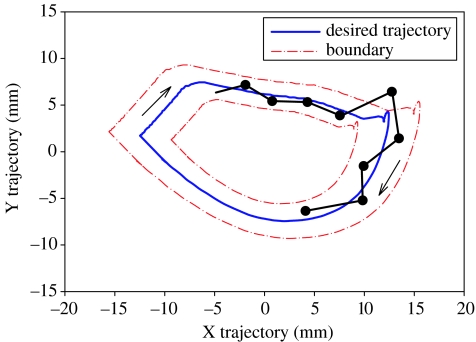
Schematic of a semi-active fixed-trajectory paradigm for step training, where the desired limb trajectory (blue) is bounded by both the inner and the outer boundaries (red). The actual trajectory (black) that the neural circuits might induce is allowed to vary within the boundary. However, once the trajectory falls outside the boundary, the robot will actively bring it back within the boundaries. The black line with periodic dots illustrates the potential positions that the intrinsic neural control might choose to generate for any given bin time. The probability that the neural control would move the limb to the exact position defined by the blue line, representing a fixed trajectory, is highly unlikely. As a result, theoretically, the neural control system is continuously disrupted by the fixed trajectory paradigm. This fixed trajectory, therefore, does not allow the neural control circuitry to respond to any of its intrinsic activation patterns, but rather forces the intrinsic circuitry to continuously respond to external perturbations. This strategy for control would seem to unnecessarily disrupt the spinal circuitry and in the process minimize or even preclude the intrinsic circuitry from interpreting relevant proprioceptive information required to generate a solution (i.e. make choices) and, thus, presumably prevent the circuitry from meaningful learning phenomena.
Figure 7
Figure 7
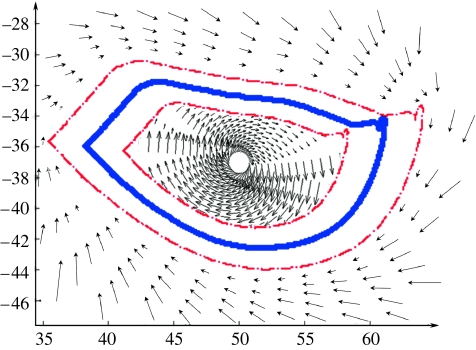
Soft robotic control schematics on how the semi-active control paradigm for step training is implemented. A moving window (red) bounds the desired trajectory (blue) of the mouse limb during stepping. Within the window, the robotic arm allows the mouse to vary its movement. However, when the neural control desired trajectory falls outside the window, the robot will experience a convergent velocity field that actively returns the mouse's limbs back within the window. This type of soft control is thought to approximate the ‘assist as needed’ approach used by experienced therapists (modified from Cai et al. 2005).
Figure 8
Figure 8
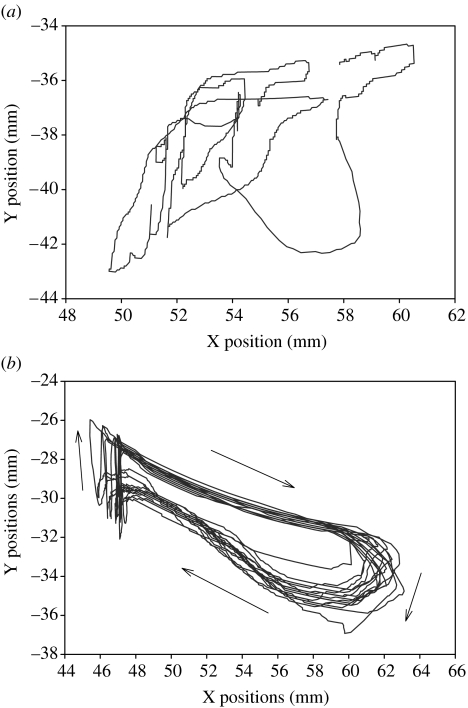
(a) Trajectory plot of the ankle of an untrained adult transected mouse without any drug administration attempting to step on a moving treadmill for 10 s at a rate of 3 cm s−1. (b) Trajectory plot of the ankle of an adult transected mouse successfully stepping on a moving treadmill for 10 s at a rate of 3 cm s−1 after four weeks of step training with quipazine (0.5 mg kg−1) daily for 10 min d−1, 5 days per week. Arrows in (b) are showing the direction of ankle movements. Note the more consistent trajectories in the trained versus untrained mouse. The untrained mouse often failed to execute any successful plantar placing steps as shown in (b).

References

    1. Anderson J.R, Michalski R.S, Carbonell J.G, Mitchell T.M. M. Kaufmann; Los Altos, CA: 1983. Machine learning: an artificial intelligence approach.
    1. Antri M, Orsal D, Barthe J.Y. Locomotor recovery in the chronic spinal rat: effects of long-term treatment with a 5-HT2 agonist. Eur. J. Neurosci. 2002;16:467–476. - DOI - PubMed
    1. Arshavsky Y.I, Deliagina T.G, Orlovsky G.N. Pattern generation. Curr. Opin. Neurobiol. 1997;7:781–789. - DOI - PubMed
    1. Barbeau H, Rossignol S. Recovery of locomotion after chronic spinalization in the adult cat. Brain Res. 1987;412:84–95. - DOI - PubMed
    1. Barbeau H, Fung J, Leroux A, Ladouceur M. A review of the adaptability and recovery of locomotion after spinal cord injury. Prog. Brain Res. 2002;137:9–25. - PubMed

Publication types