Comparative Study
. 2006 Dec;50(12):4144-52.
doi: 10.1128/AAC.00418-06. Epub 2006 Aug 28.

Effective prevention of microbial biofilm formation on medical devices by low-energy surface acoustic waves

Affiliations
Comparative Study

Effective prevention of microbial biofilm formation on medical devices by low-energy surface acoustic waves

Zadik Hazan et al. Antimicrob Agents Chemother. 2006 Dec.

Abstract

Low-energy surface acoustic waves generated from electrically activated piezo elements are shown to effectively prevent microbial biofilm formation on indwelling medical devices. The development of biofilms by four different bacteria and Candida species is prevented when such elastic waves with amplitudes in the nanometer range are applied. Acoustic-wave-activated Foley catheters have all their surfaces vibrating with longitudinal and transversal dispersion vectors homogeneously surrounding the catheter surfaces. The acoustic waves at the surface are repulsive to bacteria and interfere with the docking and attachment of planktonic microorganisms to solid surfaces that constitute the initial phases of microbial biofilm development. FimH-mediated adhesion of uropathogenic Escherichia coli to guinea pig erythrocytes was prevented at power densities below thresholds that activate bacterial force sensor mechanisms. Elevated power densities dramatically enhanced red blood cell aggregation. We inserted Foley urinary catheters attached with elastic-wave-generating actuators into the urinary tracts of male rabbits. The treatment with the elastic acoustic waves maintained urine sterility for up to 9 days compared to 2 days in control catheterized animals. Scanning electron microscopy and bioburden analyses revealed diminished biofilm development on these catheters. The ability to prevent biofilm formation on indwelling devices and catheters can benefit the implanted medical device industry.


Figures
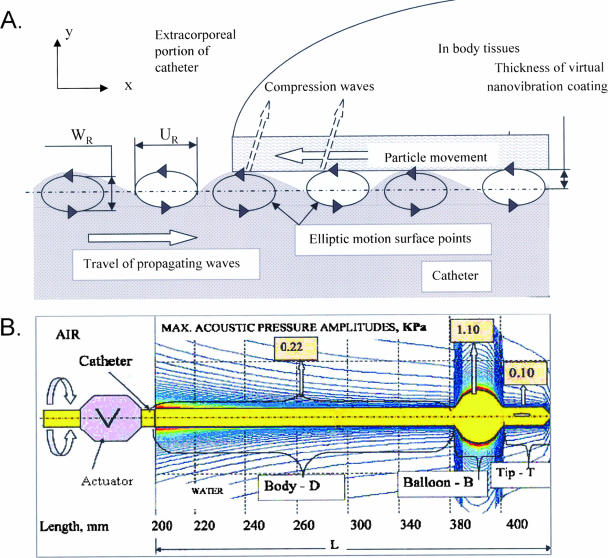
FIG. 1.
FIG. 1.
(A) Schematic illustration of the modes of dispersion of surface acoustic waves on solid surfaces. Horizontal particle displacement (UR) and another transversal compression wave component (WR) are indicated. (B) Schematic illustration of acoustic pressure amplitude distribution of the coating nanowaves among the different parts of a urinary catheter (body, balloon, and tip). Max., maximum; L, length.
FIG.2.
FIG.2.
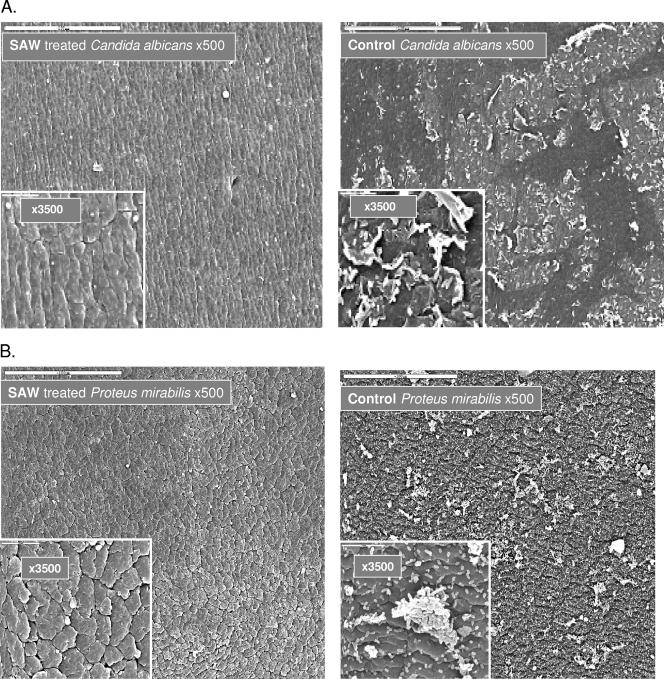
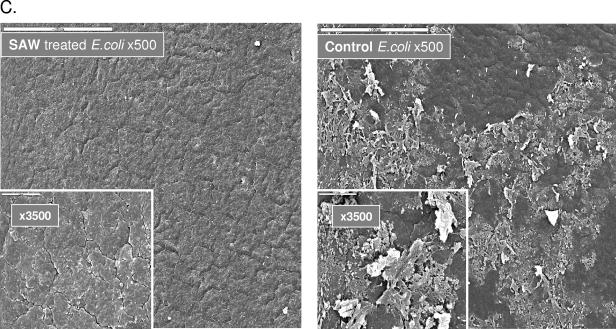
Scanning electron microscopic analyses of external surfaces of SAW-vibrated 16Fr urinary catheter segments, on which several types of bacteria were passed in culture. Catheter segments, 6 cm long in 25-ml tissue culture flasks (Corning, N.Y.), were attached to a piezo resonator that generated acoustic pressure amplitudes ranging from 0.16 kPa at the edge of the catheter to 0.21 kPa at the center. Fresh media containing 103 CFU/ml of several types of bacteria (from ATCC) were pumped continuously from chemostats at 0.5 ml/min and a temperature of ∼30°C for 3 days. The segments were fixed in 4% buffered formaldehyde, rinsed four times with PBS, and dehydrated incrementally with 25% to 100% aqueous ethanol gradients. Following drying in a Bio-Rad C.P.D 750 critical point dryer, the samples were mounted on metal stubs and coated with a gold layer, and three different areas on each catheter were examined by SEM. Surfaces of SAW-treated catheters (left panels) are compared to nontreated controls (right panels).
FIG.2.
FIG.2.
Scanning electron microscopic analyses of external surfaces of SAW-vibrated 16Fr urinary catheter segments, on which several types of bacteria were passed in culture. Catheter segments, 6 cm long in 25-ml tissue culture flasks (Corning, N.Y.), were attached to a piezo resonator that generated acoustic pressure amplitudes ranging from 0.16 kPa at the edge of the catheter to 0.21 kPa at the center. Fresh media containing 103 CFU/ml of several types of bacteria (from ATCC) were pumped continuously from chemostats at 0.5 ml/min and a temperature of ∼30°C for 3 days. The segments were fixed in 4% buffered formaldehyde, rinsed four times with PBS, and dehydrated incrementally with 25% to 100% aqueous ethanol gradients. Following drying in a Bio-Rad C.P.D 750 critical point dryer, the samples were mounted on metal stubs and coated with a gold layer, and three different areas on each catheter were examined by SEM. Surfaces of SAW-treated catheters (left panels) are compared to nontreated controls (right panels).
FIG. 3.
FIG. 3.
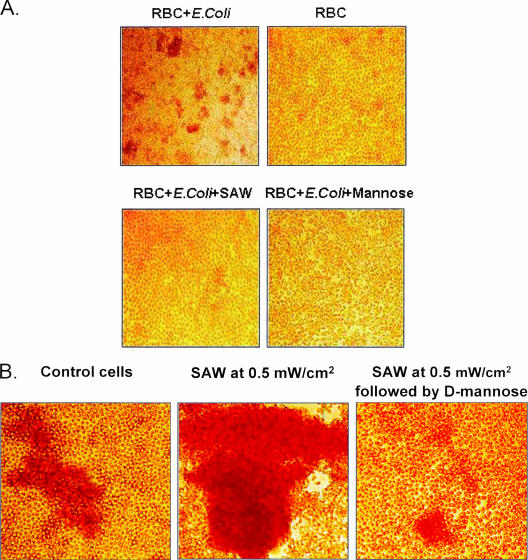
(A) Prevention of guinea pig RBC aggregation induced by adhesion of type 1 pilus-positive E. coli bacteria. Surface acoustic waves at a power intensity of 0.2 mW/cm2 are shown to effectively prevent mannose receptor-specific adhesion of bacteria to RBC and their subsequent aggregation. Specificity was confirmed with 50 mM d-mannose. (B) Enhancement of E. coli-induced guinea pig RBC aggregation by high-energy SAW. Surface acoustic waves applied at a power intensity of 0.5 mW/cm2 are shown to enhance mannose receptor-specific bacterial adhesion to RBC. The samples in panels A and B were photographed 3 h after administration of bacteria and initiation of treatment with SAW. Exceedingly large RBC aggregates formed, as shown in Fig. 3B (middle panel), which were susceptible to dissociation with d-mannose (Fig. 3B, right panel).
FIG. 4.
FIG. 4.
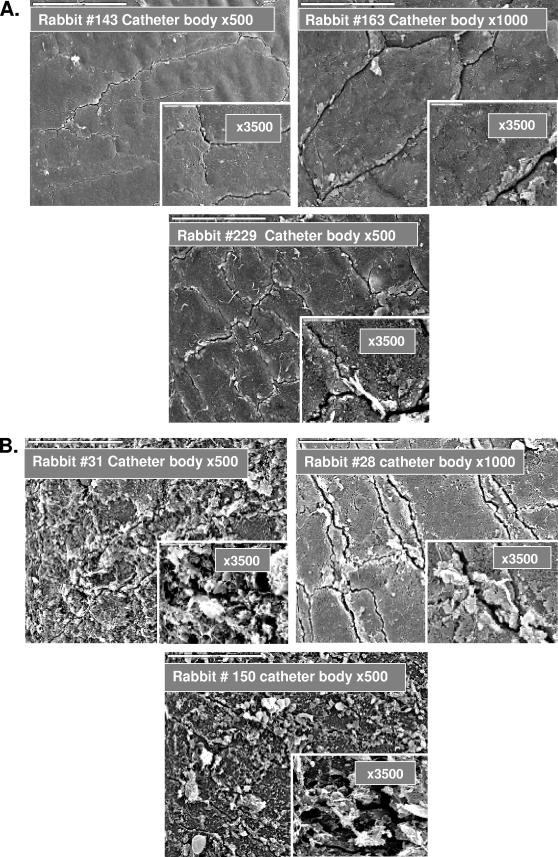
SEM analyses of the inner surfaces of catheters recovered from rabbit bladders following treatment with SAW in vivo. Catheters were removed from rabbit urinary bladders, sectioned (into body, balloon, and tip), and processed for SEM as described in the legend to Fig. 2. (A) SAW-treated animals and (B) control animals.

References

    1. An, Y. H., R. B. Dickinson, and R. J. Doyle. 2000. Mechanisms of bacterial adhesion and pathogenesis of implant and tissue infections, p. 1-21. In Y. H. An and R. J. Friedman (ed.), Handbook of bacterial adhesion: principles, methods and applications. Humana Press, Totowa, N.J.
    1. Brozel, V. S., G. M. Strydom, and T. E. Cloete. 1995. A method for the study of de novo protein synthesis in Pseudomonas aeruginosa after attachment. Biofouling 8:195-210.
    1. Carmen, J. C., B. L. Roeder, J. L. Nelson, R. L. Ogilvie, R. A. Robison, G. B. Schaalje, and W. G. Pitt. 2005. Treatment of biofilm infections on implants with low-frequency ultrasound and antibiotics. Am. J. Infect. Control 33:78-82. - PMC - PubMed
    1. Davies, D. G., A. M. Chakrabarty, and G. G. Geesey. 1993. Exopolysaccharide production in biofilms: substratum activation of alginate gene expression by Pseudomonas aeruginosa. Appl. Environ. Microbiol. 59:1181-1186. - PMC - PubMed
    1. Donskoj, L. B., O. K. Keller, and G. S. Kratysh. 1982. Ultrazvukovije elektrotechnologiceskije ustanovki. In Energija, p. 149-192. Energiosdat, St. Petersburg, Russia.

Publication types

LinkOut - more resources