. 2006 Aug 31:3:63.
doi: 10.1186/1743-422X-3-63.

New low-viscosity overlay medium for viral plaque assays

Affiliations

New low-viscosity overlay medium for viral plaque assays

Mikhail Matrosovich et al. Virol J. .

Abstract

Background: Plaque assays in cell culture monolayers under solid or semisolid overlay media are commonly used for quantification of viruses and antiviral substances. To overcome the pitfalls of known overlays, we tested suspensions of microcrystalline cellulose Avicel RC/CLtrade mark as overlay media in the plaque and plaque-inhibition assay of influenza viruses.

Results: Significantly larger plaques were formed under Avicel-containing media, as compared to agar and methylcellulose (MC) overlay media. The plaque size increased with decreasing Avicel concentration, but even very diluted Avicel overlays (0.3%) ensured formation of localized plaques. Due to their low viscosity, Avicel overlays were easier to use than methylcellulose overlays, especially in the 96-well culture plates. Furthermore, Avicel overlay could be applied without prior removal of the virus inoculum thus facilitating the assay and reducing chances of cross-contamination. Using neuraminidase inhibitor oseltamivir carboxylate, we demonstrated applicability of the Avicel-based plaque reduction assay for testing of antiviral substances.

Conclusion: Plaque assay under Avicel-containing overlay media is easier, faster and more sensitive than assays under agar- and methylcellulose overlays. The assay can be readily performed in a 96-well plate format and seems particularly suitable for high-throughput virus titrations, serological studies and experiments on viral drug sensitivity. It may also facilitate work with highly pathogenic agents performed under hampered conditions of bio-safety labs.


Figures

Figure 1
Figure 1
Parallel plaque assays in 6-well plates under agar overlay and overlays containing 1.2%, 0.6%, and 0.3% of Avicel RC-581. MDCK cells were infected with influenza virus A/Memphis/14/96-M (H1N1) and immuno-stained using aminoethylcarbazole substrate (AEC).
Figure 2
Figure 2
Parallel plaque assays in 6-well plates under agar (left) and 1.2% Avicel RC-581 (right). Infection with A/Memphis/14/96-M (H1N1) in MDCK cells. Replicate cultures were either immuno-stained with AEC (top) or stained with crystal violet dye (bottom).
Figure 3
Figure 3
Parallel plaque assays under overlays prepared using three different types of Avicel (CL-661, RC-591 and RC-581) with the same concentration (1.2%). Infection with A/Memphis/14/96-M (H1N1) in MDCK cells. Two replicate wells of the 6-well plate are shown for each overlay. Immuno-staining (AEC).
Figure 4
Figure 4
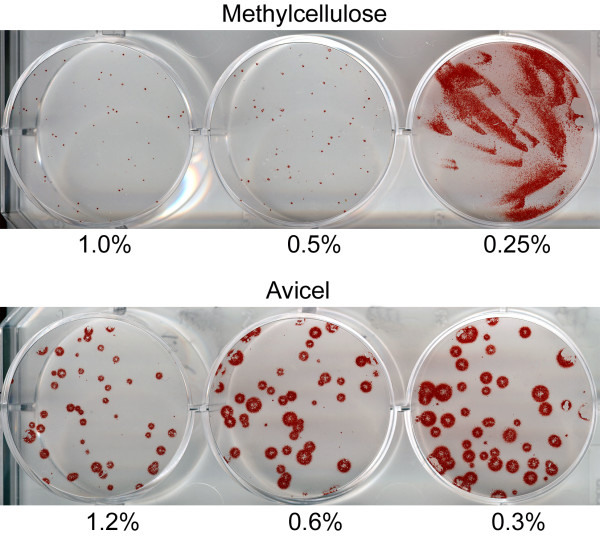
Parallel plaque assays under methylcellulose (top panel) and Avicel RC-581 (bottom panel). Numbers depict concentrations of the MC and Avicel in the overlay. A/Memphis/14/96-M (H1N1); MDCK-SIAT1 cells in 6-well plates; immuno-staining (AEC).
Figure 5
Figure 5
Plaques formed by influenza viruses in MDCK cells under 1.2% Avicel RC-581 overlay. Top row, from left to right: viruses isolated from humans A/Memphis/14/96-M (H1N1), A/Hong Kong/1/68 (H3N2), A/Hessen/1/03 (H3N2) and A/Thailand/KAN-1/04 (H5N1). Bottom row, from left to right: avian viruses A/Duck/Alberta/119/98, A/Duck/Minnesota/1525/81 (H5N1), A/Chicken/Indonesia/1/05 (H5N1) and A/Chicken/Germany/R28/03 (H7N7). Immuno-staining with either True Blue (blue) or AEC (red).
Figure 6
Figure 6
Three different assay variants (a-c) in 96-well plate. Either 12 or 24 replicate wells with MDCK cells were inoculated with tenfold dilutions of A/Memphis/14/96-M (H1N1) as depicted at the bottom of the figure. After 1 h of incubation, the viral inoculums were removed from the top eight rows of the wells; the inoculums were left intact in rows 9–12. After that, standard liquid maintenance medium was added to rows 1–4; 1.2% Avicel RC-581 overlay medium was added to rows 5–12. TPCK-trypsin was included in each overlay medium to produce the final concentration of 1 μg/ml. Immuno-staining 24 h post infection using True Blue substrate.
Figure 7
Figure 7
Plaque reduction assay in MDCK-SIAT1 cells under Avicel overlay. A/Memphis/14/96-M (H1N1) was assayed for its sensitivity to the neuraminidase inhibitor oseltamivir carboxylate in 6 well plate (a) and in 96-well plate (b; 3 replicate rows are shown in the figure) as described in the Methods section. Numbers depict final concentration of the inhibitor (μM) after the addition of the overlay.

References

    1. Cooper PD. The plaque assay of animal viruses. In: Maramorosch K, Koprowski H, editor. Methods in Virology. III. N.Y and London, Academic Press; 1967. pp. 243–311.
    1. Matrosovich M, Matrosovich T, Carr J, Roberts NA, Klenk H-D. Overexpression of the alpha-2,6-sialyltransferase in MDCK cells increases influenza virus sensitivity to neuraminidase inhibitors. J Virol. 2003;77:8418–8425. doi: 10.1128/JVI.77.15.8418-8425.2003. - DOI - PMC - PubMed
    1. Avicel RC/CL Microcrystalline cellulose and carboxymethylcellulose sodium, NF. Specifications and analytical methods http://www.fmcbiopolymer.com/Portals/bio/Content/Docs/Pharmaceuticals/Av...
    1. FMC Biopolymer website. Avicel RC/CL http://www.fmcbiopolymer.com/Pharmaceuticals/Products/AvicelRCCL/tabid/5...
    1. Gambaryan AS, Matrosovich MN, Bender CA, Kilbourne ED. Differences in the biological phenotype of low-yielding (L) and high-yielding (H) variants of swine influenza virus A/NJ/11/76 are associated with their different receptor-binding activity. Virology. 1998;247:223–231. doi: 10.1006/viro.1998.9274. - DOI - PubMed

Publication types

LinkOut - more resources