. 2006 Dec;356(1-2):68-78.
doi: 10.1016/j.virol.2006.07.039. Epub 2006 Aug 30.

Cervical keratinocytes containing stably replicating extrachromosomal HPV-16 are refractory to transformation by oncogenic H-Ras

Affiliations

Cervical keratinocytes containing stably replicating extrachromosomal HPV-16 are refractory to transformation by oncogenic H-Ras

Kristi L Berger et al. Virology. 2006 Dec.

Abstract

Ras expression in human epithelial cells with integrated HPV genomes has been shown to cause tumorigenic transformation. The effects of Ras in cells representing early stage HPV-associated disease (i.e., when HPV is extrachromosomal and the oncogenes are under control of native promoters) have not been examined. Here, we used human cervical keratinocyte cell lines containing stably replicating extrachromosomal HPV-16 and present the novel finding that these cells resist transformation by oncogenic H-Ras. Ras expression consistently diminished anchorage-independent growth (AI), reduced E6 and E7 expression, and caused p53 induction in these cells. Conversely, AI was enhanced or maintained in Ras-transduced cervical cells that were immortalized with a 16E6/E7 retrovirus, and minimal effects on E6 and E7 expression were observed. Ras expression with either episomal HPV-16 or LXSN-E6/E7 was insufficient for tumorigenic growth suggesting that other events are needed for tumorigenic transformation. In conclusion, our results indicate that Ras-mediated transformation depends on the context of HPV oncogene expression and that this is an important point to address when developing HPV tumor models.


Figures
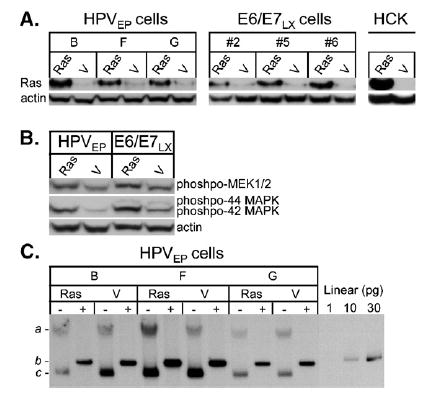
Fig. 1
Fig. 1
(A) Western blot verifying Ras protein expression one passage after retroviral transduction of pBabe-puro H-RasG12V (Ras) or pBabe-puro vector (V). Cell lines used are HPVEP clones (B, F, and G), E6/E7LX clones (#2, #5, and #6), or primary HCKs. (B) Western blot verifying functionality of the H-RasG12V construct by activation of downstream effectors via phosphorylation of MEK1/2 and 44/42 MAPK proteins in HPVEP and E6/E7LX cells. (C) Southern blot displaying viral DNA present in HPVEP clonal populations expressing Ras or vector. Cells were cultured for 10 passages (˜20 population doublings) after Ras-retrovirus infection and DNA was digested either with BgιII (− lanes) or BamHI (+ lanes). BgιII cleaves cellular genomic DNA, leaving the HPV genome as an intact supercoiled episome (c) or nicked-circular plasmid (a). BamHI linearizes the HPV genome (b). Picogram quantities of linearized HPV-16 plasmid were used to estimate copy number as previously described (see Materials and methods). The 30 pg lane is equivalent to 5 copies per cell.
Fig. 2
Fig. 2
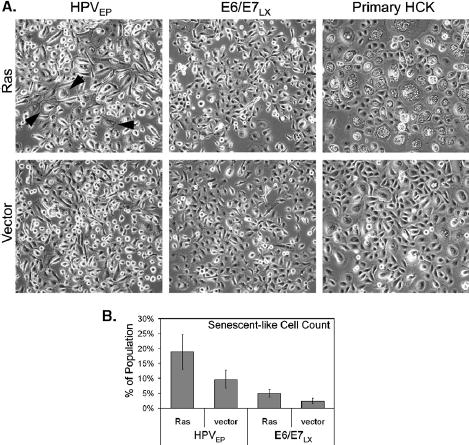
(A) Microphotographs of morphological changes induced by H-RasG12V. Photographed cultures of HPVEP clone G, HPVEP clone #2, and HCKs were grown without irradiated feeders. Black arrows point to enlarged cells in Ras-expressing HPVEP cells, which are rarely found in E6/E7LX cultures. HCKs demonstrate typical morphology induced by oncogenic Ras in primary epithelial cells. (B) Blinded counts of enlarged and flattened cells, indicative of senescence, from triplicate plates of either HPVEP clone G or HPVEP clone #2 are expressed as a percentage of the total number of cells counted. Data are expressed as the mean±SD.
Fig. 3
Fig. 3
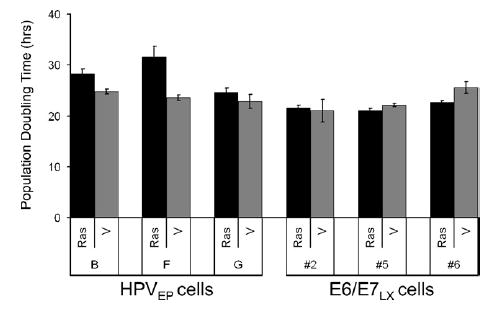
Population doubling (PD) time was determined over a 3-day period from absorbance data generated from crystal violet staining of cultures (see Materials and methods). H-RasG12V increased PD time in two of three HPVEP clones. No change in PD time was observed for two E6/E7LX clones, #2 and #5, while Ras slightly decreased PD time in one cell line, clone #6. Data are expressed as the mean±SD of triplicate data points.
Fig. 4
Fig. 4
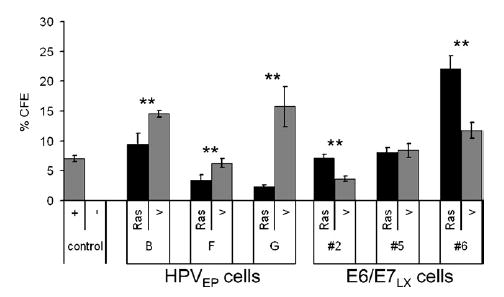
H-RasG12V significantly reduced anchorage-independent (AI) colony formation of all HPVEP clones (**p<0.001) and stimulated growth of two E6/E7LX clones (**p<0.001). Percent colony forming efficiency (%CFE) is reported as the percentage of colonies that grew in soft agar per number of cells initially seeded. HPV-negative C33A cells (+) control; primary HCKs (−) control. Data are expressed as the mean±SD of triplicate data points.
Fig. 5
Fig. 5
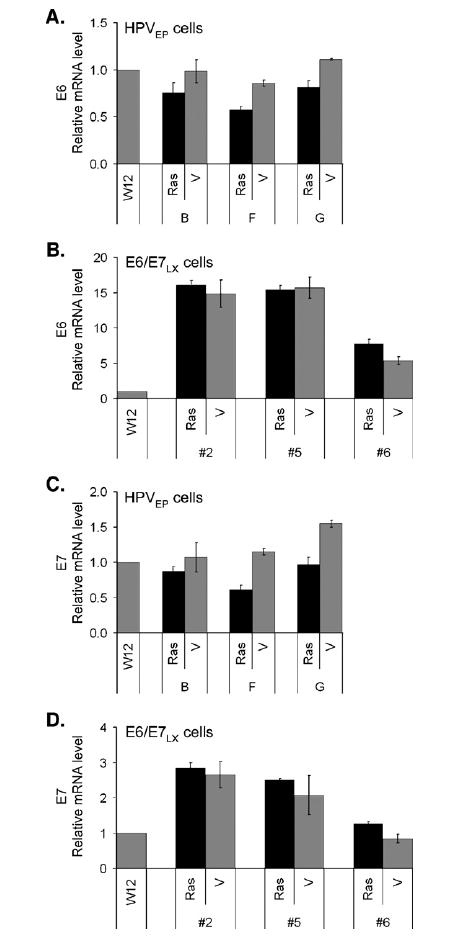
Real-time RT-PCR for E6 transcripts in Ras or vector-transduced HPVEP (A) or E6/E7LX cells (B) and E7 transcripts in HPVEP (C) or E6/E7LX cells (D) all standardized to 18S mRNA levels. HPVEP cells contain the full genome derived from W12-E cells. E6/E7LX cells dually express E6 and E7 from a single retroviral promoter. For reference, RNA levels were calculated relative to W12 cervical cells, the cell line containing episomal HPV-16 from which the W12-E clone was derived. Data are expressed as the mean±SD of triplicate data points.
Fig. 6
Fig. 6
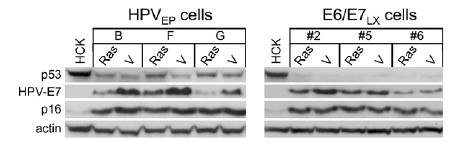
Western blot of p53, HPV16-E7, and p16INK4a proteins in HPVEP and E6/E7LX clonal populations. Primary HCKs were used for reference. Lanes consist of lysates collected one passage after transduction and selection for H-RasG12V or vector (V).

References

    1. Alonio LV, Picconi MA, Dalbert D, Mural J, Bartt O, Bazan G, Dominguez M, Teyssie AR. Ha-ras oncogene mutation associated to progression of papillomavirus induced lesions of uterine cervix. J Clin Virol. 2003;27:263–269. - PubMed
    1. Andersson S, Safari H, Mints M, Lewensohn-Fuchs I, Gyllensten U, Johansson B. Type distribution, viral load and integration status of high-risk human papillomaviruses in pre-stages of cervical cancer (CIN) Br J Cancer. 2005;92:2195–2200. - PMC - PubMed
    1. Arias-Pulido H, Peyton CL, Joste NE, Vargas H, Wheeler CM. Human papillomavirus type 16 integration in cervical carcinoma in situ and in invasive cervical cancer. J Clin Microbiol. 2006;44:1755–1762. - PMC - PubMed
    1. Bernard C, Mougin C, Laurent R, Lab M. Oncogene activation: an informative marker for the human papillomavirus-lesions severity. Cancer Detect Prev. 1994;18:273–282. - PubMed
    1. Bihani T, Mason DX, Jackson TJ, Chen SC, Boettner B, Lin AW. Differential oncogenic Ras signaling and senescence in tumor cells. Cell Cycle. 2004;3:1201–1207. - PubMed

Publication types

MeSH terms

Substances