


Familial ALS-superoxide dismutases associate with mitochondria and shift their redox potentials
- PMID: 16945901
- PMCID: PMC1557633
- DOI: 10.1073/pnas.0605814103
Familial ALS-superoxide dismutases associate with mitochondria and shift their redox potentials
Abstract
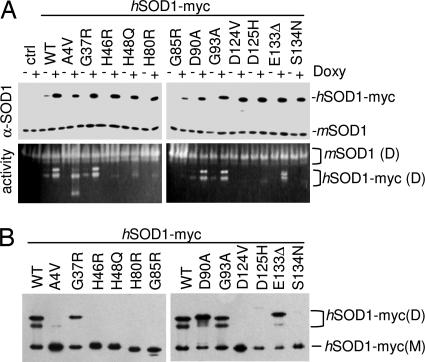
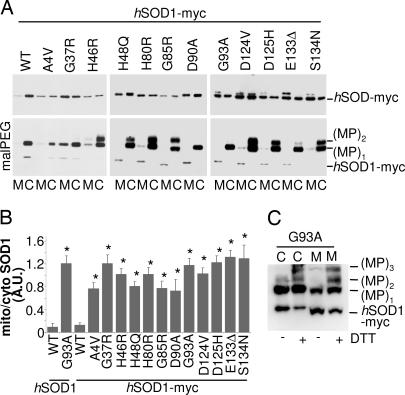
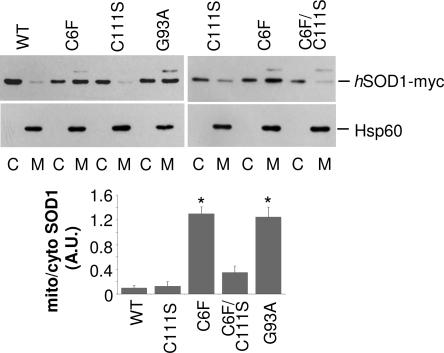
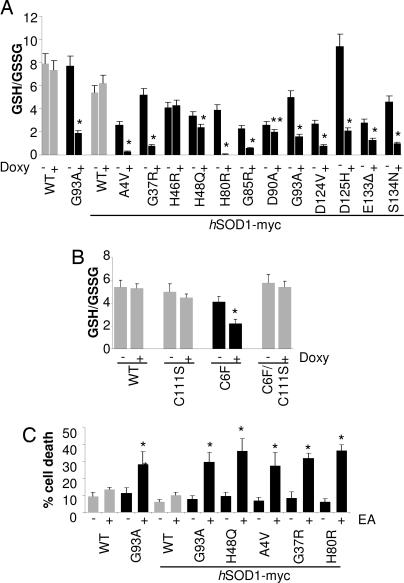
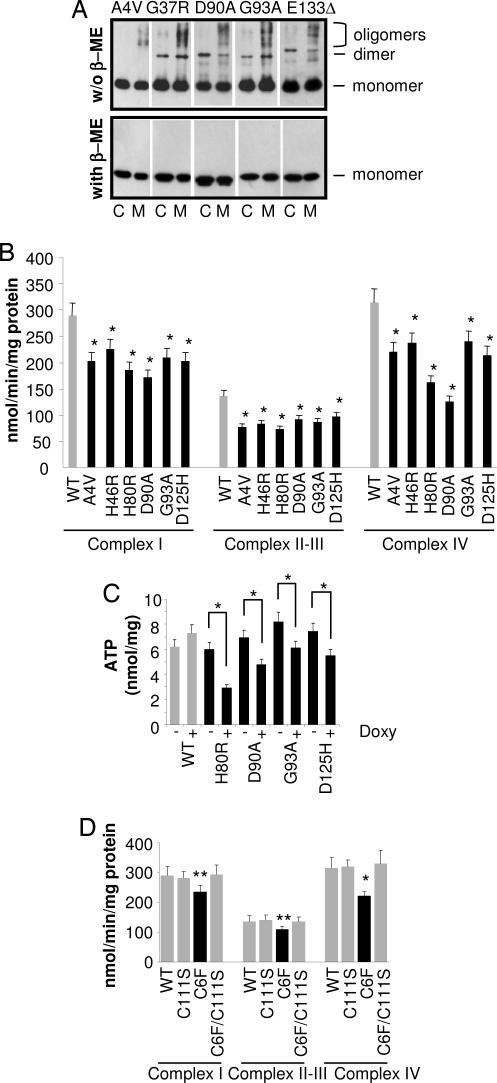
Recent studies suggest that the toxicity of familial amyotrophic lateral sclerosis mutant Cu, Zn superoxide dismutase (SOD1) arises from its selective recruitment to mitochondria. Here we demonstrate that each of 12 different familial ALS-mutant SOD1s with widely differing biophysical properties are associated with mitochondria of motoneuronal cells to a much greater extent than wild-type SOD1, and that this effect may depend on the oxidation of Cys residues. We demonstrate further that mutant SOD1 proteins associated with the mitochondria tend to form cross-linked oligomers and that their presence causes a shift in the redox state of these organelles and results in impairment of respiratory complexes. The observation that such a diverse set of mutant SOD1 proteins behave so similarly in mitochondria of motoneuronal cells and so differently from wild-type SOD1 suggests that this behavior may explain the toxicity of ALS-mutant SOD1 proteins, which causes motor neurons to die.
Conflict of interest statement
Conflict of interest statement: No conflicts declared.
Figures
References
-
- Valentine JS, Doucette PA, Potter SZ. Annu Rev Biochem. 2005;74:563–593. - PubMed
-
- Hayward LJ, Rodriguez JA, Kim JW, Tiwari A, Goto JJ, Cabelli DE, Valentine JS, Brown RH., Jr J Biol Chem. 2002;277:15923–15931. - PubMed
-
- Rodriguez JA, Valentine JS, Eggers DK, Roe JA, Tiwari A, Brown RH, Jr, Hayward LJ. J Biol Chem. 2002;277:15932–15937. - PubMed
Publication types
MeSH terms
Substances
Grants and funding
LinkOut - more resources
Full Text Sources
Medical
Miscellaneous
