


DNA-mediated anisotropic mechanical reinforcement of a virus
- PMID: 16945903
- PMCID: PMC1564217
- DOI: 10.1073/pnas.0601881103
DNA-mediated anisotropic mechanical reinforcement of a virus
Abstract
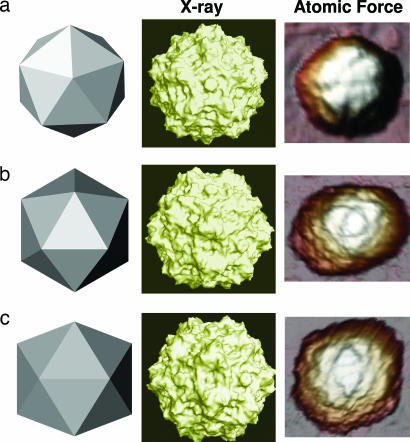
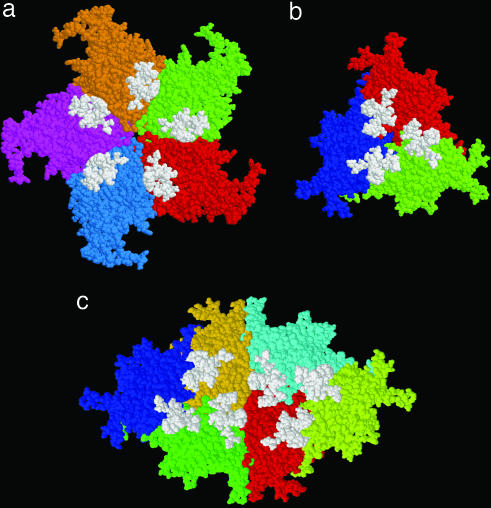
In this work, we provide evidence of a mechanism to reinforce the strength of an icosahedral virus by using its genomic DNA as a structural element. The mechanical properties of individual empty capsids and DNA-containing virions of the minute virus of mice are investigated by using atomic force microscopy. The stiffness of the empty capsid is found to be isotropic. Remarkably, the presence of the DNA inside the virion leads to an anisotropic reinforcement of the virus stiffness by approximately 3%, 40%, and 140% along the fivefold, threefold, and twofold symmetry axes, respectively. A finite element model of the virus indicates that this anisotropic mechanical reinforcement is due to DNA stretches bound to 60 concavities of the capsid. These results, together with evidence of biologically relevant conformational rearrangements of the capsid around pores located at the fivefold symmetry axes, suggest that the bound DNA may reinforce the overall stiffness of the viral particle without canceling the conformational changes needed for its infectivity.
Conflict of interest statement
Conflict of interest statement: No conflicts declared.
Figures


References
-
- Hamm CE, Merkel R, Springer O, Jurkojc P, Maier C, Prechtel K, Smetacek V. Nature. 2003;421:841–843. - PubMed
-
- Goodman RP, Schaap IAT, Tardin CF, Erben CM, Berry RM, Schmidt CF, Turberfield AJ. Science. 2005;310:1661–1665. - PubMed
-
- Rossmann MG, Johnson JE. Annu Rev Biochem. 1989;58:533–573. - PubMed
-
- Johnson JE, Speir JA. In: Encyclopedia of Virology. Granoff A, Webster R, editors. London: Academic; 1999. pp. 1946–1956.
-
- Chiu W, Garcea RL, Burnett RM. Structural Biology of Viruses. Oxford: Oxford Univ Press; 1997.
Publication types
MeSH terms
Substances
Grants and funding
LinkOut - more resources
Full Text Sources
Other Literature Sources
