


Racial variation in treatment preferences and willingness to randomize in the Spine Patient Outcomes Research Trial (SPORT)
- PMID: 16946665
- PMCID: PMC2745937
- DOI: 10.1097/01.brs.0000232708.66608.ac
Racial variation in treatment preferences and willingness to randomize in the Spine Patient Outcomes Research Trial (SPORT)
Abstract
Study design: Analysis of baseline data for patients enrolled in Spine Patient Outcomes Research Trial (SPORT), a project conducting three randomized and three observational cohort studies of surgical and nonoperative treatments for intervertebral disc herniation (IDH), spinal stenosis (SpS), and degenerative spondylolisthesis (DS).
Objective: To explore racial variation in treatment preferences and willingness to be randomized.
Summary of background data: Increasing minority participation in research has been a priority at the NIH. Prior studies have documented lower rates of participation in research and preferences for invasive treatment among African-Americans.
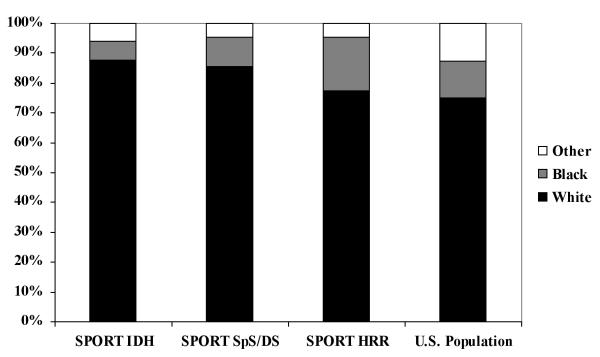
Methods: Patients enrolled in SPORT (March 2000 to February 2005) that reported data on their race (n = 2,323) were classified as White (87%), Black (8%), or Other (5%). Treatment preferences (nonoperative, unsure, surgical), and willingness to be randomized were compared among these groups while controlling for baseline differences using multivariate logistic regression. RESULTS.: There were numerous significant differences in baseline characteristics among the racial groups. Following adjustment for these differences, Blacks remained less likely to prefer surgical treatment among both IDH (White, 55%; Black, 37%; Other, 55%, P = 0.023) and SpS/DS (White, 46%; Black, 30%; Other, 43%; P = 0.017) patients. Higher randomization rates among Black IDH patients (46% vs. 30%) were no longer significant following adjustment (odds ratio [OR] = 1.45, P = 0.235). Treatment preference remained a strong independent predictor of randomization in multivariate analyses for both IDH (unsure OR = 3.88, P < 0.001 and surgical OR = 0.23, P < 0.001) and SpS/DS (unsure OR = 6.93, P < 0.001 and surgical OR = 0.45, P < 0.001) patients.
Conclusions: Similar to prior studies, Black participants were less likely than Whites or Others to prefer surgical treatment; however, they were no less likely to agree to be randomized. Treatment preferences were strongly related to both race and willingness to be randomized.
References
-
- NIH Policy and Guidelines on the Inclusion of Women and Minorities As Subjects in Clinical Research - Amended, October, 2001 [National Institutes of Health, Office of Extramural Research] 2001. Available at: http://grants1.nih.gov/grants/funding/women_min/guidelines_amended_10_20....
-
- Vastag B. Researchers say changes needed in recruitment policies for NIH trials. Journal of the American Medical Association. 2003;289:536–7. - PubMed
-
- Shavers V, Lynch C, Burmeister L. Racial differences in factors that influence the willingness to participate in medical research studies. Annals of Epidemiology. 2002;12:248–56. - PubMed
-
- Ibrahim S, Siminoff L, Burant C, Kwoh C. Differences in expectations of outcome mediate African American/White patient differences in “willingness” to consider joint replacement. Arthritis & Rheumatism. 2002;46:2429–35. - PubMed
Publication types
MeSH terms
Grants and funding
LinkOut - more resources
Full Text Sources
Other Literature Sources
Medical
