


To detach the long head of the biceps tendon after tenodesis or not: outcome analysis at the 4-year follow-up of two different techniques
- PMID: 16947053
- PMCID: PMC2267623
- DOI: 10.1007/s00264-006-0206-8
To detach the long head of the biceps tendon after tenodesis or not: outcome analysis at the 4-year follow-up of two different techniques
Abstract
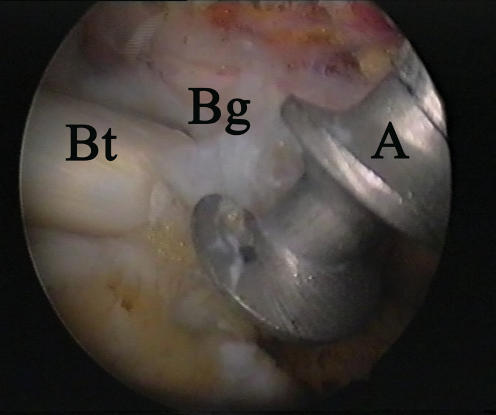
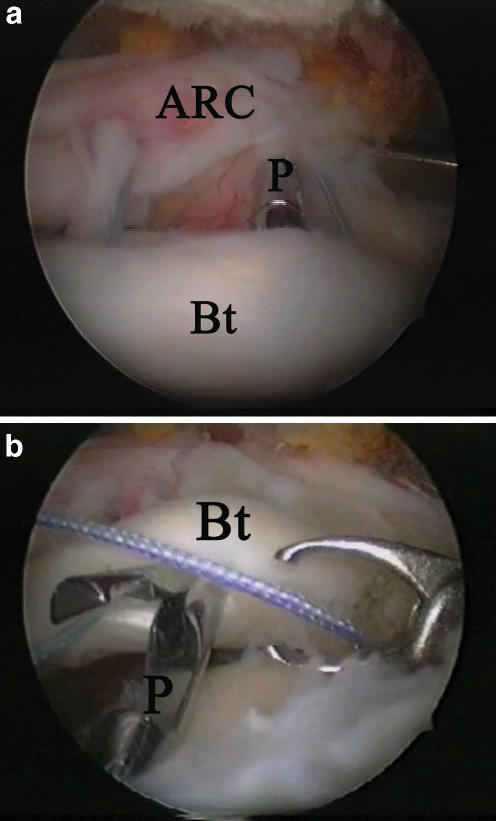
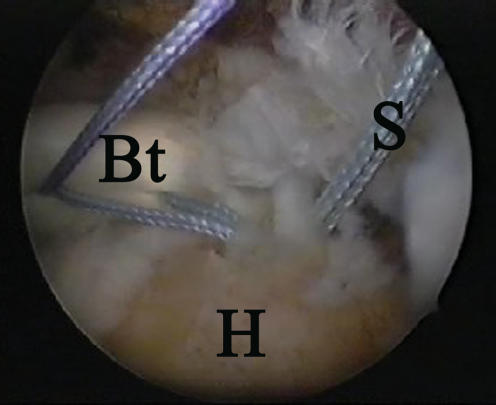
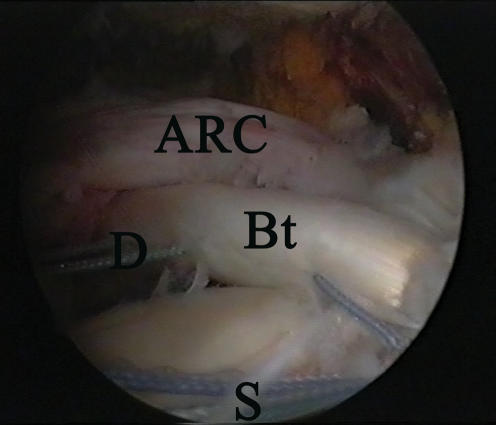
The aim of this study was to determine whether or not detaching the biceps tendon from the glenoid after tenodesis performed with the inclusion of the biceps in the rotator cuff suture results in an improved outcome. From 1999 to 2001, 22 patients had an arthroscopic rotator cuff repair and associated biceps tendon lesions that were repaired with two new arthroscopic techniques of tenodesis incorporating the biceps tendon in the rotator cuff suture. Patients were randomised into one of two groups: tenodesis without tenotomy (group 1) and tenodesis with tenotomy (group 2). Preoperative and postoperative functions were assessed by means of a modified UCLA rating scale and shoulder ROM. The mean follow-up period was 47.2 months (range 36- 59). In group 1 (tenodesis without tenotomy), eight patients had an excellent postoperative score and three a good postoperative score. The UCLA rating system used for evaluation showed a statistically significant improvement from the preoperative average rating of 10.5 (5-15) to the postoperative average score of 33 (29-35) (P<0.05). In group 2 (tenodesis with tenotomy), the UCLA rating system used for evaluation showed a statistically significant improvement from the preoperative rating of 11.1 to the postoperative score of 32.9 (P<0.05). No statistically significant difference in the total UCLA scores was found when comparing the repairs performed with or without tenotomy. Follow-up results with regard to ROM were not different between the two groups, and the range of motion was improved in all measured directions. In this series, every patient qualified as having good to excellent results according to the UCLA score. This study suggests that there is no difference between detaching and not detaching the biceps after including it in the repair.
Le but de cette étude est de déterminer si le fait de détacher le tendon du biceps de la cavité glénoïde après ténodèse réalisé avec inclusion du tendon dans la réparation de la coiffe des rotateurs a une influence sur le résultat. De 1999 à 2001, 22 patients ont eu une réparation de la coiffe des rotateurs sous arthroscopie associée à des lésions du tendon du biceps qui furent réparés avec deux nouvelles techniques arthroscopiques de ténodèse incorporant le biceps dans la réparation de la coiffe. Les patients furent randomisés en deux groupes : ténodèse sans ténotomie (groupe 1) et ténodèse avec ténotomie (groupe 2). La fonction préopératoire et post opératoire a été mesurée au moyen de l’échelle UCLA et de la mesure des amplitudes articulaires. La durée moyenne du suivi est de 47.2 mois (allant de 36 à 59). Dans le groupe 1 (ténodèse sans ténotomie) 8 patients ont eu un excellent score post opératoire et 3 un bon score post opératoire. Le score UCLA utilisé pour l’évaluation a montré une amélioration significative avec une moyenne préopératoire de 10.5 (5 à 15) et une moyenne post opératoire de 33 (29 à 35) (P<0.05). Dans le groupe 2 (ténodèse avec ténotomie), le score UCLA utilisé pour l’évaluation montre une différence significative avec un score préopératoire de 11.1 et post opératoire de 32.9 (P<0.05). Il n’a pas été trouvé de différence significative au niveau du score UCLA quand on compare les réparations réalisées avec ou sans ténotomies. Les résultats au recul, en ce qui concerne le score amplitude n’étaient pas différents entre les deux groupes et les amplitudes de mouvements étaient améliorées dans toutes les directions. Dans ces séries, tous les patients étaient considérés comme des bons à excellents résultats selon le score UCLA. Cette étude suggère donc qu’il n’y a pas de différence que l’on détache ou pas le long biceps après l’avoir inclus dans la réparation.
Figures
References
-
- Barber FA, Byrd JW, Wolf EM, Burkhart SS (2001) How would you treat the partially torn biceps tendon? Arthroscopy 17:636–639 - PubMed
-
- Bigliani LU, Morrison DS, April EW (1986) The morphology of the acromion and its relationship to rotator cuff tears. Orthop Trans 10:228
-
- Bigliani LU, Cordasco FA, McIlveen SJ, Musso ES (1992) Operative repair of massive rotator cuff tears: long-term results. J Shoulder Elbow Surg 1:120–130 - PubMed
-
- Boileau P, Krishnan SG, Coste JS, Walch G (2002) Arthroscopic biceps tenodesis: a new technique using bioabsorbable interference screw fixation. Arthroscopy 18:1002–1012 - PubMed
-
- Burkhead WZ (1990) The biceps tendon. In: Rockwood CA, Matsen FAI (eds) The shoulder. Philadelphia. WB Saunders, pp 791–836
Publication types
MeSH terms
LinkOut - more resources
Full Text Sources
