. 2006 Sep;188(18):6529-38.
doi: 10.1128/JB.00308-06.

The Pseudomonas aeruginosa universal stress protein PA4352 is essential for surviving anaerobic energy stress

Affiliations

The Pseudomonas aeruginosa universal stress protein PA4352 is essential for surviving anaerobic energy stress

Nelli Boes et al. J Bacteriol. 2006 Sep.

Abstract

During infection of the cystic fibrosis (CF) lung, Pseudomonas aeruginosa microcolonies are embedded in the anaerobic CF mucus. This anaerobic environment seems to contribute to the formation of more robust P. aeruginosa biofilms and to an increased antibiotic tolerance and therefore promotes persistent infection. This study characterizes the P. aeruginosa protein PA4352, which is important for survival under anaerobic energy stress conditions. PA4352 belongs to the universal stress protein (Usp) superfamily and harbors two Usp domains in tandem. In Escherichia coli, Usp-type stress proteins are involved in survival during aerobic growth arrest and under various other stresses. A P. aeruginosa PA4352 knockout mutant was tested for survival under several stress conditions. We found a decrease in viability of this mutant compared to the P. aeruginosa wild type during anaerobic energy starvation caused by the missing electron acceptors oxygen and nitrate. Consistent with this phenotype under anaerobic conditions, the PA4352 knockout mutant was also highly sensitive to carbonyl cyanide m-chlorophenylhydrazone, the chemical uncoupler of the electron transport chain. Primer extension experiments identified two promoters upstream of the PA4352 gene. One promoter is activated in response to oxygen limitation by the oxygen-sensing regulatory protein Anr. The center of a putative Anr binding site was identified 41.5 bp upstream of the transcriptional start site. The second promoter is active only in the stationary phase, however, independently of RpoS, RelA, or quorum sensing. This is the second P. aeruginosa Usp-type stress protein that we have identified as important for survival under anaerobic conditions, which resembles the environment during persistent infection.


Figures

FIG. 1.
FIG. 1.
Phenotype of the CFU obtained from viable plating of P. aeruginosa wild-type cells and the ΔPA4352 mutant on LB agar plates after 9 hours of anaerobic stationary phase. Cultures of P. aeruginosa were incubated anaerobically in LB supplemented with 50 mM KNO3. After 9 hours of incubation in the stationary phase, aliquots from (A) wild-type P. aeruginosa containing the empty mini-CTX2 vector (NB058), (B) the ΔPA4352 mutant containing the empty mini-CTX2 vector (NB059), and (C) the complemented ΔPA4352 mutant containing pNB011 with the PA4352 gene (NB060) were taken, and 50 μl of a 10−5 dilution was plated on LB agar plates. The plates were incubated aerobically for 20 h at 37°C.
FIG. 2.
FIG. 2.
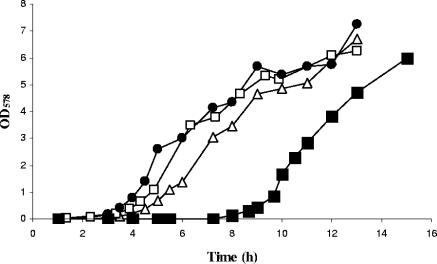
Effect of the PA4352 knockout in P. aeruginosa on recovery from nitrate starvation in the anaerobic stationary phase. Cultures of P. aeruginosa were incubated anaerobically in LB supplemented with 50 mM KNO3 and allowed to pass 9 h of stationary phase before being diluted in fresh LB medium. The inoculum contained 4.2 × 10⁸ to 6.1 × 108 viable cells per ml as determined by viable-cell counts and Live/Dead staining (see Materials and Methods). The diluted cultures were incubated aerobically at 37°C to generate the growth curves shown of the wild-type strain containing the empty mini-CTX2 (NB058) (open triangles), the ΔPA4352 mutant containing the empty mini-CTX2 vector (NB059) (filled squares), and the complemented ΔPA4352 mutant (NB060) containing pNB011 with the PA4352 gene (open squares). To rescue the phenotype of the ΔPA4352 mutant, one culture of the ΔPA4352 mutant was supplemented with additional KNO3 (30 mM) 5 hours prior to dilution (filled circles).
FIG. 3.
FIG. 3.
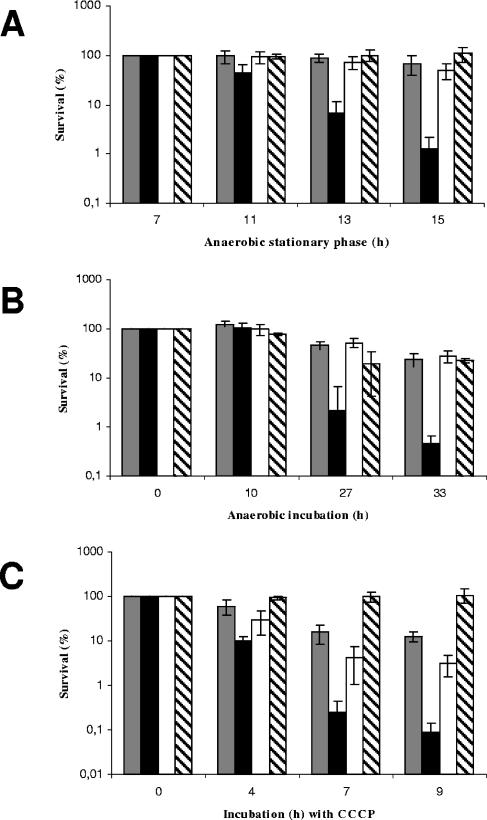
Premature death of the ΔPA4352 mutant caused by restriction of the terminal electron acceptor nitrate (A), by restriction of oxygen (B), and by addition of CCCP in the anaerobic stationary phase (C). (A) Cultures of P. aeruginosa were incubated anaerobically in LB supplemented with 50 mM KNO3. The survival (%) of wild-type cells containing the empty mini-CTX2 vector (NB058) (gray bars), of the ΔPA4352 mutant containing the empty mini-CTX2 vector (NB059) (black bars), and of the complemented ΔPA4352 mutant (NB060) (white bars) was determined by viable-cell counts during the stationary phase. One culture of the ΔPA4352 mutant was supplemented with additional KNO3 (30 mM) 7 hours after entry into the stationary phase (striped bars). (B) Cultures of P. aeruginosa were incubated aerobically in LB, and as a control, an additional culture of the ΔPA4352 mutant was incubated in LB supplemented with KNO3 (50 mM). After reaching the stationary phase, the cultures were incubated for an additional 15 h under aerobic conditions. To initiate anaerobiosis, the cultures were transferred to hermetically sealed bottles. The control culture of the ΔPA4352 mutant grown in LB with 50 mM KNO3 was supplemented with additional KNO3 (30 mM) immediately after the shift to anaerobiosis to prevent nitrate limitation (striped bars). The survival (%) of wild-type cells containing the empty mini-CTX2 vector (NB058) (gray bars), the ΔPA4352 mutant containing the empty mini-CTX2 vector (NB059) (black bars), and the complemented ΔPA4352 mutant (NB060) (white bars) was determined by viable-cell counts during the stationary phase. (C) CCCP sensitivity was examined in the anaerobic stationary phase. After 7 h of stationary phase, cultures of P. aeruginosa wild-type cells containing the empty mini-CTX2 vector (NB058) (gray bars), the ΔPA4352 mutant containing the empty mini-CTX2 vector (NB059) (black bars), and the complemented ΔPA4352 mutant (NB060) (white bars) were supplemented with an additional 30 mM KNO3 and challenged with CCCP (0.2 mM). One culture of the ΔPA4352 mutant was supplemented with KNO3 without CCCP (striped bars). All experiments were repeated three times, and standard deviations are indicated.
FIG. 4.
FIG. 4.
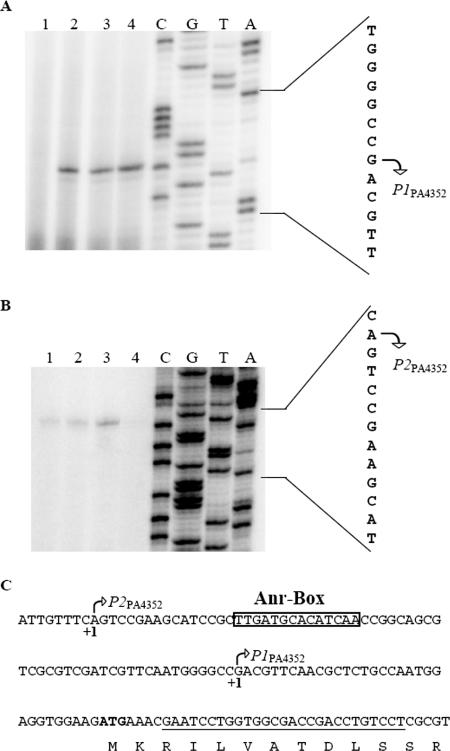
Primer extension analysis of PA4352 transcription, which identified the positions of P1PA4352 (A) and P2PA4352 (B). Total cellular RNA was extracted from aerobically grown cultures of the P. aeruginosa anr mutant (lanes 1) and wild-type cells (lanes 2) harvested in the early stationary phase and also wild-type cells cultivated under anaerobic conditions in the early stationary phase (lanes 3) and during exponential growth (OD578, 0.7) (lanes 4) in LB supplemented with 50 mM KNO3. Thirty micrograms of each prepared RNA was applied to primer extension analysis, using the primer oNB021, shown in panel C. The primer extension products were separated on a 6% urea-acrylamide gel, together with a sequencing ladder generated with oNB021. The complementary sequence of the transcription initiation start site is represented, and the 5′ ends of the PA4352 transcripts are indicated by arrows. (C) Nucleotide sequence of the upstream and downstream regions flanking the transcriptional start sites of PA4352. The Anr binding site is boxed. The first few N-terminal amino acids of the PA4352 protein are shown in one-letter code. The position of the oligonucleotide (oNB021) used for primer extension is underlined.
FIG. 5.
FIG. 5.
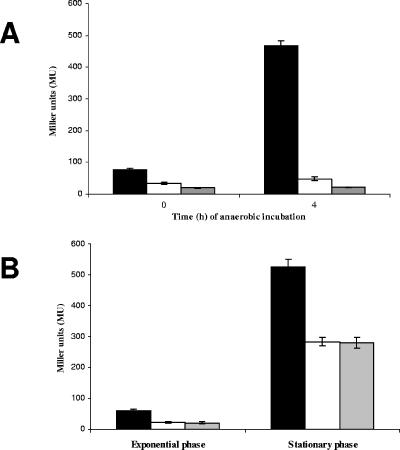
(A) Induction of the PPA4352-lacZ fusion during anaerobiosis in P. aeruginosa wild type (black bars), the anr mutant (white bars), and the mutated promoter PPA4352ΔANR-lacZ in wild-type cells (gray bars). The strains were grown at 37°C in LB to an OD578 of 0.7 (time zero) and transferred to hermetically sealed bottles for a 4-hour incubation (time 4). β-Galactosidase activities were determined at the indicated time points. (B) Expression patterns of PPA4352-lacZ in P. aeruginosa wild-type cells (black bars) and the anr mutant (white bars) and the PPA4352ΔANR-lacZ fusion containing a mutated Anr recognition site in wild-type cells (gray bars). The cells were grown aerobically in LB at 37°C. β-Galactosidase activities were determined in exponential and late stationary phases (see Materials and Methods). All experiments were repeated three times, and standard deviations are indicated.
FIG. 6.
FIG. 6.
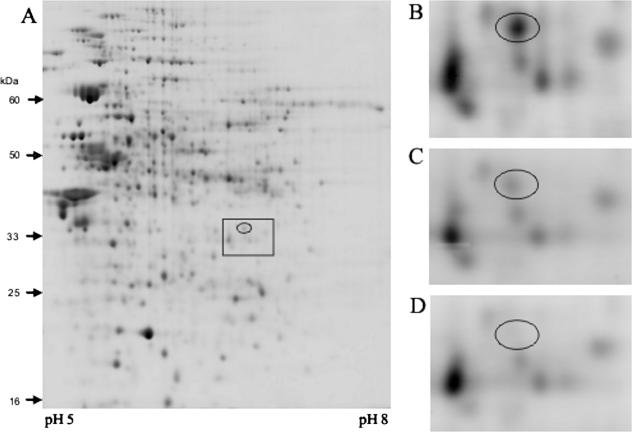
(A) Image of a 2D polyacrylamide gel showing the protein pattern of the P. aeruginosa wild type. Cells were grown to the stationary phase aerobically in LB and harvested for protein extraction after 15 h in the stationary phase. 2D gel electrophoresis was performed by using IPG strips covering a pH range from 5 to 8 (IPG Ready Strips; Bio-Rad, Munich, Germany). The ellipse marks the position of the PA4352 protein spot, and the boxed area indicates the enlarged zone shown in Fig. 6B to D. (B to D) Enlarged areas of 2D gel images indicating the positions of PA4352 in the P. aeruginosa wild type (B), the anr mutant (C), and the ΔPA4352 mutant (D). The positions of the PA4352 protein spots are marked by ellipses.

References

    1. Aiba, H., S. Adhya, and B. de Crombrugghe. 1981. Evidence for two gal promoters in intact Escherichia coli. J. Biol. Chem. 256:11905-11910. - PubMed
    1. Arai, H., T. Kodama, and Y. Igarashi. 1997. Cascade regulation of the two CRP/FNR-related transcriptional regulators (ANR and DNR) and the denitrification enzymes in Pseudomonas aeruginosa. Mol. Microbiol. 25:1141-1148. - PubMed
    1. Ausubel, F. M., R. Brent, R. E. Kingston, D. D. Moore, J. G. Seidman, J. A. Smith, and K. Struhl. 1995. Current protocols in molecular biology. John Wiley & Sons, New York, N.Y.
    1. Bateman, A., L. Coin, R. Durbin, R. D. Finn, V. Hollich, S. Griffiths-Jones, A. Khanna, M. Marshall, S. Moxon, E. L. Sonnhammer, D. J. Studholme, C. Yeats, and S. R. Eddy. 2004. The Pfam protein families database. Nucleic Acids Res. 32:D138-D141. - PMC - PubMed
    1. Beatson, S. A., C. B. Whitchurch, A. B. Semmler, and J. S. Mattick. 2002. Quorum sensing is not required for twitching motility in Pseudomonas aeruginosa. J. Bacteriol. 184:3598-3604. - PMC - PubMed

Publication types

MeSH terms

LinkOut - more resources