


Identification of an essential gene of Listeria monocytogenes involved in teichoic acid biogenesis
- PMID: 16952950
- PMCID: PMC1595501
- DOI: 10.1128/JB.00771-06
Identification of an essential gene of Listeria monocytogenes involved in teichoic acid biogenesis
Abstract
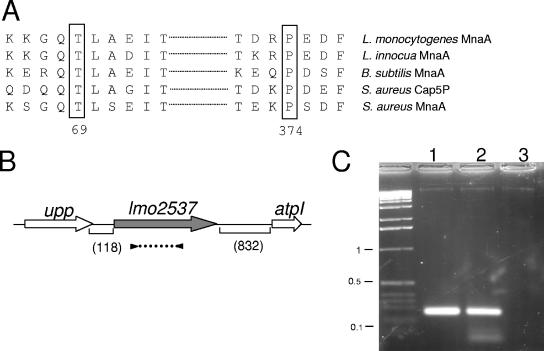
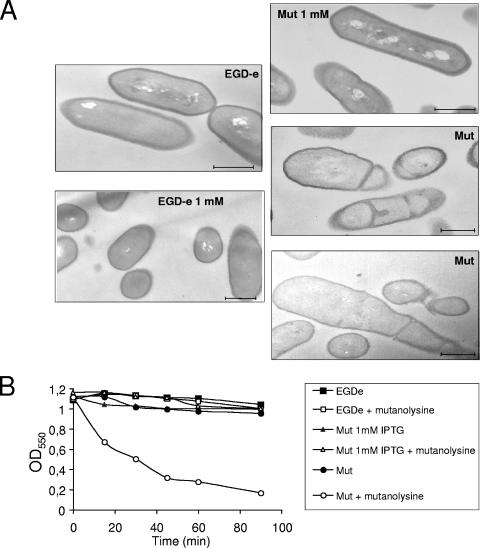
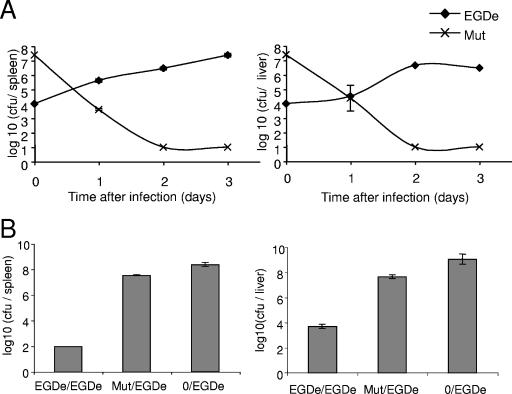
Listeria monocytogenes is a facultative intracellular gram-positive bacterium responsible for severe opportunistic infections in humans and animals. We had previously identified a gene encoding a putative UDP-N-acetylglucosamine 2-epimerase, a precursor of the teichoic acid linkage unit, in the genome of L monocytogenes strain EGD-e. This gene, now designated lmo2537, encodes a protein that shares 62% identity with the cognate epimerase MnaA of Bacillus subtilis and 55% identity with Cap5P of Staphylococcus aureus. Here, we addressed the role of lmo2537 in L. monocytogenes pathogenesis by constructing a conditional knockout mutant. The data presented here demonstrate that lmo2537 is an essential gene of L. monocytogenes that is involved in teichoic acid biogenesis. In vivo, the conditional mutant is very rapidly eliminated from the target organs of infected mice and thus is totally avirulent.
Figures


References
-
- Abachin, E., C. Poyart, E. Pellegrini, E. Milohanic, F. Fiedler, P. Berche, and P. Trieu-Cuot. 2002. Formation of d-alanyl-lipoteichoic acid is required for adhesion and virulence of Listeria monocytogenes. Mol. Microbiol. 43:1-14. - PubMed
-
- Ames, B. N. 1966. Assay of inorganic phosphate, total phosphate, and phosphatases. Methods Enzymol. 8:115-118.
-
- Appelberg, R. 2006. Macrophage nutriprive antimicrobial mechanisms. J. Leukoc. Biol. - PubMed
-
- Autret, N., and A. Charbit. 2005. Lessons from signature-tagged mutagenesis on the infectious mechanisms of pathogenic bacteria. FEMS Microbiol. Rev. 29:703-717. - PubMed
Publication types
MeSH terms
Substances
LinkOut - more resources
Full Text Sources
