. 2006 Sep 13;128(36):11940-7.
doi: 10.1021/ja062948k.

Substituents on quinone methides strongly modulate formation and stability of their nucleophilic adducts

Affiliations

Substituents on quinone methides strongly modulate formation and stability of their nucleophilic adducts

Emily E Weinert et al. J Am Chem Soc. .

Abstract

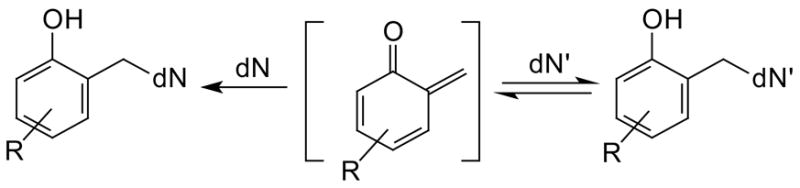
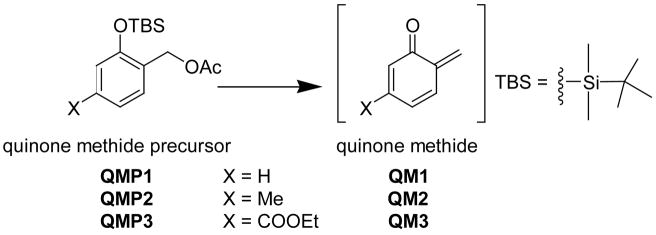
Electronic perturbation of quinone methides (QM) greatly influences their stability and in turn alters the kinetics and product profile of QM reaction with deoxynucleosides. Consistent with the electron-deficient nature of this reactive intermediate, electron-donating substituents are stabilizing and electron-withdrawing substituents are destabilizing. For example, a dC N3-QM adduct is made stable over the course of observation (7 days) by the presence of an electron-withdrawing ester group that inhibits QM regeneration. Conversely, a related adduct with an electron-donating methyl group is very labile and regenerates its QM with a half-life of approximately 5 h. The generality of these effects is demonstrated with a series of alternative quinone methide precursors (QMP) containing a variety of substituents attached at different positions with respect to the exocyclic methylene. The rates of nucleophilic addition to substituted QMs measured by laser flash photolysis similarly span 5 orders of magnitude with electron-rich species reacting most slowly and electron-deficient species reacting most quickly. The reversibility of QM reaction can now be predictably adjusted for any desired application.


Figures
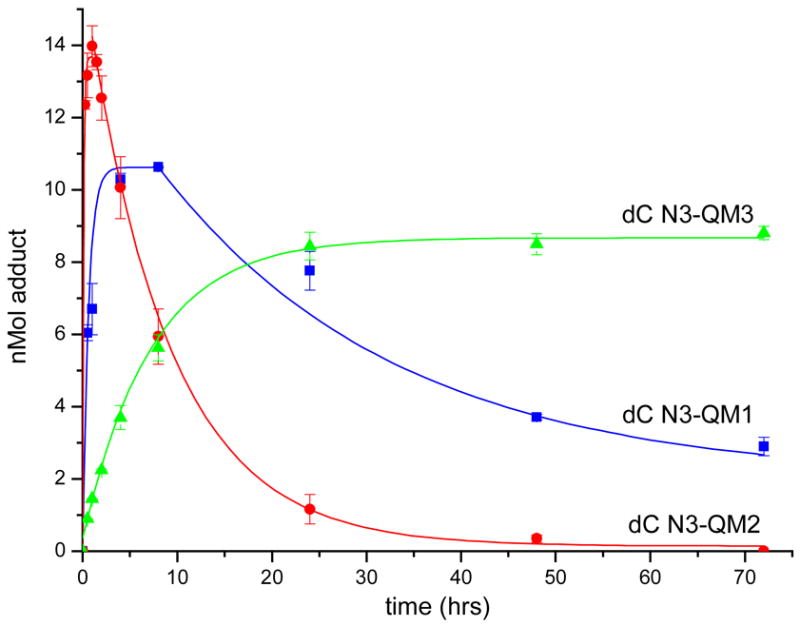
Figure 1
Figure 1
Formation and decomposition of quinone methide adducts of dC N3. Reaction conditions and product analysis are described in the Experimental Procedures. Each point represents the average of at least three independent determinations and was fit to exponential processes for highlighting the net trends of the data. The indicated error derives from the standard deviations.
Figure 2
Figure 2
Time-dependent profile of adducts formed by the electron-rich QM2 and deoxynucleosides. Reaction conditions and product analysis are identical to those used for Figure 1. Again, each point represents the average of at least three independent determinations and was fit to exponential processes for highlighting the net trends of the data. The indicated error derives from the standard deviations.
Figure 3
Figure 3
Time-dependent profile of adducts formed by the electron-poor QM3 and deoxynucleosides. Reaction conditions and product analysis are identical to those used for Figure 1. Again, each point represents the average of at least three independent determinations and was fit to exponential processes for highlighting the net trends of the data. The indicated error derives from the standard deviations.
Figure 4
Figure 4
Free energy relationships ln(ky/kH) vs Hammet σp (a,b,c) and Hammet σp (a′,b′,c′) for the addition reactions of morpholine (a, a′), water (b, b′) and thiol (c, c′).
Scheme 1
Scheme 1
Repair and Reformation of a DNA Adduct
Scheme 2
Scheme 2
Nucleobase Structure
Scheme 3
Scheme 3
Reversible and Irreversible Formation of QM Adducts
Scheme 4
Scheme 4
QM generation from Silyl-protected Precursors
Scheme 5
Scheme 5
Photogeneration of QM
Scheme 6
Scheme 6
Aromaticity Develops in the Transition-state of QM Addition

References

    1. Zewail-Foote M, Hurley LH. J Am Chem Soc. 2001;123:6485–6495. - PubMed
    1. Mattes WB, Hartley JA, Kohn KW. Nucleic Acids Res. 1986;14:2971–2987. - PMC - PubMed
    1. Kohn KW, Hartley JA, Mattes WB. Nucleic Acids Res. 1987;15:10531–10549. - PMC - PubMed
    1. Colvin OM, Friedman HS, Gamcsik MP, Fenselau C, Hilton J. Adv Enz Regula. 1993;33:19–26. - PubMed
    1. Dedon PC, Plastaras JP, Rouzer CA, Marnett LJ. Proc Natl Acad Sci USA. 1998;95:11113–11116. - PMC - PubMed

Publication types