Regulation of peripheral inflammation by spinal p38 MAP kinase in rats
- PMID: 16953659
- PMCID: PMC1560929
- DOI: 10.1371/journal.pmed.0030338
Regulation of peripheral inflammation by spinal p38 MAP kinase in rats
Abstract
Background: Somatic afferent input to the spinal cord from a peripheral inflammatory site can modulate the peripheral response. However, the intracellular signaling mechanisms in the spinal cord that regulate this linkage have not been defined. Previous studies suggest spinal cord p38 mitogen-activated protein (MAP) kinase and cytokines participate in nociceptive behavior. We therefore determined whether these pathways also regulate peripheral inflammation in rat adjuvant arthritis, which is a model of rheumatoid arthritis.
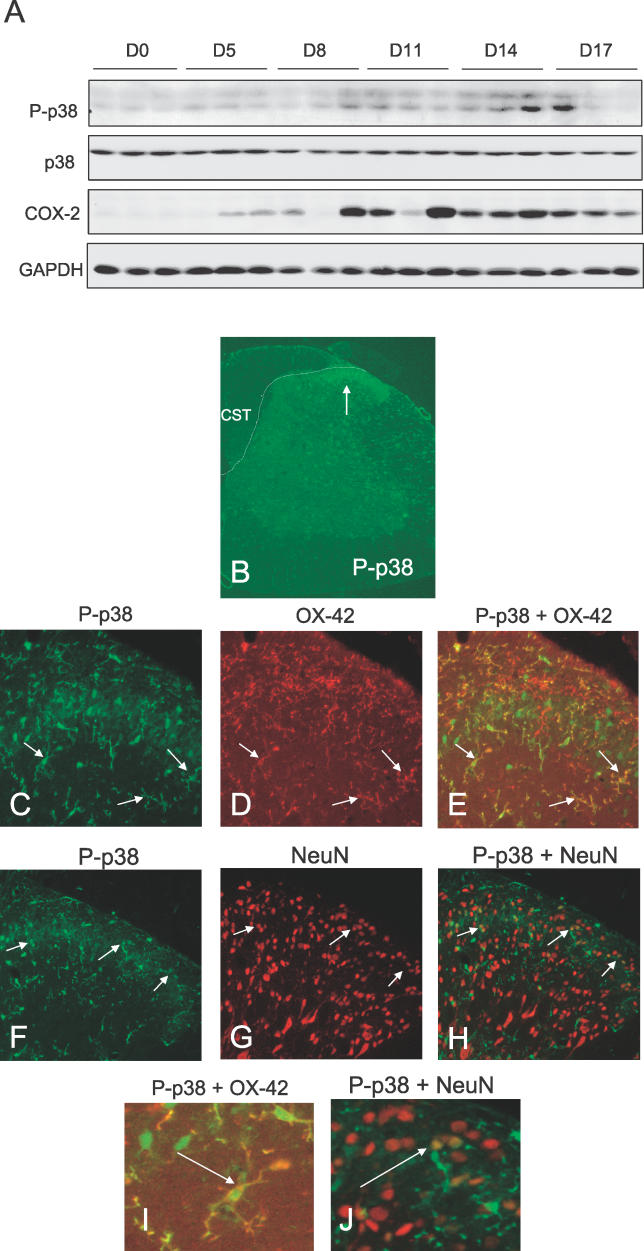
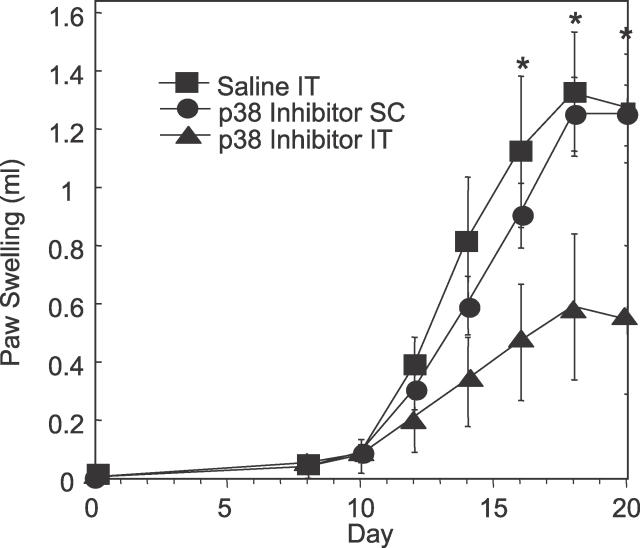
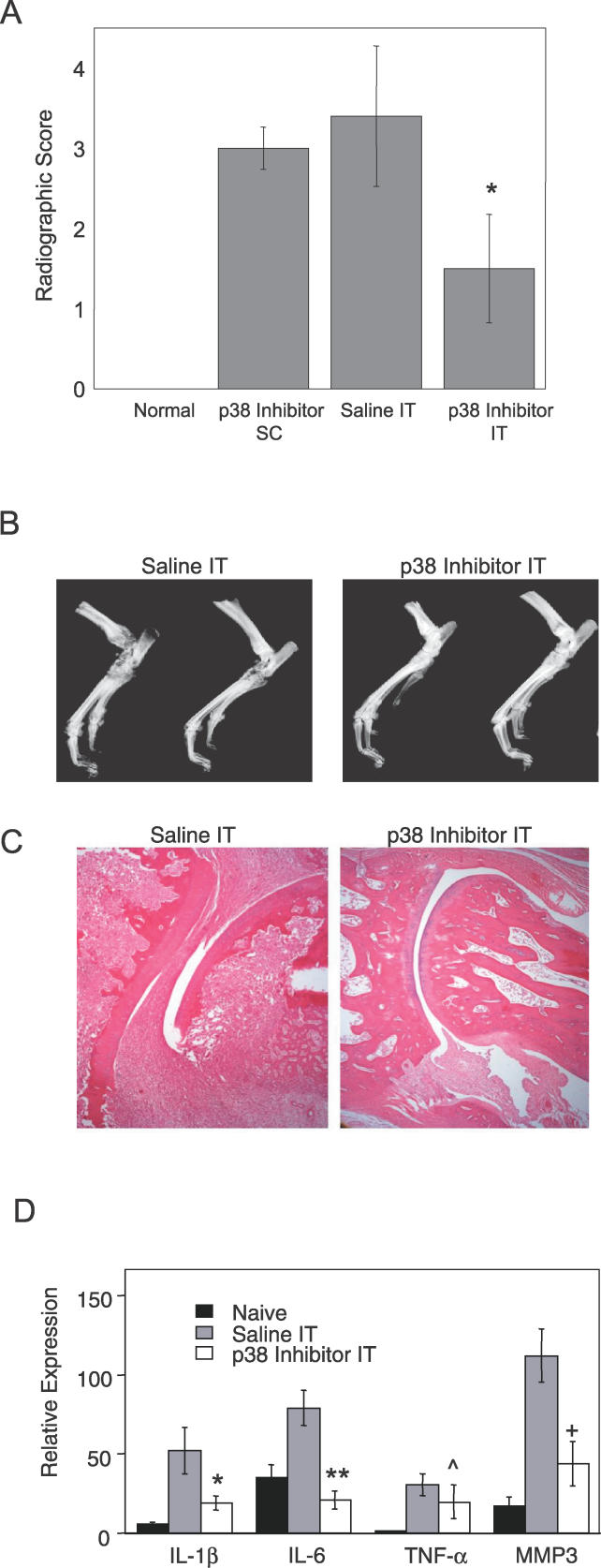
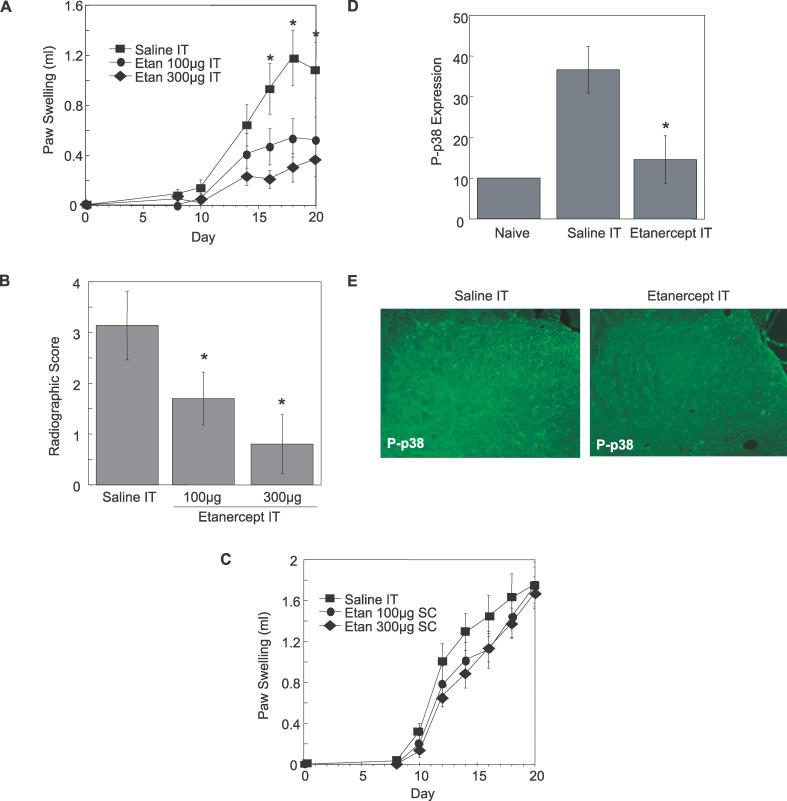
Methods and findings: Selective blockade of spinal cord p38 MAP kinase by administering the p38 inhibitor SB203580 via intrathecal (IT) catheters in rats with adjuvant arthritis markedly suppressed paw swelling, inhibited synovial inflammation, and decreased radiographic evidence of joint destruction. The same dose of SB203580 delivered systemically had no effect, indicating that the effect was mediated by local concentrations in the neural compartment. Evaluation of articular gene expression by quantitative real-time PCR showed that spinal p38 inhibition markedly decreased synovial interleukin-1 and -6 and matrix metalloproteinase (MMP3) gene expression. Activation of p38 required tumor necrosis factor alpha (TNFalpha) in the nervous system because IT etanercept (a TNF inhibitor) given during adjuvant arthritis blocked spinal p38 phosphorylation and reduced clinical signs of adjuvant arthritis.
Conclusions: These data suggest that peripheral inflammation is sensed by the central nervous system (CNS), which subsequently activates stress-induced kinases in the spinal cord via a TNFalpha-dependent mechanism. Intracellular p38 MAP kinase signaling processes this information and profoundly modulates somatic inflammatory responses. Characterization of this mechanism could have clinical and basic research implications by supporting development of new treatments for arthritis and clarifying how the CNS regulates peripheral immune responses.
Conflict of interest statement
Figures
Comment in
-
Spinal delivery of p38: TNF-alpha inhibitors.PLoS Med. 2006 Nov;3(11):e511. doi: 10.1371/journal.pmed.0030511. PLoS Med. 2006. PMID: 17132064 Free PMC article. No abstract available.
References
-
- Sluka KA, Westlund KN. Centrally administered non-NMDA but not NMDA receptor antagonists block peripheral knee joint inflammation. Pain. 1993;55:217–225. - PubMed
-
- Boyle DL, Moore J, Yang L, Sorkin LS, Firestein GS. Spinal adenosine receptor activation inhibits inflammation and joint destruction in rat adjuvant-induced arthritis. Arthritis Rheum. 2002;46:3076–3082. - PubMed
-
- Svensson CI, Marsala M, Westerlund A, Calcutt NA, Campana WM, et al. Activation of p38 mitogen-activated protein kinase in spinal microglia is a critical link in inflammation-induced spinal pain processing. J Neurochem. 2003;86:1534–1544. - PubMed
-
- Yaksh TL, Rudy RA. Chronic catheterization of the spinal subarachnoid space. Physiol Behav. 1976;17:1031–1036. - PubMed
Publication types
MeSH terms
Substances
Grants and funding
LinkOut - more resources
Full Text Sources
Other Literature Sources
Medical
Miscellaneous