Common fragile sites are conserved features of human and mouse chromosomes and relate to large active genes
- PMID: 16954539
- PMCID: PMC1581431
- DOI: 10.1101/gr.5335506
Common fragile sites are conserved features of human and mouse chromosomes and relate to large active genes
Abstract
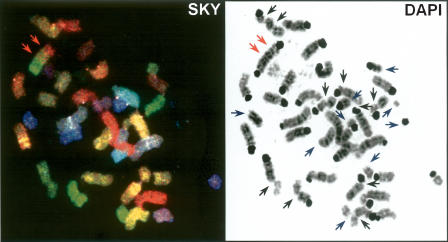
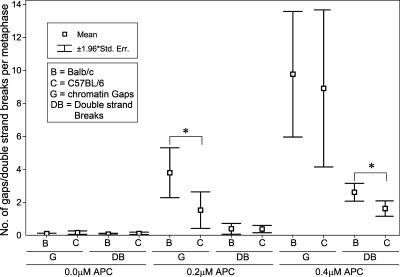
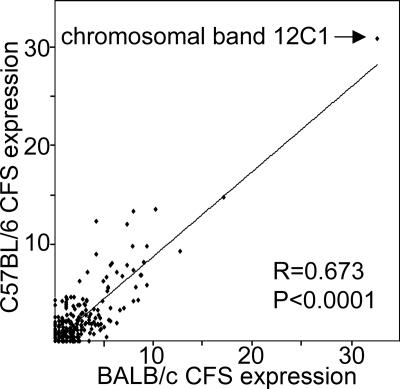
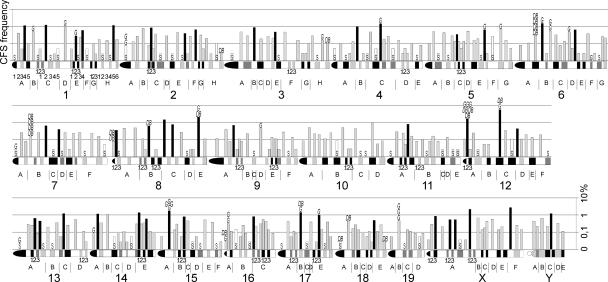
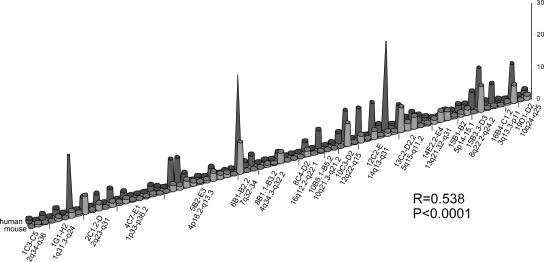
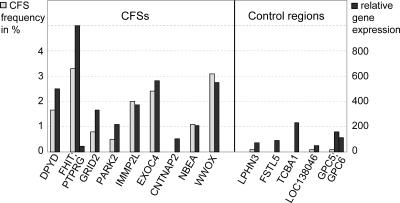
Common fragile sites (CFSs) are seen as chromosomal gaps and breaks brought about by inhibition of replication, and it is thought that they cluster with tumor breakpoints. This study presents a comprehensive analysis using conventional and molecular cytogenetic mapping of CFSs and their expression frequencies in two mouse strains, BALB/c and C57BL/6, and in human probands. Here we show that induced mouse CFSs relate to sites of spontaneous gaps and breaks and that CFS expression levels in chromosome bands are conserved between the two mouse strains and between syntenic mouse and human DNA segments. Furthermore, four additional mouse CFSs were found to be homologous to human CFSs on the molecular cytogenetic level (Fra2D-FRA2G, Fra4C2-FRA9E, Fra6A3.1-FRA7G, and Fra6B1-FRA7H), increasing the number of such CFSs already described in the literature to eight. Contrary to previous reports, DNA helix flexibility is not increased in the 15 human and eight mouse CFSs molecularly defined so far, compared to large nonfragile control regions. Our findings suggest that the mechanisms that provoke instability at CFSs are evolutionarily conserved. The role that large transcriptionally active genes may play in CFS expression is discussed.
Figures
References
-
- Arlt M.F., Casper A.M., Glover T.W., Casper A.M., Glover T.W., Glover T.W. Common fragile sites. Cytogenet. Genome Res. 2003;100:92–100. - PubMed
-
- Arlt M.F., Xu B., Durkin S.G., Casper A.M., Kastan M.B., Glover T.W., Xu B., Durkin S.G., Casper A.M., Kastan M.B., Glover T.W., Durkin S.G., Casper A.M., Kastan M.B., Glover T.W., Casper A.M., Kastan M.B., Glover T.W., Kastan M.B., Glover T.W., Glover T.W. BRCA1 is required for common-fragile-site stability via its G2/M checkpoint function. Mol. Cell. Biol. 2004;24:6701–6709. - PMC - PubMed
-
- Austin M.J., Collins J.M., Corey L.A., Nance W.E., Neale M.C., Schieken R.M., Brown J.A., Collins J.M., Corey L.A., Nance W.E., Neale M.C., Schieken R.M., Brown J.A., Corey L.A., Nance W.E., Neale M.C., Schieken R.M., Brown J.A., Nance W.E., Neale M.C., Schieken R.M., Brown J.A., Neale M.C., Schieken R.M., Brown J.A., Schieken R.M., Brown J.A., Brown J.A. Aphidicolin-inducible common fragile-site expression: Results from a population survey of twins. Am. J. Hum. Genet. 1992;50:76–83. - PMC - PubMed
-
- Callahan G., Denison S.R., Phillips L.A., Shridhar V., Smith D.I., Denison S.R., Phillips L.A., Shridhar V., Smith D.I., Phillips L.A., Shridhar V., Smith D.I., Shridhar V., Smith D.I., Smith D.I. Characterization of the common fragile site FRA9E and its potential role in ovarian cancer. Oncogene. 2003;22:590–601. - PubMed
-
- Casper A.M., Nghiem P., Arlt M.F., Glover T.W., Nghiem P., Arlt M.F., Glover T.W., Arlt M.F., Glover T.W., Glover T.W. ATR regulates fragile site stability. Cell. 2002;111:779–789. - PubMed
Publication types
MeSH terms
Substances
LinkOut - more resources
Full Text Sources