


Latent Kaposi's sarcoma-associated herpesvirus infection of endothelial cells activates hypoxia-induced factors
- PMID: 16956952
- PMCID: PMC1641760
- DOI: 10.1128/JVI.00673-06
Latent Kaposi's sarcoma-associated herpesvirus infection of endothelial cells activates hypoxia-induced factors
Abstract
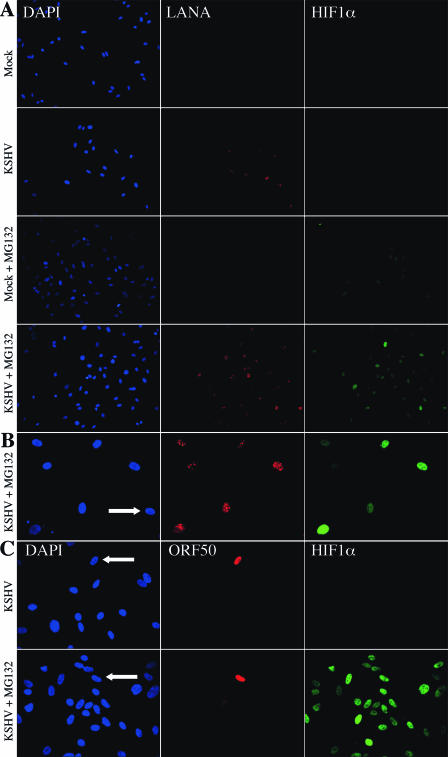
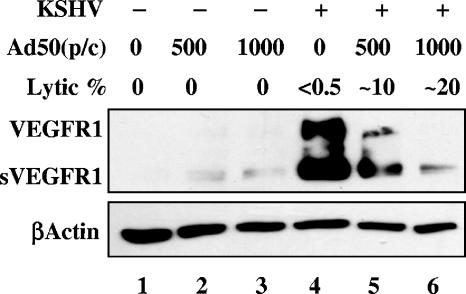
Kaposi's sarcoma-associated herpesvirus (KSHV or HHV-8) is the etiological agent of Kaposi's sarcoma, a highly vascularized, endothelial-derived tumor. A direct role for KSHV-mediated induction of angiogenesis has been proposed based upon the nature of the neoplasia and various KSHV gene overexpression and infection model systems. We have found that KSHV infection of endothelial cells induces mRNA of hypoxia-induced factor 1alpha (HIF1alpha) and HIF2alpha, two homologous alpha subunits of the heterodimeric transcription factor HIF. HIF is a master regulator of both developmental and pathological angiogenesis, composed of an oxygen-sensitive alpha subunit and a constitutively expressed beta subunit. HIF is classically activated posttranscriptionally with hypoxia, leading to increased protein stability of HIF1alpha and/or HIF2alpha. However, we demonstrate that both alpha subunits are up-regulated at the transcript level by KSHV infection. The transcriptional activation of HIF leads to a functional increase in HIF activity under normoxic conditions, as demonstrated by both luciferase reporter assay and the increased expression of vascular endothelial growth factor receptor 1 (VEGFR1), an HIF-responsive gene. KSHV infection synergizes with hypoxia mimics and induces higher expression levels of HIF1alpha and HIF2alpha protein, and HIF1alpha is increased in a significant proportion of the latently infected endothelial cells. Src family kinases are required for the activation of HIF and the downstream gene VEGFR1 by KSHV. We also show that KS lesions, in vivo, express elevated levels of HIF1alpha and HIF2alpha proteins. Thus, KSHV stimulates the HIF pathway via transcriptional up-regulation of both HIF alphas, and this activation may play a role in KS formation, localization, and progression.
Figures





References
-
- Bedogni, B., S. M. Welford, D. S. Cassarino, B. J. Nickoloff, A. J. Giaccia, and M. B. Powell. 2005. The hypoxic microenvironment of the skin contributes to Akt-mediated melanocyte transformation. Cancer Cells 8:443-454. - PubMed
-
- Blackbourn, D. J., S. Fujimura, T. Kutzkey, and J. A. Levy. 2000. Induction of human herpesvirus-8 gene expression by recombinant interferon gamma. AIDS 14:98-99. - PubMed
-
- Bosco, M. C., M. Puppo, S. Pastorino, Z. Mi, G. Melillo, S. Massazza, A. Rapisarda, and L. Varesio. 2004. Hypoxia selectively inhibits monocyte chemoattractant protein-1 production by macrophages. J. Immunol. 172:1681-1690. - PubMed
Publication types
MeSH terms
Substances
Grants and funding
LinkOut - more resources
Full Text Sources
Miscellaneous
