


Increased vancomycin MICs for Staphylococcus aureus clinical isolates from a university hospital during a 5-year period
- PMID: 16957043
- PMCID: PMC1698298
- DOI: 10.1128/JCM.01388-06
Increased vancomycin MICs for Staphylococcus aureus clinical isolates from a university hospital during a 5-year period
Abstract
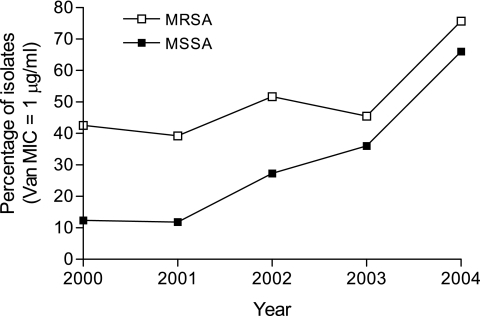
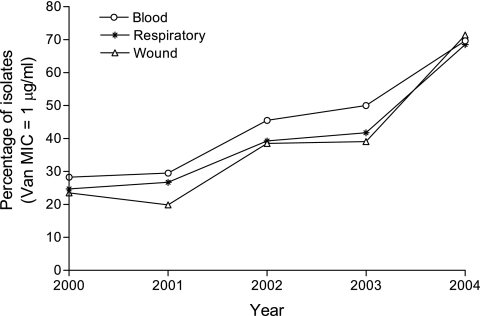
Staphylococcus aureus is one of the most commonly isolated organisms in nosocomial infections. While the prevalence of methicillin-resistant S. aureus (MRSA) continues to increase worldwide, there is concern about an increase in vancomycin MICs among S. aureus strains. The prevalence of MRSA and vancomycin MIC trends in S. aureus from patients in a university hospital were analyzed. Clinical Laboratory Standards Institute (CLSI, formerly NCCLS) reference broth microdilution MIC testing was performed on all clinically relevant S. aureus isolates from January 2000 through December 2004. A total of 6,003 S. aureus isolates were analyzed. No vancomycin-resistant S. aureus isolates were detected. One MRSA isolate had a vancomycin MIC of 8 mug/ml and was confirmed as vancomycin-intermediate S. aureus. Among the 6,002 remaining isolates, a shift in vancomycin MICs from </=0.5 to 1.0 mug/ml was observed during the 5-year period. The percentage of S. aureus isolates with a vancomycin MIC of 1 mug/ml in 2004 was significantly higher than the percentage of isolates in 2000 (70.4% versus 19.9%; P < 0.01). This vancomycin MIC shift was more notable in methicillin-susceptible S. aureus. Our 5 years of routine testing of clinical isolates using the CLSI reference broth microdilution MIC method demonstrated a tendency toward decreasing susceptibility to vancomycin in S. aureus.
Figures

References
-
- Biedenbach, D. J., G. J. Moet, and R. N. Jones. 2004. Occurrence and antimicrobial resistance pattern comparisons among bloodstream infection isolates from the SENTRY Antimicrobial Surveillance Program (1997-2002). Diagn. Microbiol. Infect. Dis. 50:59-69. - PubMed
-
- Cartolano, G. L., M. Cheron, D. Benabid, M. Leneveu, and A. Boisivon. 2004. Methicillin-resistant Staphylococcus aureus (MRSA) with reduced susceptibility to glycopeptides (GISA) in 63 French general hospitals. Clin. Microbiol. Infect. 10:448-451. - PubMed
-
- Centers for Disease Control and Prevention. 2002. Staphylococcus aureus resistant to vancomycin—United States, 2002. Morb. Mortal. Wkly. Rep. 51:565-567. - PubMed
-
- Centers for Disease Control and Prevention. 2002. Vancomycin-resistant Staphylococcus aureus—Pennsylvania, 2002. Morb. Mortal. Wkly. Rep. 51:902. - PubMed
-
- Centers for Disease Control and Prevention. 2004. Vancomycin-resistant Staphylococcus aureus—New York, 2004. Morb. Mortal. Wkly. Rep. 53:322-323. - PubMed
MeSH terms
Substances
LinkOut - more resources
Full Text Sources
Other Literature Sources
Medical
