


Pyrosequencing, a high-throughput method for detecting single nucleotide polymorphisms in the dihydrofolate reductase and dihydropteroate synthetase genes of Plasmodium falciparum
- PMID: 16957045
- PMCID: PMC1698350
- DOI: 10.1128/JCM.01209-06
Pyrosequencing, a high-throughput method for detecting single nucleotide polymorphisms in the dihydrofolate reductase and dihydropteroate synthetase genes of Plasmodium falciparum
Abstract
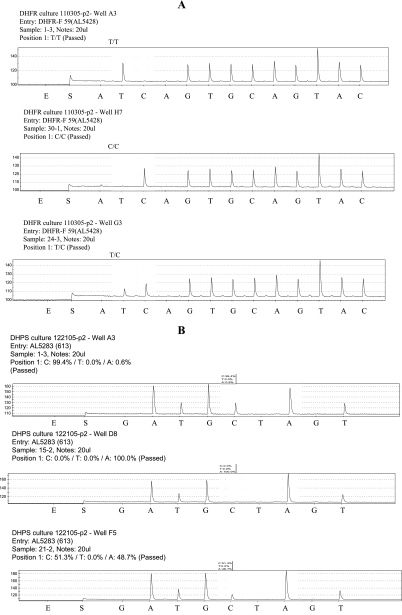
A pyrosequencing protocol was developed as a rapid and reliable method to identify the mutations of the dhfr and dhps genes of Plasmodium falciparum that are associated with antifolate resistance. The accuracy and specificity of this method were tested using six laboratory-cultured P. falciparum isolates harboring known single nucleotide polymorphisms (SNPs) in the genes dhfr (codons 50, 51, 59, 108, and 164) and dhps (codons 436, 437, 540, 581, and 613). The lowest threshold for detection of all the SNPs tested by pyrosequencing was the equivalent of two to four parasite genomes. Also, this method was highly specific for P. falciparum, as it did not amplify any DNA products from the other species of human malaria parasites. We also mixed wild-type and mutant-type parasite DNAs in various proportions to determine how pyrosequencing, restriction fragment length polymorphism (RFLP), and direct conventional sequencing (for dhfr) compared with each other in detecting different SNPs in the mixture. In general, pyrosequencing and RFLP showed comparable sensitivities in detecting most of the SNPs in dhfr except for the 164L mutation, which required at least twice the amount of DNA for pyroseqencing as for RFLP. For detecting SNPs in dhps, pyrosequencing was slightly more sensitive than RFLP and direct sequencing. Overall, pyrosequencing was faster and less expensive than either RFLP or direct sequencing. Thus, pyrosequencing is a practical alternative method that can be used in a high-throughput format for molecular surveillance of antimalarial-drug resistance.
Figures
References
-
- Abdel-Muhsin, A. M., L. C. Ranford-Cartwright, A. R. Medani, S. Ahmed, S. Suleiman, B. Khan, P. Hunt, D. Walliker, and H. A. Babiker. 2002. Detection of mutations in the Plasmodium falciparum dihydrofolate reductase (dhfr) gene by dot-blot hybridization. Am. J. Trop. Med. Hyg. 67:24-27. - PubMed
-
- Ahmadian, A., M. Ehn, and S. Hober. 2006. Pyrosequencing: history, biochemistry and future. Clin. Chim. Acta 363:83-94. - PubMed
-
- Ahmed, A., D. Bararia, S. Vinayak, M. Yameen, S. Biswas, V. Dev, A. Kumar, M. A. Ansari, and Y. D. Sharma. 2004. Plasmodium falciparum isolates in India exhibit a progressive increase in mutations associated with sulfadoxine-pyrimethamine resistance. Antimicrob. Agents Chemother. 48:879-889. - PMC - PubMed
-
- Alifrangis, M., S. Enosse, R. Pearce, C. Drakeley, C. Roper, I. F. Khalil, W. M. Nkya, A. M. Ronn, T. G. Theander, and I. C. Bygbjerg. 2005. A simple, high-throughput method to detect Plasmodium falciparum single nucleotide polymorphisms in the dihydrofolate reductase, dihydropteroate synthase, and P. falciparum chloroquine resistance transporter genes using polymerase chain reaction and enzyme-linked immunosorbent assay-based technology. Am. J. Trop. Med. Hyg. 72:155-162. - PubMed
-
- Anderson, T. J., and C. Roper. 2005. The origins and spread of antimalarial drug resistance: lessons for policy makers. Acta Trop. 94:269-280. - PubMed
Publication types
MeSH terms
Substances
LinkOut - more resources
Full Text Sources
Other Literature Sources
