. 2006 Sep 28;443(7110):448-52.
doi: 10.1038/nature05091. Epub 2006 Sep 6.

Increasing p16INK4a expression decreases forebrain progenitors and neurogenesis during ageing

Affiliations

Increasing p16INK4a expression decreases forebrain progenitors and neurogenesis during ageing

Anna V Molofsky et al. Nature. .

Abstract

Mammalian ageing is associated with reduced regenerative capacity in tissues that contain stem cells. It has been proposed that this is at least partially caused by the senescence of progenitors with age; however, it has not yet been tested whether genes associated with senescence functionally contribute to physiological declines in progenitor activity. Here we show that progenitor proliferation in the subventricular zone and neurogenesis in the olfactory bulb, as well as multipotent progenitor frequency and self-renewal potential, all decline with age in the mouse forebrain. These declines in progenitor frequency and function correlate with increased expression of p16INK4a, which encodes a cyclin-dependent kinase inhibitor linked to senescence. Ageing p16INK4a-deficient mice showed a significantly smaller decline in subventricular zone proliferation, olfactory bulb neurogenesis, and the frequency and self-renewal potential of multipotent progenitors. p16INK4a deficiency did not detectably affect progenitor function in the dentate gyrus or enteric nervous system, indicating regional differences in the response of neural progenitors to increased p16INK4a expression during ageing. Declining subventricular zone progenitor function and olfactory bulb neurogenesis during ageing are thus caused partly by increasing p16INK4a expression.


Figures
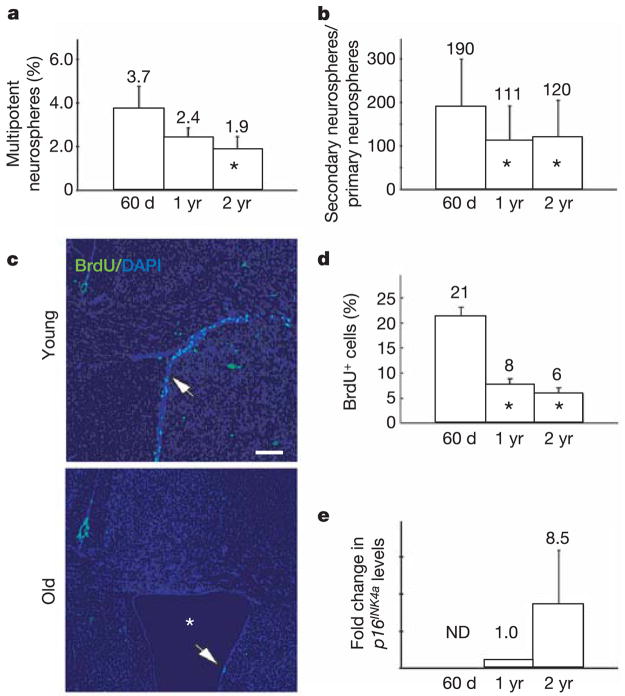
Figure 1
Figure 1. Neural progenitor function declines with age
a, The percentage of SVZ cells that formed multipotent neurospheres in culture declined with age (asterisk, P < 0.05 relative to 60-day-old mice; three independent experiments; 5–6 mice per age; error bars for all panels are ±s.d.). b, The self-renewal potential of these primary neurospheres also declined with age (asterisk, P < 0.05; three independent experiments; 5–6 mice per age). c, d, Proliferation in the SVZ (percentage of BrdU+ cells after a 2-h pulse) also declined significantly with age (three mice per age; 5–7 sections per mouse). The SVZ thinned in old mice (c, arrows), and the lateral ventricle expanded (asterisk) due to cortical atrophy (c, lateral ventricle is not visible at this magnification in young mice; scale bar, 200μm). e, p16INK4a mRNA expression increased with age as detected by quantitative (real-time) PCR in uncultured SVZ cells (three independent samples per age). Note that 1-yr-old samples were set to 1.0 as the reference sample. ND, not detected.
Figure 2
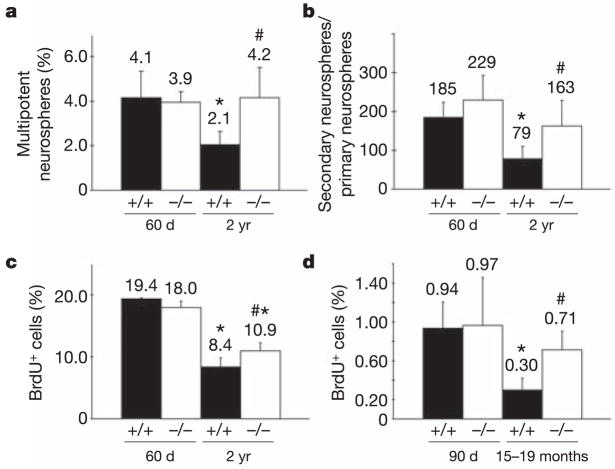
Figure 2. p16INK4a causes age-related declines in stem and progenitor cell function in the SVZ
a, The percentage of SVZ cells that formed multipotent neurospheres in culture significantly declined in 2-yr-old wild-type mice as compared with 60-day-old mice (asterisk, P < 0.01) but significantly increased in old mice with p16INK4a deficiency (hash, P < 0.01 relative to old wild-type mice). b, Self-renewal potential (the number of secondary neurospheres generated per subcloned primary neurosphere) significantly declined in old wild-type mice as compared to young mice (asterisk, P < 0.05). p16INK4a deficiency significantly increased the self-renewal of neurospheres from old but not young mice (hash, P < 0.05 relative to old wild-type mice). c, The percentage of SVZ cells that incorporated a 2-h pulse of BrdU significantly declined in old as compared to young mice (asterisk, P < 0.01), but significantly increased in old mice with p16INK4a deficiency (hash, P < 0.01 relative to old wild-type mice). d, The frequency of BrdU label-retaining cells in the SVZ significantly declined in old wild-type mice as compared with young wild-type mice (asterisk, P < 0.05), but significantly increased in old mice with p16INK4a deficiency (hash, P < 0.05 relative to old wild-type mice). All values are mean ± s.d. for at least three independent experiments. All mice were histologically negative for intracranial neoplasms.
Figure 3
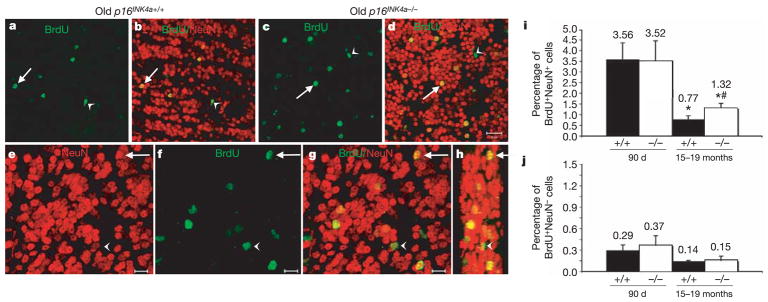
Figure 3. p16INK4a causes age-related declines in olfactory bulb neurogenesis
a–d, Low-magnification images (scale bar, 20μm) from sagittal sections of the olfactory bulb of old wild-type (a, b; same field of view) and p16INK4a-deficient (c, d; same field of view) mice. Arrows point to new neurons in the granular layer (BrdU+NeuN+) whereas arrowheads point to new non-neuronal cells (BrdU+NeuN). e–h, Higher magnification images (scale bar, 10μm) from one field of view from an old p16INK4a-deficient mouse. Arrow indicates BrdU+NeuN+ neuron; arrowhead indicates BrdUþNeuN non-neuronal cell. Panel h is a three-dimensional, reconstructed side view (80° turn in the z-axis) of panel g. i, Neurogenesis significantly (asterisk, P < 0.05) declined with age (BrdU+NeuN+ neurons as a percentage of all NeuN+ neurons). p16INK4a deficiency did not affect the level of neurogenesis in young mice, but significantly (hash, P = 0.02 relative to old wild-type mice) increased neurogenesis in old mice. j, The frequency of BrdU+NeuN non-neuronal cells was not significantly affected by p16INK4a deficiency (also as a percentage of NeuN+ neurons). The same trends were observed when the counts were expressed per unit area (not shown). Values are mean ± s.d. from 25 to 30 fields of view per mouse, three mice per treatment.

Comment in

References

    1. Chien KR, Karsenty G. Longevity and lineages: toward the integrative biology of degenerative diseases in heart, muscle, and bone. Cell. 2005;120:533–544. - PubMed
    1. Geiger H, Van Zant G. The aging of lympho-hematopoietic stem cells. Nature Immunol. 2002;3:329–333. - PubMed
    1. Lombard DB, et al. DNA repair, genome stability, and aging. Cell. 2005;120:497–512. - PubMed
    1. Campisi J. Senescent cells, tumor suppression, and organismal aging: good citizens, bad neighbors. Cell. 2005;120:513–522. - PubMed
    1. Lowe SW, Sherr CJ. Tumor suppression by Ink4a–Arf: progress and puzzles. Curr Opin Genet Dev. 2003;13:77–83. - PubMed

Publication types

MeSH terms

Substances