


Dopamine efflux in the nucleus accumbens during within-session extinction, outcome-dependent, and habit-based instrumental responding for food reward
- PMID: 16960698
- PMCID: PMC1820758
- DOI: 10.1007/s00213-006-0526-9
Dopamine efflux in the nucleus accumbens during within-session extinction, outcome-dependent, and habit-based instrumental responding for food reward
Abstract
Rationale: Dopamine (DA) activity in the nucleus accumbens (NAc) is related to the general motivational effects of rewarding stimuli. Dickinson and colleagues have shown that initial acquisition of instrumental responding reflects action-outcome relationships based on instrumental incentive learning, which establishes the value of an outcome. Given that the sensitivity of responding to outcome devaluation is not affected by NAc lesions, it is unlikely that incentive learning during the action-outcome phase is mediated by DA activity in the NAc.
Objectives: DA efflux in the NAc after limited and extended training was compared on the assumption that comparable changes would be observed during both action-outcome- and habit-based phases of instrumental responding for food. This study also tested the hypothesis that increase in NAc DA activity is correlated with instrumental responding during extinction maintained by a conditioned stimulus paired with food.
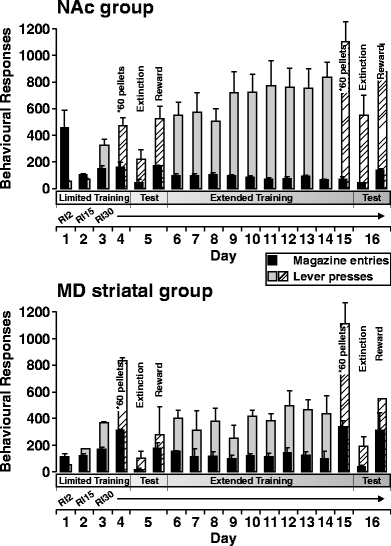
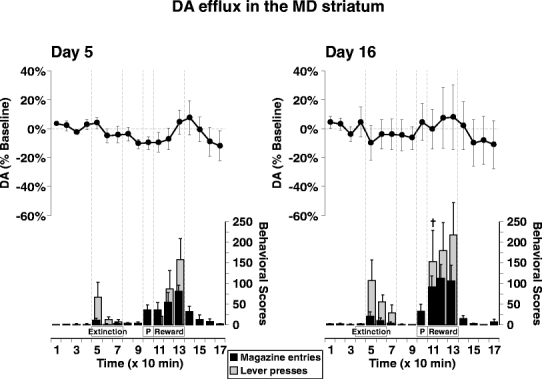
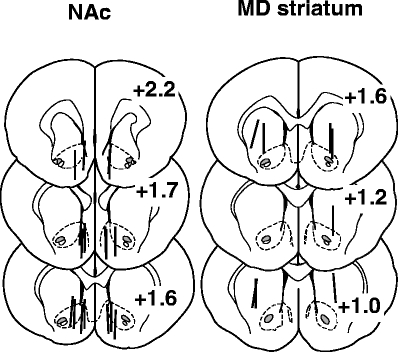
Methods: Rats were trained to lever press for food (random-interval 30 s schedule). On the 5th and 16th day of training, microdialysis samples were collected from the NAc or mediodorsal striatum (a control site for generalized activity) during instrumental responding in extinction and then for food reward, and analyzed for DA content using high performance liquid chromatography.
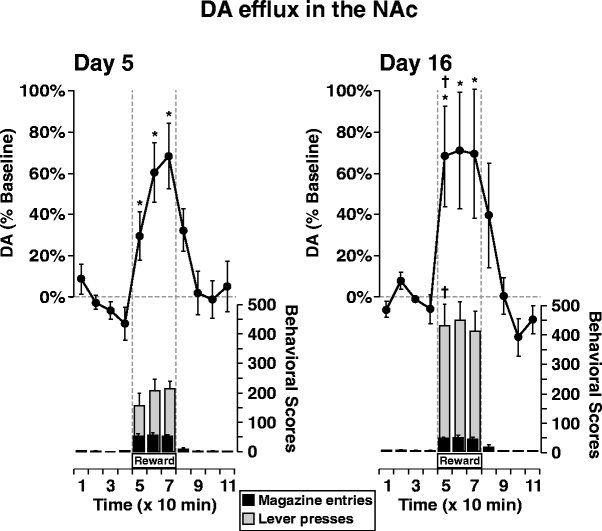
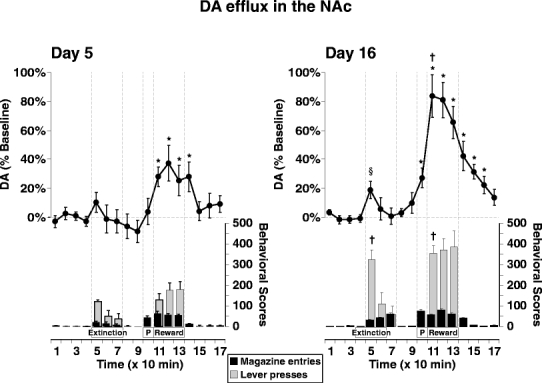
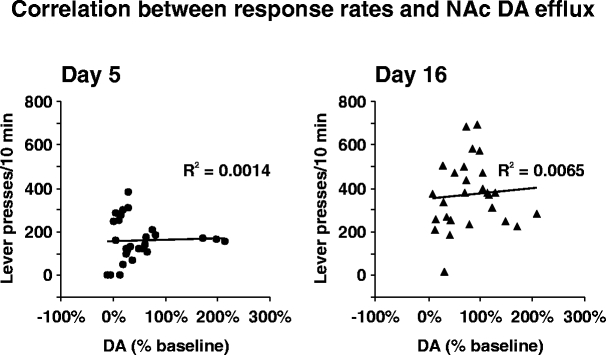
Results: Increase in DA efflux in the NAc accompanied responding for food pellets on both days 5 and 16, with the magnitude of increase significantly enhanced on day 16. DA efflux was also significantly elevated during responding in extinction only on day 16.
Conclusions: These results support a role for NAc DA activity in Pavlovian, but not instrumental, incentive learning.
Figures
References
-
- None
- Adams CD, Dickinson A (1981) Instrumental responding following reinforcer devaluation. Q J Exp Psychol 33B:109–122
-
- {'text': '', 'ref_index': 1, 'ids': [{'type': 'PMC', 'value': 'PMC6782999', 'is_inner': False, 'url': 'https://pmc.ncbi.nlm.nih.gov/articles/PMC6782999/'}, {'type': 'PubMed', 'value': '10493774', 'is_inner': True, 'url': 'https://pubmed.ncbi.nlm.nih.gov/10493774/'}]}
- Ahn S, Phillips AG (1999) Dopaminergic correlates of sensory-specific satiety in the medial prefrontal cortex and nucleus accumbens of the rat. J Neurosci 19:RC29 - PMC - PubMed
-
- {'text': '', 'ref_index': 1, 'ids': [{'type': 'PMC', 'value': 'PMC6758436', 'is_inner': False, 'url': 'https://pmc.ncbi.nlm.nih.gov/articles/PMC6758436/'}, {'type': 'PubMed', 'value': '12486191', 'is_inner': True, 'url': 'https://pubmed.ncbi.nlm.nih.gov/12486191/'}]}
- Ahn S, Phillips AG (2002) Modulation by central and basolateral amygdalar nuclei of dopaminergic correlates of feeding to satiety in the rat nucleus accumbens and medial prefrontal cortex. J Neurosci 22:10958–10965 - PMC - PubMed
-
- {'text': '', 'ref_index': 1, 'ids': [{'type': 'PubMed', 'value': '1475401', 'is_inner': True, 'url': 'https://pubmed.ncbi.nlm.nih.gov/1475401/'}]}
- Balleine B, Dickinson A (1992) Signalling and incentive processes in instrumental reinforcer devaluation. Q J Exp Psychol B 45:285–301 - PubMed
-
- {'text': '', 'ref_index': 1, 'ids': [{'type': 'DOI', 'value': '10.1016/0166-4328(94)90104-X', 'is_inner': False, 'url': 'https://doi.org/10.1016/0166-4328(94)90104-x'}, {'type': 'PubMed', 'value': '7718151', 'is_inner': True, 'url': 'https://pubmed.ncbi.nlm.nih.gov/7718151/'}]}
- Balleine B, Killcross S (1994) Effects of ibotenic acid lesions of the nucleus accumbens on instrumental action. Behav Brain Res 65:181–193 - PubMed
Publication types
MeSH terms
Substances
LinkOut - more resources
Full Text Sources
Other Literature Sources
