. 2006;7(9):R82.
doi: 10.1186/gb-2006-7-9-r82.

Multiplatform genome-wide identification and modeling of functional human estrogen receptor binding sites

Affiliations

Multiplatform genome-wide identification and modeling of functional human estrogen receptor binding sites

Vinsensius B Vega et al. Genome Biol. 2006.

Abstract

Background: Transcription factor binding sites (TFBS) impart specificity to cellular transcriptional responses and have largely been defined by consensus motifs derived from a handful of validated sites. The low specificity of the computational predictions of TFBSs has been attributed to ubiquity of the motifs and the relaxed sequence requirements for binding. We posited that the inadequacy is due to limited input of empirically verified sites, and demonstrated a multiplatform approach to constructing a robust model.

Results: Using the TFBS for the estrogen receptor (ER)alpha (estrogen response element [ERE]) as a model system, we extracted EREs from multiple molecular and genomic platforms whose binding to ERalpha has been experimentally confirmed or rejected. In silico analyses revealed significant sequence information flanking the standard binding consensus, discriminating ERE-like sequences that bind ERalpha from those that are nonbinders. We extended the ERE consensus by three bases, bearing a terminal G at the third position 3' and an initiator C at the third position 5', which were further validated using surface plasmon resonance spectroscopy. Our functional human ERE prediction algorithm (h-ERE) outperformed existing predictive algorithms and produced fewer than 5% false negatives upon experimental validation.

Conclusion: Building upon a larger experimentally validated ERE set, the h-ERE algorithm is able to demarcate better the universe of ERE-like sequences that are potential ER binders. Only 14% of the predicted optimal binding sites were utilized under the experimental conditions employed, pointing to other selective criteria not related to EREs. Other factors, in addition to primary nucleotide sequence, will ultimately determine binding site selection.


Figures
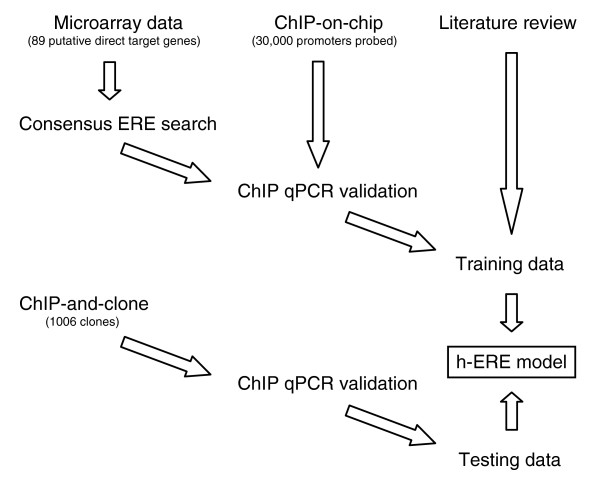
Figure 1
Figure 1
Schematics of ERE discovery and validation for model training and testing. ERE, estrogen response element; ChIP, chromatin immunoprecipitation; qPCR, quantitative polymerase chain reaction.
Figure 2
Figure 2
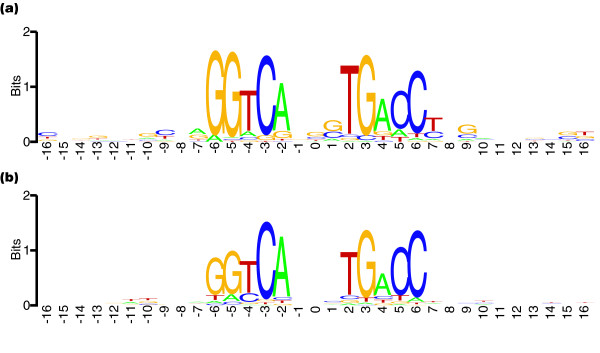
Sequence logos. Shown are sequence logos for (a) the 45 ER-binding loci with 10 bp flanking sequences and (b) 58 ER nonbinding loci with 10 bp flanking sequences. The logo for the binders exhibited additional signal at the third bases upstream and downstream of the core palindromic ERE. bp, base pairs; ER, estrogen receptor; ERE, estrogen response element.
Figure 3
Figure 3
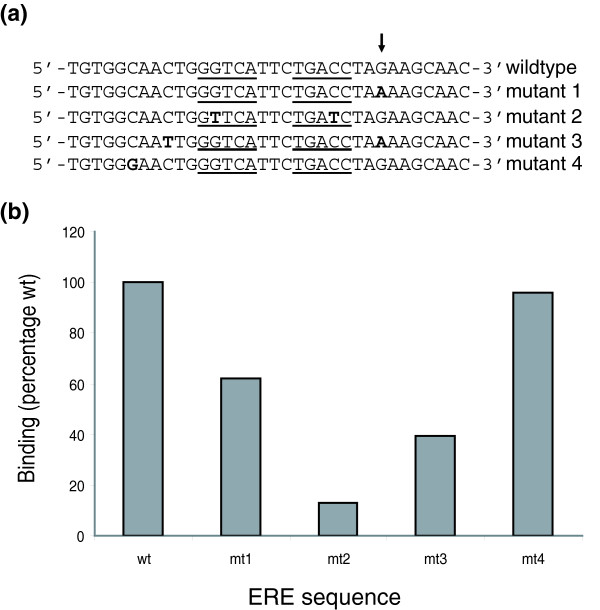
Substitution of the conserved guanine outside of the canonical ERE disrupts ER binding. (a) Interactions between ER and wild-type and mutant EREs were measured by SPR. The canonical ERE is underlined, and the conserved guanine is indicated by an arrow. Base substitutions are indicated in bold. (b) Binding of ER to ERE is indicated as a percentage of binding relative to the wild-type sequence. ER, estrogen receptor; ERE, estrogen response element; SPR, surface plasmon resonance.
Figure 4
Figure 4
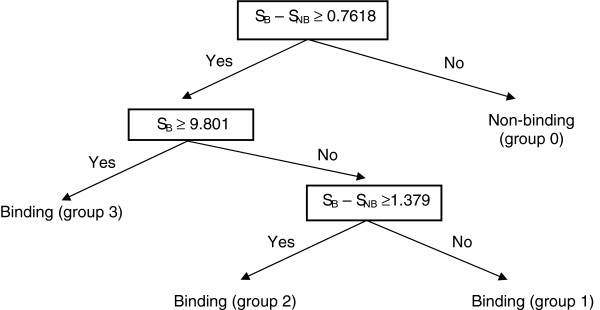
Decision tree for ERE prediction. Group 3 EREs would be predicted to be the highest likelihood binders of ER. ER, estrogen receptor; ERE, estrogen response element; SB, binding score; SNB, nonbinding score.

References

    1. Nilsson S, Gustafsson J-Å. Estrogen receptor action. Crit Rev Eukaryot Gene Expr. 2002;12:237–257. doi: 10.1615/CritRevEukaryotGeneExpr.v12.i4.10. - DOI - PubMed
    1. Klein-Hitpass L, Ryffel GU, Heitlinger E, Cato AC. A 13 bp palindrome is a functional estrogen responsive element and interacts specifically with estrogen receptor. Nucleic Acids Res. 1988;16:647–663. - PMC - PubMed
    1. Klein-Hitpass L, Schorpp M, Wagner U, Ryffel GU. An estrogen-responsive element derived from the 5' flanking region of the Xenopus vitellogenin A2 gene functions in transfected human cells. Cell. 1986;46:1053–1061. doi: 10.1016/0092-8674(86)90705-1. - DOI - PubMed
    1. Klinge CM. Estrogen receptor interaction with estrogen response elements. Nucleic Acids Res. 2001;29:2905–2919. doi: 10.1093/nar/29.14.2905. - DOI - PMC - PubMed
    1. Stormo GD, Hartzell GW., 3rd Identifying protein-binding sites from unaligned DNA fragments. Proc Natl Acad Sci USA. 1989;86:1183–1187. doi: 10.1073/pnas.86.4.1183. - DOI - PMC - PubMed

Substances

LinkOut - more resources