


Kinetic and structural insight into the mechanism of BphD, a C-C bond hydrolase from the biphenyl degradation pathway
- PMID: 16964968
- PMCID: PMC2519953
- DOI: 10.1021/bi0611098
Kinetic and structural insight into the mechanism of BphD, a C-C bond hydrolase from the biphenyl degradation pathway
Abstract
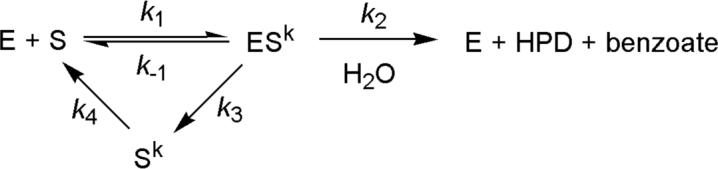
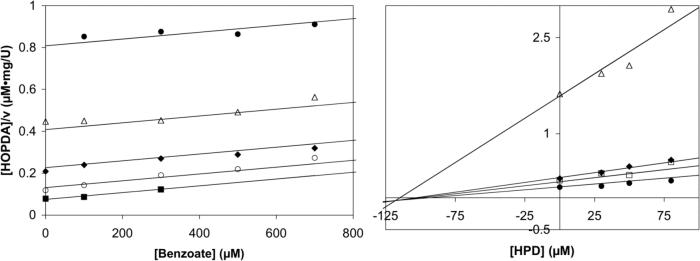
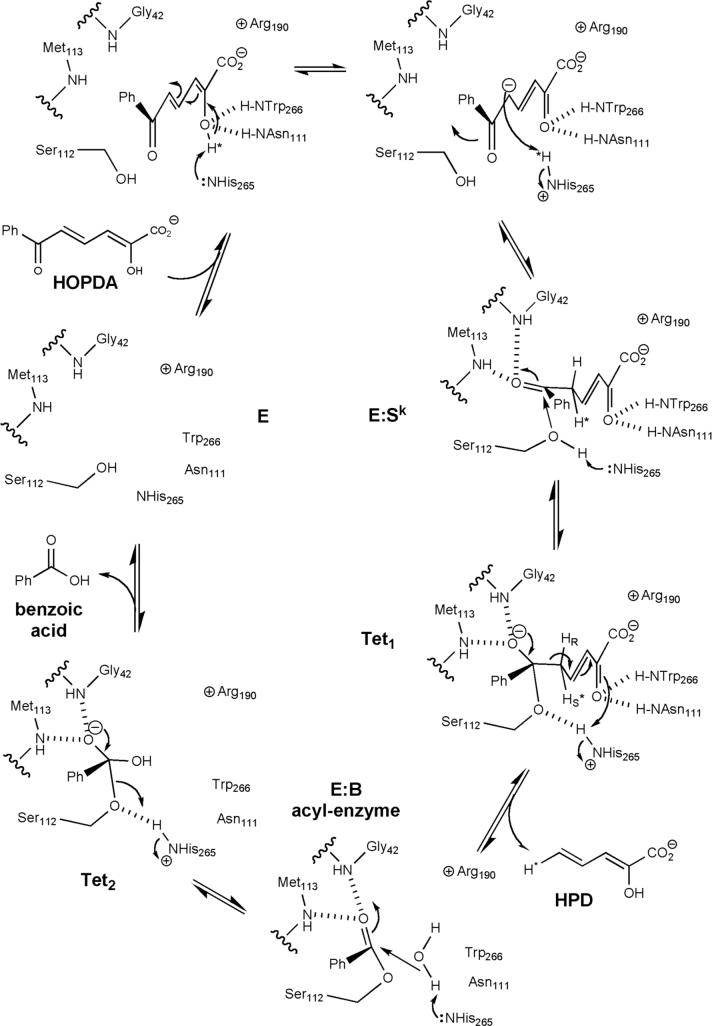
Kinetic and structural analyses of 2-hydroxy-6-oxo-6-phenylhexa-2,4-dienoic acid (HOPDA) hydrolase from Burkholderia xenovorans LB400 (BphD(LB400)) provide insight into the catalytic mechanism of this unusual serine hydrolase. Single turnover stopped-flow analysis at 25 degrees C showed that the enzyme rapidly (1/tau(1) approximately 500 s(-1)) transforms HOPDA (lambda(max) = 434 nm) into a species with electronic absorption maxima at 473 and 492 nm. The absorbance of this enzyme-bound species (E:S) decayed in a biphasic manner (1/tau(2) = 54 s(-1), 1/tau(3) = 6 s(-1) approximately k(cat)) with simultaneous biphasic appearance (48 and 8 s(-1)) of an absorbance band at 270 nm characteristic of one of the products, 2-hydroxypenta-2,4-dienoic acid (HPD). Increasing solution viscosity with glycerol slowed 1/tau(1) and 1/tau(2) but affected neither 1/tau(3) nor k(cat), suggesting that 1/tau(2) may reflect diffusive HPD dissociation, and 1/tau(3) represents an intramolecular event. Product inhibition studies suggested that the other product, benzoate, is released after HPD. Contrary to studies in a related hydrolase, we found no evidence that ketonized HOPDA is partially released prior to hydrolysis, and, therefore, postulate that the biphasic kinetics reflect one of two mechanisms, pending assignment of E:S (lambda(max) = 492 nm). The crystal structures of the wild type, the S112C variant, and S112C incubated with HOPDA were each determined to 1.6 A resolution. The latter reveals interactions between conserved active site residues and the dienoate moiety of the substrate. Most notably, the catalytic residue His265 is hydrogen-bonded to the 2-hydroxy/oxo substituent of HOPDA, consistent with a role in catalyzing ketonization. The data are more consistent with an acyl-enzyme mechanism than with the formation of a gem-diol intermediate.
Figures






References
-
- Dagley S. Biochemical approach to some problems of environmental pollution. Essays Biochem. 1975;11:81–138. - PubMed
-
- Pieper DH. Aerobic degradation of polychlorinated biphenyls. Appl. Microbiol. Biotechnol. 2005;67:170–191. - PubMed
-
- Seah SYK, Labbé G, Nerdinger S, Johnson MR, Snieckus V, Eltis LD. Identification of a serine hydrolase as a key determinant in the microbial degradation of polychlorinated biphenyls. J. Biol. Chem. 2000;275:15701–15708. - PubMed
-
- Ohtsubo Y, Kudo T, Tsuda M, Nagata Y. Strategies for bioremediation of polychlorinated biphenyls. Appl. Microbiol. Biotechnol. 2004;65:250–258. - PubMed
Publication types
MeSH terms
Substances
Grants and funding
LinkOut - more resources
Full Text Sources
Molecular Biology Databases
Research Materials
Miscellaneous
