. 2006 Sep 19;103(38):13950-5.
doi: 10.1073/pnas.0606312103. Epub 2006 Sep 11.

Molecular switch for alternative conformations of the HIV-1 V3 region: implications for phenotype conversion

Affiliations

Molecular switch for alternative conformations of the HIV-1 V3 region: implications for phenotype conversion

Osnat Rosen et al. Proc Natl Acad Sci U S A. .

Abstract

HIV-1 coreceptor usage plays a critical role in virus tropism and pathogenesis. A switch from CCR5- to CXCR4-using viruses occurs during the course of HIV-1 infection and correlates with subsequent disease progression. A single mutation at position 322 within the V3 loop of the HIV-1 envelope glycoprotein gp120, from a negatively to a positively charged residue, was found to be sufficient to switch an R5 virus to an X4 virus. In this study, the NMR structure of the V3 region of an R5 strain, HIV-1(JR-FL), in complex with an HIV-1-neutralizing antibody was determined. Positively charged and negatively charged residues at positions 304 and 322, respectively, oppose each other in the beta-hairpin structure, enabling a favorable electrostatic interaction that stabilizes the postulated R5 conformation. Comparison of the R5 conformation with the postulated X4 conformation of the V3 region (positively charged residue at position 322) reveals that electrostatic repulsion between residues 304 and 322 in X4 strains triggers the observed one register shift in the N-terminal strand of the V3 region. We posit that electrostatic interactions at the base of the V3 beta-hairpin can modulate the conformation and thereby influence the phenotype switch. In addition, we suggest that interstrand cation-pi interactions between positively charged and aromatic residues induce the switch to the X4 conformation as a result of the S306R mutation. The existence of three pairs of identical (or very similar) amino acids in the V3 C-terminal strand facilitates the switch between the R5 and X4 conformations.


Conflict of interest statement

The authors declare no conflict of interest.

Figures
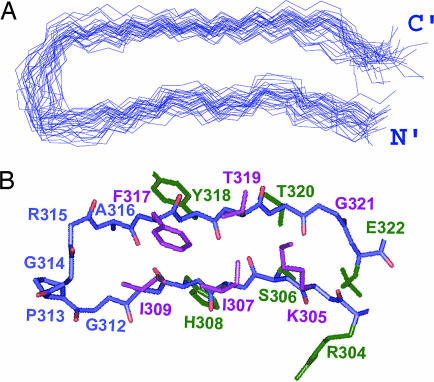
Fig. 1.
Fig. 1.
Solution structure of a V3JR-FL peptide bound to the 447-52D Fv. (A) Backbone superposition of the 30 lowest-energy structures of 304–322gp120JR-FL. (B) Stick representation of 304–322gp120JR-FL bound to the 447-52D Fv. Side chains pointing out from the page are colored purple, side chains pointing inward are colored green, and side chains of the loop residues are colored blue.
Fig. 2.
Fig. 2.
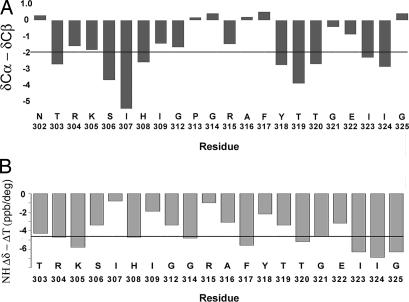
The difference between the deviations of δCα and δCβ from random coil values (ΔCα-ΔCβ) and temperature coefficients for each of the V3JR-FL residues. (A) (ΔCα-ΔCβ) are represented by vertical bars. The horizontal line denotes a threshold value of −2 ppm. Consecutive residues with values less than −2 ppm indicate existence of a β-strand conformation (8). (B) The temperature coefficients of each residue are displayed as bars. The horizontal line represents a threshold value of −4.6 ppb/K. Values greater than −4.6 ppb/K are indicative of protection from solvent exchange. Residues N302 and P313 are not included in B.
Fig. 3.
Fig. 3.
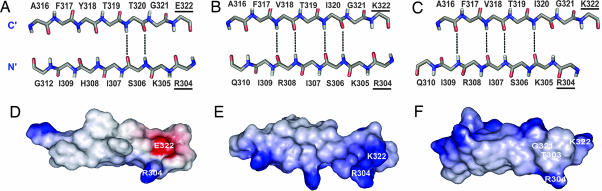
The influence of the sequence and residue-pairing in the V3 β-hairpin on the electrostatic potential at the base of the hairpin. (A) The residue pairing and hydrogen bonds in the schematic structure of V3JR-FL bound to 447-52D Fv. (B) The residue pairing and hydrogen bonds in the schematic structure of the V3IIIB bound to the 447-52D Fv. (C) The residue pairing and hydrogen bonds in V3IIIB bound to 0.5β Fv. Hydrogen bonds are indicated by black dashed lines. (DF) Electrostatic potential map calculated by the DELPHI program in different V3 structures: V3JR-FL bound to 447-52D Fv (D) and V3IIIB bound to 447-52D Fv (E). Residues R304 and K322 were modeled according to the conformation of V3JR-FL bound to 447-52D Fv (the R5 conformation of V3). (F) V3IIIB bound to 0.5β Fv; residues T303 and K322, not included in the NMR structure, were modeled. The charged residues involved in the switch between the R5 and X4 conformation are underlined. Positive potential is shown in blue, and negative potential is shown in red.
Fig. 4.
Fig. 4.
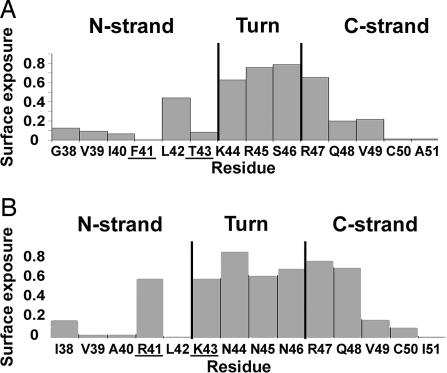
Surface exposure of the β2-β3 hairpin in macrophage inflammatory protein (MIP) 1α (A) and SDF-1 (B). Surface exposure was calculated by using the 3D structures of these proteins [PDB ID codes 1B52 and 1SDF, respectively (20, 21)].
Fig. 5.
Fig. 5.
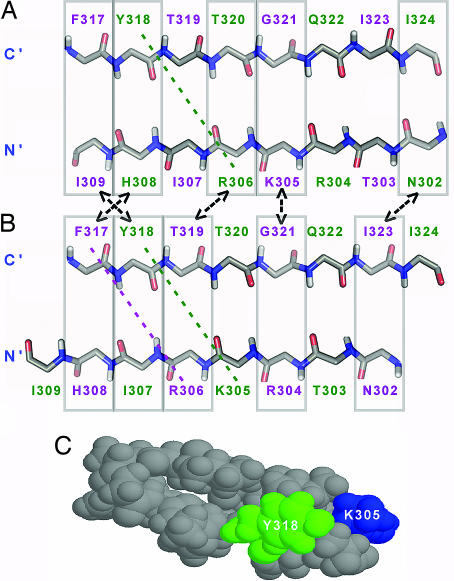
A V3 conformational switch that enhances interstrand cation-π interactions explains phenotype conversion associated with the S306R mutation. Schematic representations of the two suggested β-hairpin structures of R5 (A) and X4 (B) are shown. The presented structures have two point mutations, S306R and E322Q, that according to the 11/25 rule switch the R5 to an X4 conformation (2). Possible diagonal cation-π interactions in the suggested conformations are marked by diagonal colored dashed lines. Similar interstrand pairs are marked by rectangles connected by two-headed arrows. Residues pointing out of the page are purple; residues pointing inward are colored green. (C) CPK representation of the structure of the V3MN peptide bound to the 447-52DFv (6) showing diagonal side-chain–side-chain interactions between residue Y318 (green) and K305 (blue).

References

    1. Dittmar MT, McKnight A, Simmons G, Clapham PR, Weiss RA, Simmonds P. Nature. 1997;385:495–496. - PubMed
    1. Fouchier RA, Groenink M, Kootstra NA, Tersmette M, Huisman HG, Miedema F, Schuitemaker H. J Virol. 1992;66:3183–3187. - PMC - PubMed
    1. De Jong JJ, De Ronde A, Keulen W, Tersmette M, Goudsmit J. J Virol. 1992;66:6777–6780. - PMC - PubMed
    1. Resch W, Hoffman N, Swanstrom R. Virology. 2001;288:51–62. - PubMed
    1. Matsushita S, Maeda H, Kimachi K, Eda Y, Maeda Y, Murakami T, Tokiyoshi S, Takatsuki K. AIDS Res Hum Retroviruses. 1992;8:1107–1115. - PubMed

Publication types

MeSH terms