. 2006 Sep 19;103(38):13997-4002.
doi: 10.1073/pnas.0606236103. Epub 2006 Sep 12.

A molecular mechanism for osmolyte-induced protein stability

Affiliations

A molecular mechanism for osmolyte-induced protein stability

Timothy O Street et al. Proc Natl Acad Sci U S A. .

Erratum in

  • Proc Natl Acad Sci U S A. 2006 Nov 7;103(45):17064

Abstract

Osmolytes are small organic compounds that affect protein stability and are ubiquitous in living systems. In the equilibrium protein folding reaction, unfolded (U) native (N), protecting osmolytes push the equilibrium toward N, whereas denaturing osmolytes push the equilibrium toward U. As yet, there is no universal molecular theory that can explain the mechanism by which osmolytes interact with the protein to affect protein stability. Here, we lay the groundwork for such a theory, starting with a key observation: the transfer free energy of protein backbone from water to a water/osmolyte solution, Deltagtr, is negatively correlated with an osmolyte's fractional polar surface area. Deltagtr measures the degree to which an osmolyte stabilizes a protein. Consequently, a straightforward interpretation of this correlation implies that the interaction between the protein backbone and osmolyte polar groups is more favorable than the corresponding interaction with nonpolar groups. Such an interpretation immediately suggests the existence of a universal mechanism involving osmolyte, backbone, and water. We test this idea by using it to construct a quantitative solvation model in which backbone/solvent interaction energy is a function of interactant polarity, and the number of energetically equivalent ways of realizing a given interaction is a function of interactant surface area. Using this model, calculated Deltagtr values show a strong correlation with measured values (R = 0.99). In addition, the model correctly predicts that protecting/denaturing osmolytes will be preferentially excluded/accumulated around the protein backbone. Taken together, these model-based results rationalize the dominant interactions observed in experimental studies of osmolyte-induced protein stabilization and denaturation.


Conflict of interest statement

The authors declare no conflict of interest.

Figures

Fig. 1.
Fig. 1.
Molecular structures of osmolytes. Protecting osmolytes are TMAO, betaine, sucrose, trehalose, sarcosine, sorbitol, proline, and glycerol (AH), and denaturants are urea and guanidine (JK). Compounds are ordered by their measured Δgtr values (see Table 1), shown in space-filling representations and color-coded by atom type: oxygen (red), nitrogen (blue), and carbon (green). Water polarity is represented by its surface electrostatic potential (I, Upper), using a color saturation scale that runs from −0.07 (red) to 0.11 (blue) e/Å; white indicates neutral potential. The water surface is partitioned into discrete positive (red), negative (blue), and neutral (white) surfaces (I, Lower) using electrostatic potential cutoffs described in Methods.
Fig. 2.
Fig. 2.
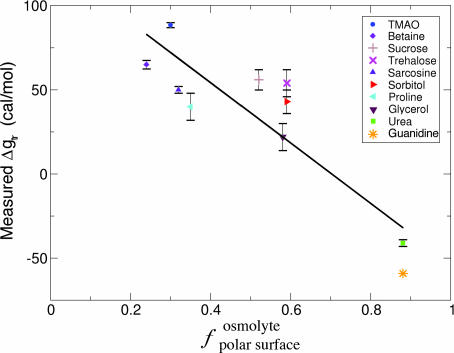
The polar fraction of osmolyte surface correlates with measured Δgtr values. Fractional polar SA, fpolar surfaceosmolyte, is plotted against Δgtr values from Table 1 for the 10 osmolytes in Fig. 1. The linear regression line (solid line) has a negative slope with a correlation coefficient of 0.88, indicating that backbone/osmolyte interactions become increasingly favorable as osmolytes become increasingly polar.
Fig. 3.
Fig. 3.
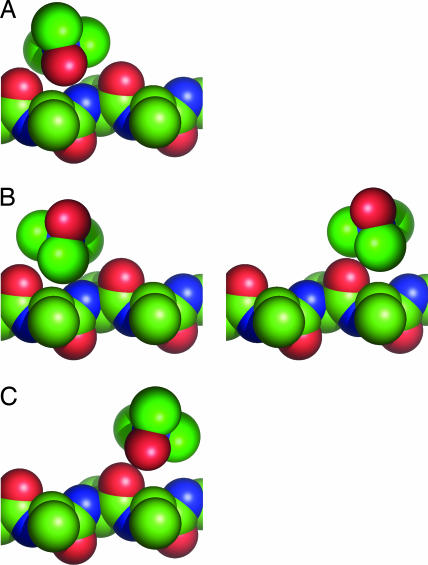
Illustrating TMAO/backbone interactions. Interactions between an osmolyte, such as TMAO (upper molecule), and the protein backbone (lower structure) can be favorable, neutral, or unfavorable. Favorable interactions are between groups of opposite charge (A), neutral interactions involve at least one nonpolar group (B), and unfavorable interactions are between groups of like charge (C). Atoms are color-coded as in Fig. 1. A large fraction of the TMAO surface is nonpolar, affording more opportunities (i.e., a higher degeneracy) for this osmolyte to realize neutral interactions than either favorable or unfavorable interactions.
Fig. 4.
Fig. 4.
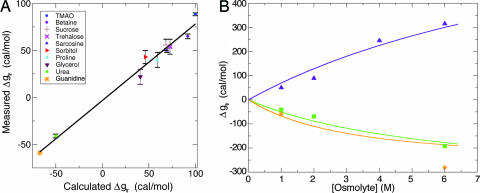
Comparison between calculated and measured Δgtr values for osmolytes. (A) Δgtr values, calculated from the model, are plotted against experimentally determined values from Table 1. Good agreement is apparent. The linear regression line (solid line) is given by Δgtrmeasured = 0.81 Δgtrcalculated − 3.2, with correlation coefficient 0.99. Data points corresponding to the 10 osmolytes in Fig. 1 are annotated in Inset. (B) Calculated Δgtr values on higher osmolyte concentrations (>1 M) are plotted against available experimental data for sarcosine (indigo triangles), urea (green squares), and guanidine (orange asterisks). Solid lines were drawn from model-based Δgtr values, extended beyond 1 M osmolyte concentrations.
Fig. 5.
Fig. 5.
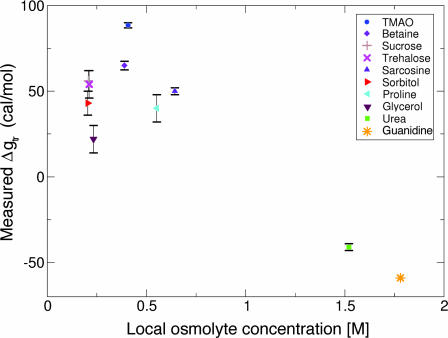
Protecting/denaturing osmolytes are preferentially depleted/accumulated at the protein backbone. Concentration of osmolyte around the backbone in a 1 M osmolyte solution plotted against measured Δgtr values from Table 1. Data points corresponding to the 10 osmolytes in Fig. 1 are annotated in Inset. The local osmolyte concentration is given by the scaled difference between 〈Opref〉 and 〈Obulk〉, described in Methods. It is apparent that the backbone concentration of protecting osmolytes (Δgtr > 0) is comparatively depleted ([osmolyte] < 1.0 M), whereas that of denaturing osmolytes (Δgtr < 0) is comparatively enriched ([osmolyte] > 1.0 M).

References

    1. Wu H. Chinese J Physiol V. 1931:321–344.
    1. Mirsky AE, Pauling L. Proc Natl Acad Sci USA. 1936;22:439–447. - PMC - PubMed
    1. Schellman JA. Biophys Chem. 2002;96:91–101. - PubMed
    1. Yancey PH, Clark ME, Hand SC, Bowlus RD, Somero GN. Science. 1982;217:1214–1222. - PubMed
    1. Record MT, Jr, Courtenay ES, Cayley DS, Guttman HJ. Trends Biochem Sci. 1998;23:143–148. - PubMed

Publication types

LinkOut - more resources