


Randomised study of adjuvant chemotherapy for completely resected p-stage I-IIIA non-small cell lung cancer
- PMID: 16969350
- PMCID: PMC2360551
- DOI: 10.1038/sj.bjc.6603336
Randomised study of adjuvant chemotherapy for completely resected p-stage I-IIIA non-small cell lung cancer
Abstract
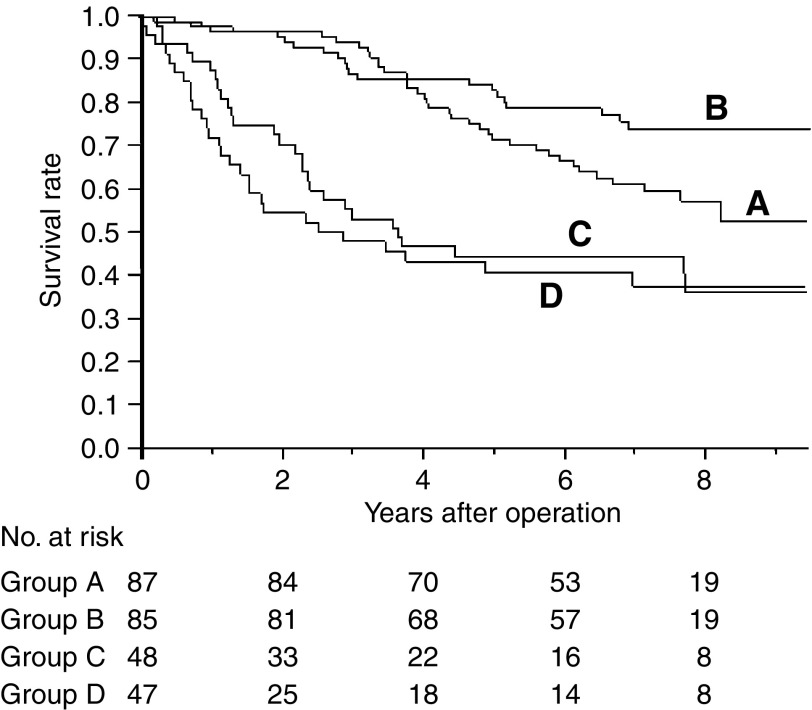
We evaluated the therapeutic usefulness of adjuvant chemotherapy in patients with completely resected non-small cell lung cancer (NSCLC). We also examined the relation between DNA ploidy pattern and the response to chemotherapy. A total of 267 patients with NSCLC (pathologically documented stage I, II, or IIIA) underwent complete resection, and DNA ploidy pattern was analysed. Patients with stage I disease (n=172) were randomly assigned to receive surgery alone (group A) or surgery followed by adjuvant chemotherapy (UFT (oral anti-cancer drug, a combination of Uracil and Tegaful) 400 mg day-1 for 1 year after surgery; group B). Stage II or IIIA disease patients (n=95) were randomly assigned to surgery alone (group C) or surgery followed by chemotherapy (two 28-day courses of cisplatin 80 mg m-2 on day 1 plus vindesine 3 mg m-2 on days 1 and 8, followed by UFT 400 mg day-1 for at least 1 year; group D). Eight-year overall survival rate in patients with stage I disease was 74.2% (95% confidence interval (CI): 64.4-84.0%) in group B and 57.6% (95% CI: 46.4-68.8%) in group A (P=0.045 by log-rank test). In patients with stage II and IIIA disease, no difference was found between groups C and D. Analysis according to DNA ploidy pattern revealed no difference between the groups. Postoperative chemotherapy with UFT was suggested to be useful in patients with completely resected stage I NSCLC. No difference was seen in relation to DNA pattern in any treatment group.
Figures
References
-
- Basaki Y, Chikahisa L, Aoyagi K, Miyadera K, Yonekura K, Hashimoto A, Okabe S, Wierzba K, Yamada Y (2001) Gamma-hydroxybutyric acid and 5-fluorouracil, metabolites of UFT, inhibit the angiogenesis induced by vascular endothelial growth factor. Angiogenesis 4: 163–173 - PubMed
-
- Bellotti M, Elsner B, Paez De Lima A, Esteva H, Marchevsky AM (1997) Neural networks as a prognostic tool for patients with non-small cell carcinoma of the lung. Mod Pathol 10: 1221–1227 - PubMed
-
- Endo C, Saito Y, Iwanami H, Tsushima T, Imai T, Kawamura M, Kondo T, Koike K, Handa M, Kanno R, Fujimura S (2003) A randomized trial of postoperative UFT therapy in p stage I, II non-small cell lung cancer: North-east Japan Study Group for Lung Cancer Surgery. Lung Cancer 40: 181–186 - PubMed
-
- Freedman LS (1982) Tables of the number of patients required in clinical trials using the logrank test. Stat Med 1: 121–129 - PubMed
-
- Fujino S, Enokibori T, Tezuka N, Asada Y, Inoue S, Kato H, Mori A (1996) A comparison of epidermal growth factor receptor levels and other prognostic parameters in non-small cell lung cancer. Eur J Cancer 32A: 2070–2074 - PubMed
Publication types
MeSH terms
Substances
LinkOut - more resources
Full Text Sources
Medical
