


Cross-protection against Marburg virus strains by using a live, attenuated recombinant vaccine
- PMID: 16973570
- PMCID: PMC1617222
- DOI: 10.1128/JVI.00959-06
Cross-protection against Marburg virus strains by using a live, attenuated recombinant vaccine
Abstract
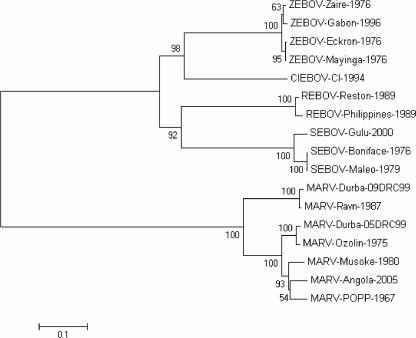
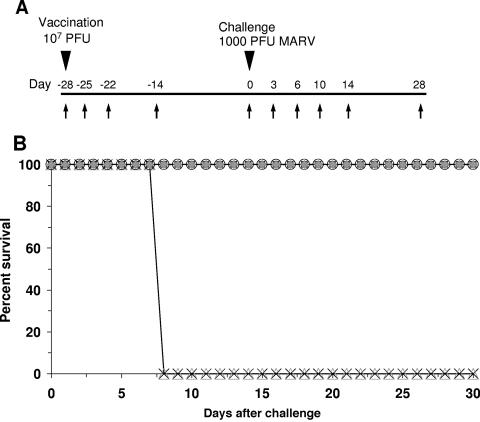
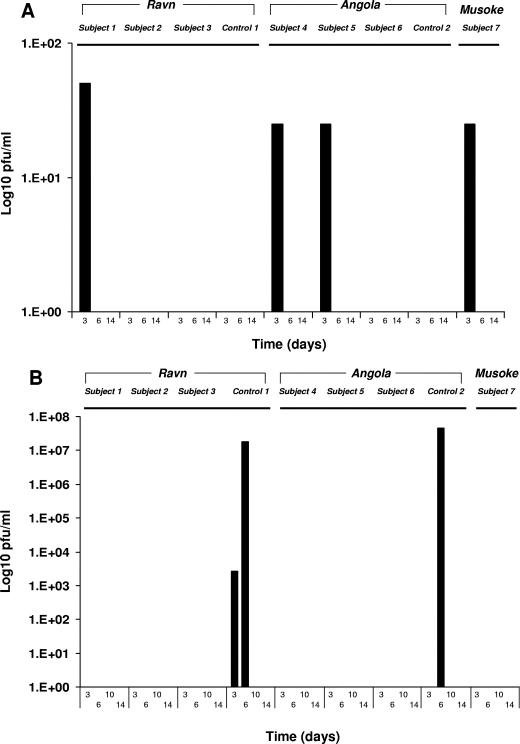
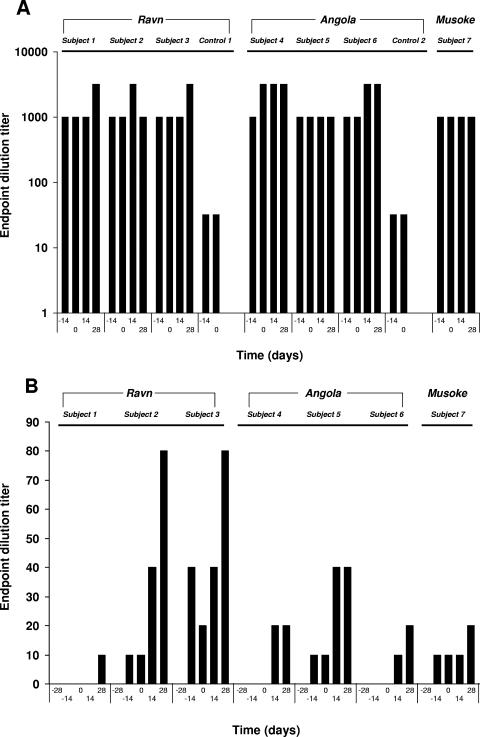
Marburg virus (MARV) has been associated with sporadic episodes of hemorrhagic fever, including a recent highly publicized outbreak in Angola that produced severe disease and significant mortality in infected patients. MARV is also considered to have potential as a biological weapon. Recently, we reported the development of a promising attenuated, replication-competent vaccine against MARV based on recombinant vesicular stomatitis virus (VSV) expressing the glycoprotein of the Musoke strain of MARV (VSVDeltaG/MARVGP-Musoke). We used this vaccine to demonstrate complete protection of cynomolgus monkeys against a homologous MARV challenge. While these results are highly encouraging, an effective vaccine would need to confer protection against all relevant strains of MARV. Here, we evaluated the protective efficacy of the VSVDeltaG/MARVGP-Musoke vaccine against two heterologous MARV strains, the seemingly more pathogenic Angola strain and the more distantly related Ravn strain. In this study, seven cynomolgus monkeys were vaccinated with the VSVDeltaG/MARVGP-Musoke vector. Three of these animals were challenged with the Angola strain, three with the Ravn strain, and a single animal with the Musoke strain of MARV. Two animals served as controls and were each injected with a nonspecific VSV vector; these controls were challenged with the Angola and Ravn strains, respectively. Both controls succumbed to challenge by day 8. However, none of the specifically vaccinated animals showed any evidence of illness either from the vaccination or from the MARV challenges and all of these animals survived. These data suggest that the VSVDeltaG/MARVGP-Musoke vaccine should be sufficient to protect against all known MARV strains.
Figures
References
-
- Borio, L., T. Inglesby, C. J. Peters, A. L. Schmaljohn, J. M. Hughes, P. B. Jahrling, T. Ksiazek, K. M. Johnson, A. Meyerhoff, T. O'Toole, M. S. Ascher, J. Bartlett, J. G. Breman, E. M. Eitzen, Jr., M. Hamburg, J. Hauer, D. A. Henderson, R. T. Johnson, G. Kwik, M. Layton, S. Lillibridge, G. J. Nabel, M. T. Osterholm, T. M. Perl, P. Russell, and K. Tonat. 2002. Hemorrhagic fever viruses as biological weapons: medical and public health management. JAMA 287:2391-2405. - PubMed
-
- Bowen, E. T., G. S. Platt, G. Lloyd, R. T. Raymond, and D. I. Simpson. 1980. A comparative study of strains of Ebola virus isolated from southern Sudan and northern Zaire in 1976. J. Med. Virol. 6:129-138. - PubMed
-
- Chirmule, N., K. Propert, S. Magosin, Y. Qian, R. Qian, and J. Wilson. 1999. Immune responses to adenovirus and adeno-associated virus in humans. Gene Ther. 6:1574-1583. - PubMed
-
- Colebunders, R., H. Sleurs, P. Pirard, M. Borchert, M. Libande, J. P. Mustin, A. Tshomba, L. Kinuani, L. A. Olinda, F. Tshioko, and J. J. Muyembe-Tamfum. 2004. Organisation of health care during an outbreak of Marburg haemorrhagic fever in the Democratic Republic of Congo, 1999. J. Infect. 48:347-353. - PubMed
-
- Daddario-DiCaprio, K. M., T. W. Geisbert, U. Stroher, J. B. Geisbert, A. Grolla, E. A. Fritz, L. Fernando, E. Kagan, P. B. Jahrling, L. E. Hensley, S. M. Jones, and H. Feldmann. 2006. Postexposure protection against Marburg haemorrhagic fever with recombinant vesicular stomatitis virus vectors in non-human primates: an efficacy assessment. Lancet 367:1399-1404. - PubMed
Publication types
MeSH terms
Substances
LinkOut - more resources
Full Text Sources
Other Literature Sources
