. 2006 Oct;80(19):9720-9.
doi: 10.1128/JVI.01216-06.

Herpes simplex virus ICP27 is required for virus-induced stabilization of the ARE-containing IEX-1 mRNA encoded by the human IER3 gene

Affiliations

Herpes simplex virus ICP27 is required for virus-induced stabilization of the ARE-containing IEX-1 mRNA encoded by the human IER3 gene

Jennifer A Corcoran et al. J Virol. 2006 Oct.

Abstract

Herpes simplex virus (HSV) stifles cellular gene expression during productive infection of permissive cells, thereby diminishing host responses to infection. Host shutoff is achieved largely through the complementary actions of two viral proteins, ICP27 and virion host shutoff (vhs), that inhibit cellular mRNA biogenesis and trigger global mRNA decay, respectively. Although most cellular mRNAs are thus depleted, some instead increase in abundance after infection; perhaps surprisingly, some of these contain AU-rich instability elements (AREs) in their 3'-untranslated regions. ARE-containing mRNAs normally undergo rapid decay; however, their stability can increase in response to signals such as cytokines and virus infection that activate the p38/MK2 mitogen-activated protein kinase (MAPK) pathway. We and others have shown that HSV infection stabilizes the ARE mRNA encoding the stress-inducible IEX-1 mRNA, and a previous report from another laboratory has suggested vhs is responsible for this effect. However, we now report that ICP27 is essential for IEX-1 mRNA stabilization whereas vhs plays little if any role. A recent report has documented that ICP27 activates the p38 MAPK pathway, and we detected a strong correlation between this activity and stabilization of IEX-1 mRNA by using a panel of HSV type 1 (HSV-1) isolates bearing an array of previously characterized ICP27 mutations. Furthermore, IEX-1 mRNA stabilization was abrogated by the p38 inhibitor SB203580. Taken together, these data indicate that the HSV-1 immediate-early protein ICP27 alters turnover of the ARE-containing message IEX-1 by activating p38. As many ARE mRNAs encode proinflammatory cytokines or other immediate-early response proteins, some of which may limit viral replication, it will be of great interest to determine if ICP27 mediates stabilization of many or all ARE-containing mRNAs.


Figures
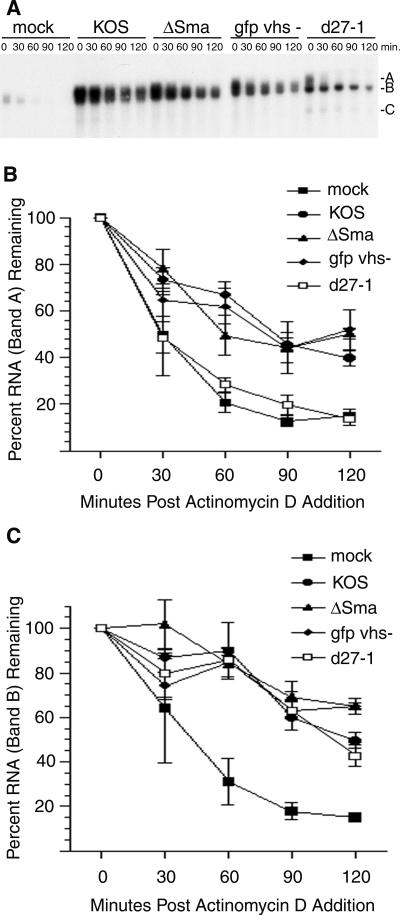
FIG. 1.
FIG. 1.
ICP27, not vhs, is required for HSV-mediated stabilization of IEX-1 RNA. (A) HeLa cells were mock infected or infected with wild-type HSV-1 (strain KOS), either of two different vhs deletion mutants of KOS (ΔSma or GFP vhs−), or a deletion mutant of KOS1.1 (d27-1) at a multiplicity of infection of 5. Actinomycin D was added at 6 hpi, and total RNA was extracted at the indicated times. The IEX-1 transcript was visualized by Northern blotting. Letters at right indicate bands A, B, and C. (B and C) The relative intensities of band A and band B at each time at were quantified by phosphorimager analysis in three independent experiments. The averages ± standard errors are plotted.
FIG. 2.
FIG. 2.
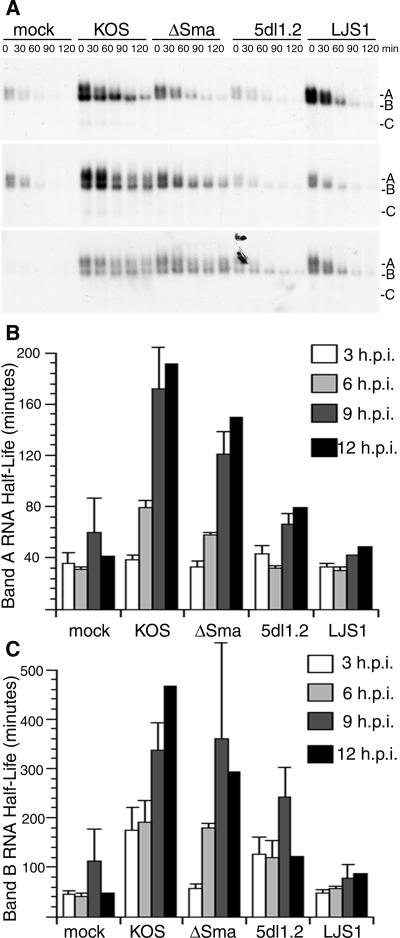
ICP27 stabilizes IEX-1 RNA at middle to late times after HSV-1 infection. HeLa cells were mock infected or infected with wild-type HSV-1 (strain KOS), a vhs deletion mutant of KOS (ΔSma), an ICP27 deletion mutant of KOS (5dl1.2), or a vhs and ICP27 double knockout of KOS (LJS1) at a multiplicity of infection of 5. Actinomycin D was added at 3, 6, 9, or 12 hpi. Total RNA was extracted at the indicated times and blotted for the IEX-1 transcript. (A) Representative blots are shown when actinomycin D was added at 3 (top panel), 6 (middle panel), or 9 (bottom panel) hpi. Letters at right indicate bands A, B, and C. (B and C) The half-lives of IEX-1 RNA bands A and B at various infection times were determined from phosphorimager analyses of three independent experiments, and the averages ± standard errors are plotted, except for the 12-h infection, where the averages of two independent experiments are plotted.
FIG. 3.
FIG. 3.
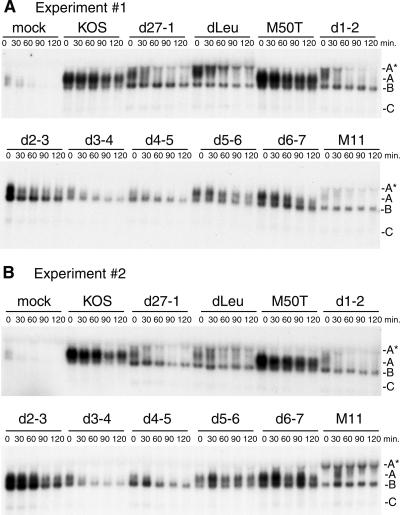
Regions of ICP27 required for stabilization of IEX-1 RNA band A. (A and B) HeLa cells were mock infected or infected with wild-type HSV-1 (strain KOS), the ICP27 null mutant of KOS (d27-1), one of the in-frame deletion mutants dLeu, d1-2, d2-3, d3-4, d4-5, d5-6, or d6-7, or one of the point mutants M50T or M11 at a multiplicity of infection of 10. Actinomycin D was added to the infected cultures at 7.5 hpi, and total RNA was extracted and blotted for the IEX-1 transcript as described in the legend for Fig. 1. Results from two representative experiments are displayed. Letters at right indicate bands A*, A, B, and C.
FIG. 4.
FIG. 4.
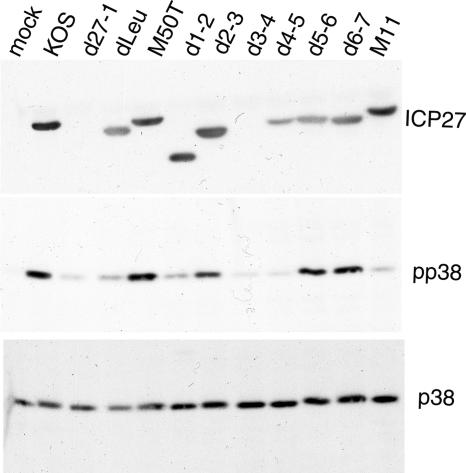
Effects of ICP27 mutations on activation of p38 MAPK. HeLa cells were mock infected or infected with wild-type HSV-1 (strain KOS), the ICP27 null mutant of KOS (d27-1), one of the in-frame deletion mutants dLeu, d1-2, d2-3, d3-4, d4-5, d5-6, or d6-7, or one of the point mutants M50T or M11 at a multiplicity of infection of 10. Infected cells were lysed at 7.5 to 8 hpi, and then total protein was separated by SDS-10% polyacrylamide gel electrophoresis and immunoblotted to verify the accumulation of ICP27 by use of the monoclonal antibody H1113 (top panel). A second blot was probed sequentially for the phosphorylated (pp38, middle panel) and nonphosphorylated (p38, bottom panel) forms of p38 kinase.
FIG. 5.
FIG. 5.
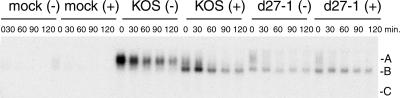
Effects of the p38 inhibitor SB203580 on HSV-induced stabilization of IEX-1 RNA band A. HeLa cells were pretreated for 30 min with either SB203580 (10 mM in dimethyl sulfoxide) (+) or an equivalent volume of dimethyl sulfoxide (−) and then mock infected or infected with wild-type HSV-1 KOS or d27-1 at a multiplicity of infection of 10. Inhibitor treatment was continued throughout the infection. Actinomycin D was added to the infected, treated cultures at 7.5 hpi, and total RNA was extracted and blotted for the IEX-1 transcript as described in the legend for Fig. 1. A representative blot is shown. Letters at right indicate bands A, B, and C.

References

    1. Arlt, A., O. Grobe, A. Sieke, M. L. Kruse, U. R. Folsch, W. E. Schmidt, and H. Schafer. 2001. Expression of the NF-kappa B target gene IEX-1 (p22/PRG1) does not prevent cell death but instead triggers apoptosis in Hela cells. Oncogene 20:69-76. - PubMed
    1. Aubert, M., S. A. Rice, and J. A. Blaho. 2001. Accumulation of herpes simplex virus type 1 early and leaky-late proteins correlates with apoptosis prevention in infected human HEp-2 cells. J. Virol. 75:1013-1030. - PMC - PubMed
    1. Bakheet, T., M. Frevel, B. R. G. Williams, W. Greer, and K. S. A. Khabar. 2001. ARED: human AU-rich element-containing mRNA database reveals an unexpectedly diverse functional repertoire of encoded proteins. Nucleic Acids Res. 29:246-254. - PMC - PubMed
    1. Barreau, C., L. Paillard, and H. B. Osborne. 2005. AU-rich elements and associated factors: are there unifying principles? Nucleic Acids Res. 33:7138-7150. - PMC - PubMed
    1. Bennasser, Y., S. Y. Le, M. Benkirane, and K. T. Jeang. 2005. Evidence that HIV-1 encodes an siRNA and a suppressor of RNA silencing. Immunity 22:607-619. - PubMed

Publication types

MeSH terms