. 2006 Oct;80(19):9761-71.
doi: 10.1128/JVI.00665-06.

Cellular target genes of Epstein-Barr virus nuclear antigen 2

Affiliations

Cellular target genes of Epstein-Barr virus nuclear antigen 2

Sabine Maier et al. J Virol. 2006 Oct.

Abstract

Epstein-Barr virus (EBV) nuclear antigen 2 (EBNA-2) is a key determinant in the EBV-driven B-cell growth transformation process. By activating an array of viral and cellular target genes, EBNA-2 initiates a cascade of events which ultimately cause cell cycle entry and the proliferation of the infected B cell. In order to identify cellular target genes that respond to EBNA-2 in the absence of other viral factors, we have performed a comprehensive search for EBNA-2 target genes in two EBV-negative B-cell lines. This screen identified 311 EBNA-2-induced and 239 EBNA-2-repressed genes that were significantly regulated in either one or both cell lines. The activation of most of these genes had not previously been attributed to EBNA-2 function and will be relevant for the identification of EBNA-2-specific contributions to EBV-associated malignancies. The diverse spectrum of EBNA-2 target genes described in this study reflects the broad spectrum of EBNA-2 functions involved in virus-host interactions, including cell signaling molecules, adapters, genes involved in cell cycle regulation, and chemokines.


Figures
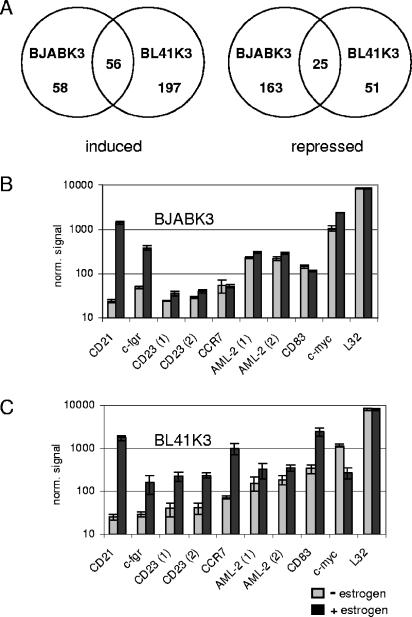
FIG. 1.
FIG. 1.
Activation of EBNA-2 in BJABK3 or BL41K3 causes the induction or repression of 550 probe sets. Total cellular RNA was extracted from BJABK3 or BL41K3 cells before or 24 h post-estrogen activation of EBNA-2 and used for microarray analyses of mRNA expression levels. (A) Venn diagrams illustrate the distribution of 550 probe sets, which were significantly either upregulated or repressed by EBNA-2 at least twofold (q value of ≤1%). Triplicate (B) or duplicate (C) results of individual probe sets upon BJABK3 (B) or BL41K3 (C) microarray analyses are shown for EBNA-2-induced genes, which have been described in the literature. Gray bars show the mean normalized (norm.) signal intensities before estrogen (−), while black bars correspond to the signal 24 h post-estrogen (+) induction. Error bars indicate standard deviations.
FIG. 2.
FIG. 2.
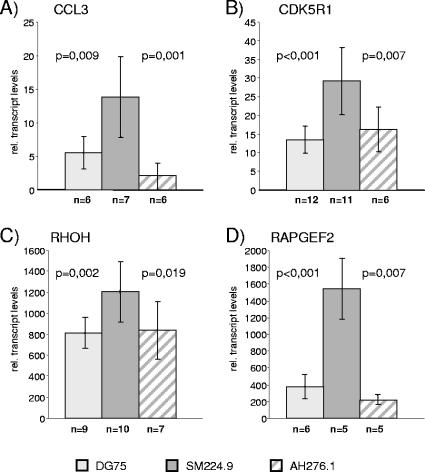
Expression of CCL3, CDK5R1, RHOH, and RAPGEF2 is repressed by CBF1. Total cellular RNAs of DG75, SM224.9, and AH276.1 were tested for the expression of CCL3, CDK5R1, RHOH, and RAPGEF2 by real-time RT-PCR. The results are given as mean values (n = number of independent experiments). The relative (rel.) transcript levels for all genes refer to a gene-specific calibrator template. Standard deviations are given as error bars, and P values were calculated by an unpaired two-sided Student t test.
FIG. 3.
FIG. 3.
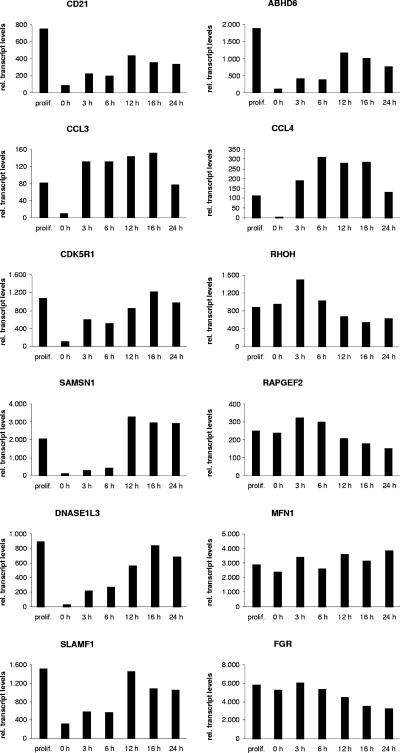
Induction of target genes in ER/EB2-5 cells. Total cellular RNAs of proliferating ER/EB2-5 cells, growth-arrested ER/EB2-5 cells (0 h) which had been cultivated in the absence of estrogen for 3 days, or estrogen-restimulated cells were harvested at the indicated time points, and gene expression was tested by real-time RT-PCR. The results are given as relative transcript levels referring to a gene-specific calibrator template.
FIG. 4.
FIG. 4.
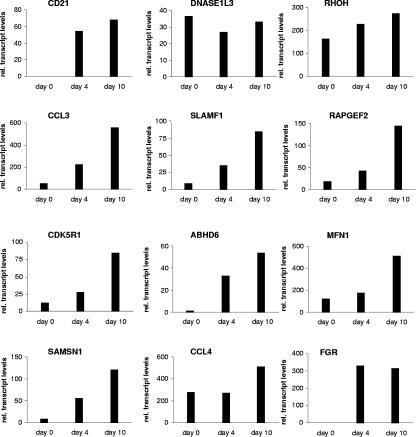
Induction of target genes upon EBV infection. Total cellular RNA was harvested from purified primary B cells before and 4 and 10 days after B95.8 infection. Gene expression was analyzed by real-time RT-PCR. The results are given as relative (rel.) transcript levels referring to a gene-specific calibrator template.
FIG. 5.
FIG. 5.
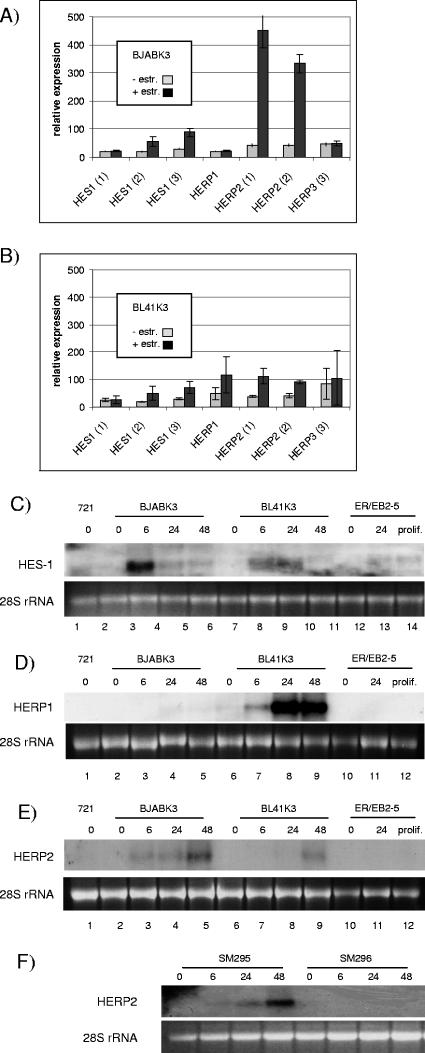
Activation of basic helix-loop-helix genes by EBNA-2. Total cellular RNA of BJABK3 (A) and BL41K3 (B) was isolated before estrogen (−) and 24 h post-estrogen (+) treatment, and expression profiles were established by hybridization of the U133A 2.0 Affymetrix array. Results are given as the mean value of triplicates for HES-1, HERP1, -2, and -3. Results of all available probe sets are provided. Error bars indicate standard deviations. Different B-cell lines treated with estrogen for the indicated time periods were tested for HES-1 (C), HERP1 (D), and HERP2 (E and F) expression by Northern blot analysis. Equal loading of the lanes is visualized by ethidium bromide staining of the 28S rRNA for each blot. prolif., proliferation.

References

    1. Bashir, R., J. Luka, K. Cheloha, M. Chamberlain, and F. Hochberg. 1993. Expression of Epstein-Barr virus proteins in primary CNS lymphoma in AIDS patients. Neurology 43:2358-2362. - PubMed
    1. Ben-Bassat, H., N. Goldblum, S. Mitrani, T. Goldblum, J. M. Yoffey, M. M. Cohen, Z. Bentwich, B. Ramot, E. Klein, and G. Klein. 1977. Establishment in continuous culture of a new type of lymphocyte from a “Burkitt like” malignant lymphoma (line D.G.-75). Int. J. Cancer 19:27-33. - PubMed
    1. Bessho, Y., G. Miyoshi, R. Sakata, and R. Kageyama. 2001. Hes7: a bHLH-type repressor gene regulated by Notch and expressed in the presomitic mesoderm. Genes Cells 6:175-185. - PubMed
    1. Birkenbach, M., K. Josefsen, R. Yalamanchili, G. Lenoir, and E. Kieff. 1993. Epstein-Barr virus-induced genes: first lymphocyte-specific G protein-coupled peptide receptors. J. Virol. 67:2209-2220. - PMC - PubMed
    1. Burgstahler, R., B. Kempkes, K. Steube, and M. Lipp. 1995. Expression of the chemokine receptor BLR2/EBI1 is specifically transactivated by Epstein-Barr virus nuclear antigen 2. Biochem. Biophys. Res. Commun. 215:737-743. - PubMed

Publication types

MeSH terms

Associated data