. 2006 Oct;80(19):9831-6.
doi: 10.1128/JVI.00878-06.

The 37/67-kilodalton laminin receptor is a receptor for adeno-associated virus serotypes 8, 2, 3, and 9

Affiliations

The 37/67-kilodalton laminin receptor is a receptor for adeno-associated virus serotypes 8, 2, 3, and 9

Bassel Akache et al. J Virol. 2006 Oct.

Abstract

Adeno-associated virus serotype 8 (AAV8) is currently emerging as a powerful gene transfer vector, owing to its capability to efficiently transduce many different tissues in vivo. While this is believed to be in part due to its ability to uncoat more readily than other AAV serotypes such as AAV2, understanding all the processes behind AAV8 transduction is important for its application and optimal use in human gene therapy. Here, we provide the first report of a cellular receptor for AAV8, the 37/67-kDa laminin receptor (LamR). We document binding of LamR to AAV8 capsid proteins and intact virions in vitro and demonstrate its contribution to AAV8 transduction of cultured cells and mouse liver in vivo. We also show that LamR plays a role in transduction by three other closely related serotypes (AAV2, -3, and -9). Sequence and deletion analysis allowed us to map LamR binding to two protein subdomains predicted to be exposed on the AAV capsid exterior. Use of LamR, which is constitutively expressed in many clinically relevant tissues and is overexpressed in numerous cancers, provides a molecular explanation for AAV8's broad tissue tropism. Along with its robust transduction efficiency, our findings support the continued development of AAV8-based vectors for clinical applications in humans, especially for tumor gene therapy.


Figures
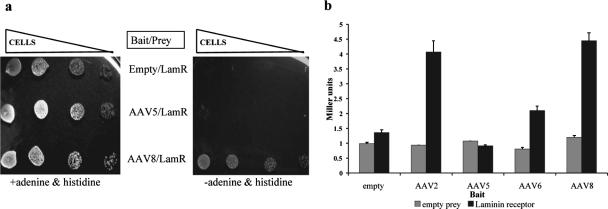
FIG. 1.
FIG. 1.
AAV8 and AAV2 capsid proteins bind the 37/67-kDa laminin receptor in yeast. (a) Yeast transformed with the LamR prey plasmid and the various bait plasmids was grown, serially diluted, and spotted on medium with or without adenine and histidine. The activation of both the ade2 and his3 reporter genes preceded by Gal4p binding sites is necessary for growth on medium lacking adenine and histidine. (b) Yeast transformed with the indicated combinations of bait and prey plasmids was assayed for activation of the reporter lacZ gene using β-galactosidase assays.
FIG. 2.
FIG. 2.
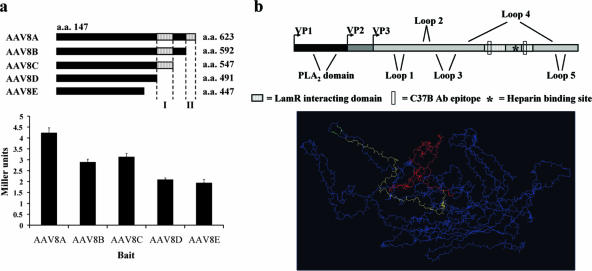
Two AAV8 capsid subdomains mediate binding to the 37/67-kDa laminin receptor. (a) Schematic of the AAV8 bait deletion constructs AAV8B to -E (top panel). Yeast transformed with the indicated combinations of bait and the LamR prey plasmid was assayed for activation of the reporter lacZ gene using β-galactosidase assays (bottom panel). Two C-terminal regions were identified (I and II in top panel) whose deletion led to a reduction in lacZ transactivation. (b) Schematic representation of the AAV capsid protein VP1 including the location of the previously identified AAV2 outer capsid loops, phospholipase A2 (PLA2) domain, the heparin binding motif, and the here-identified LamR-interacting domains (top panel). Also highlighted are two regions comprising the epitope for the monoclonal antibody (Ab) C37, whose binding blocks AAV2 cellular attachment. A three-dimensional representation of a single capsid protein subunit reveals that the two LamR-interacting domains, VP1 residues 491 to 547 (I in panel a) in red and 593 to 623 (II in panel a) in yellow, are on the outer surface of the capsid and in close proximity to the heparin binding motif (in green) (bottom panel).
FIG. 3.
FIG. 3.
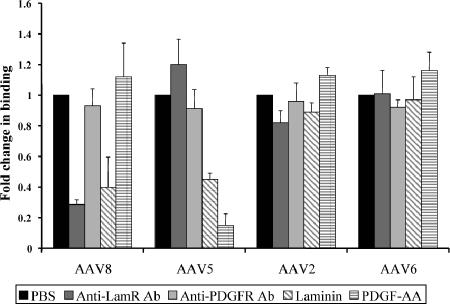
AAV8 attaches to mammalian cells through binding of LamR. Binding assays were performed by incubating HeLa cells with PBS, soluble laminin, PDGF-AA, an antibody (Ab) directed against the 37/67-kDa laminin receptor, or an antibody directed against PDGFR-β, followed by chilling and incubation with 6,500 recombinant particles/cell of each of the indicated serotypes. Quantitative PCR was performed to measure the amount of bound virus using primers specific to the viral genome encompassing the hf.IX gene.
FIG. 4.
FIG. 4.
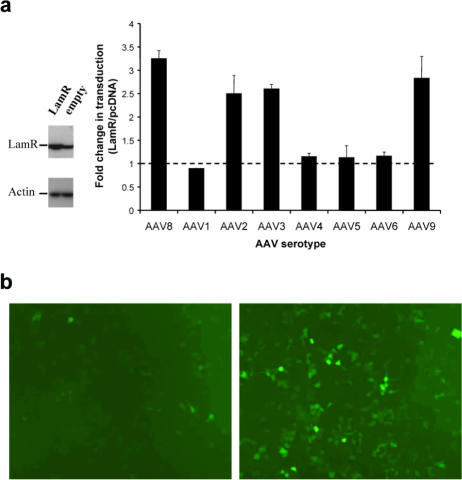
Overexpression of the 37/67-kDa laminin receptor increases transduction by AAV8, -2, -3, and -9 in vitro. (a) Total protein extracts from the stably transfected NIH 3T3 cells were analyzed by Western blot analysis using the anti-laminin receptor or antiactin antibody (left panel). The same two cell pools were incubated with 1 × 10⁵ particles/cell of AAV1, -3, -4, -5, -6, -8, or -9(gfp) or 5 × 10³ particles/cell of AAV2(gfp) for 1 hour, and amounts of transduced cells were determined after 3 days (right panel). (b) AAV8(gfp) (1 × 10⁶ particles/cell) was incubated for 1 hour with a pool of NIH 3T3 cells stably transfected with the empty pcDNA plasmid (left panel) or with the laminin receptor expression plasmid (right panel). GFP expression, indicating successful AAV8 transduction, was visualized after 3 days.
FIG. 5.
FIG. 5.
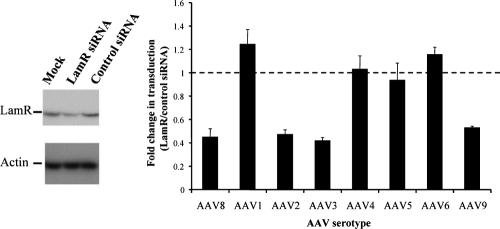
Inhibition of 37/67-kDa laminin receptor expression by RNAi inhibits transduction by AAV8, -2, -3, and -9 in vitro. Total protein extracts from NIH 3T3 cells that were mock transfected or transfected with the indicated siRNA were analyzed by Western blotting using the anti-LamR or antiactin antibody (left panel). Cells transfected with the anti-lamR siRNA or control siRNA were incubated with 1 × 10⁵ particles/cell of gfp-expressing AAV1, -3, -4, -5, -6, -8, or -9 or 5 × 10³ particles/cell of gfp-expressing AAV2 for 1 hour, and amounts of transduced cells were determined after 3 days (right panel).
FIG. 6.
FIG. 6.
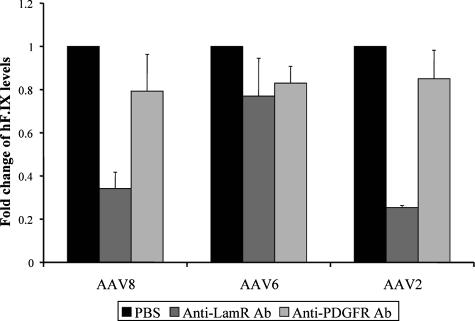
AAV8- and AAV2-mediated transduction of mouse liver depends on the 37/67-kDa laminin receptor. An anti-LamR antibody (Ab), anti-PDGFR antibody, or PBS was intravenously injected into mice, followed 6 hours later by infusion of 1 × 10¹¹ particles of AAV2, AAV6, or AAV8(hf.IX) per mouse via the same route. After 3 days, plasma levels of hF.IX were determined by enzyme-linked immunosorbent assay.

References

    1. Ardini, E., B. Sporchia, L. Pollegioni, M. Modugno, C. Ghirelli, F. Castiglioni, E. Tagliabue, and S. Menard. 2002. Identification of a novel function for 67-kDa laminin receptor: increase in laminin degradation rate and release of motility fragments. Cancer Res. 62:1321-1325. - PubMed
    1. Ardini, E., E. Tagliabue, A. Magnifico, S. Buto, V. Castronovo, M. I. Colnaghi, and S. Menard. 1997. Co-regulation and physical association of the 67-kDa monomeric laminin receptor and the α6β4 integrin. J. Biol. Chem. 272:2342-2345. - PubMed
    1. Blackburn, S. D., R. A. Steadman, and F. B. Johnson. 2006. Attachment of adeno-associated virus type 3H to fibroblast growth factor receptor 1. Arch. Virol. 151:617-623. - PubMed
    1. Bossis, I., and J. A. Chiorini. 2003. Cloning of an avian adeno-associated virus (AAAV) and generation of recombinant AAAV particles. J. Virol. 77:6799-6810. - PMC - PubMed
    1. Bouchara, J. P., M. Sanchez, A. Chevailler, A. Marot-Leblond, J. C. Lissitzky, G. Tronchin, and D. Chabasse. 1997. Sialic acid-dependent recognition of laminin and fibrinogen by Aspergillus fumigatus conidia. Infect. Immun. 65:2717-2724. - PMC - PubMed

Publication types

MeSH terms

LinkOut - more resources