


Rapid viral decay in simian immunodeficiency virus-infected macaques receiving quadruple antiretroviral therapy
- PMID: 16973590
- PMCID: PMC1617217
- DOI: 10.1128/JVI.00394-06
Rapid viral decay in simian immunodeficiency virus-infected macaques receiving quadruple antiretroviral therapy
Abstract
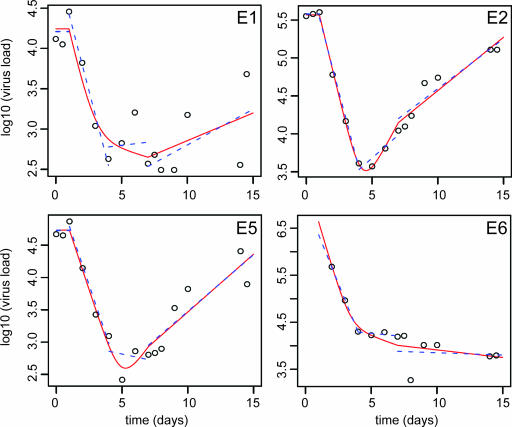
The viral dynamics in human immunodeficiency virus type 1 (HIV-1) infection have been studied extensively using mathematical modeling, but data from other primate lentivirus systems are scarce. This study was initiated to increase the understanding of the differences and similarities between the different primate lentiviruses. Four cynomolgus macaques were infected with SIVmac251. Six months after infection the monkeys received a 7-day course of subcutaneous, quadruple antiretroviral therapy with zidovudine, lamivudine, tenofovir, and ritonavir-boosted lopinavir. Plasma virus levels were determined before therapy, daily during the first 10 days of therapy, and after 14 days using a sensitive commercial reverse transcriptase assay. All four monkeys showed a rapid and uniform decline in plasma virus load between day 1 and day 4 of treatment (first-phase decay). Two mathematical models, a piecewise linear regression analysis and a nonlinear model, were used to estimate the rate of viral decay in plasma and gave similar results. The mean half-life for plasma virus was 0.47 days (range, 0.37 to 0.50) and reflects the underlying decline of virus-producing CD4+ lymphocytes. This is the fastest primate lentivirus decay described hitherto. The rapid decay may be due to the high antiviral potency of the therapy or to intrinsic differences between simian immunodeficiency virus (SIV) infection in macaques and HIV-1 infection in humans.
Figures
References
-
- Bonhoeffer, S., G. A. Funk, H. F. Gunthard, M. Fischer, and V. Muller. 2003. Glancing behind virus load variation in HIV-1 infection. Trends Microbiol. 11:499-504. - PubMed
-
- Brandin, E., C. Brostrom, E. Gille, S. Bonhoeffer, and J. Albert. 2005. Short communication: HIV type 2 dynamics. AIDS Res. Hum. Retrovir. 21:608-610. - PubMed
-
- Chun, T. W., L. Carruth, D. Finzi, X. Shen, J. A. DiGiuseppe, H. Taylor, M. Hermankova, K. Chadwick, J. Margolick, T. C. Quinn, Y. H. Kuo, R. Brookmeyer, M. A. Zeiger, P. Barditch-Crovo, and R. F. Siliciano. 1997. Quantification of latent tissue reservoirs and total body viral load in HIV-1 infection. Nature 387:183-188. - PubMed
-
- Finzi, D., M. Hermankova, T. Pierson, L. M. Carruth, C. Buck, R. E. Chaisson, T. C. Quinn, K. Chadwick, J. Margolick, R. Brookmeyer, J. Gallant, M. Markowitz, D. D. Ho, D. D. Richman, and R. F. Siliciano. 1997. Identification of a reservoir for HIV-1 in patients on highly active antiretroviral therapy. Science 278:1295-1300. - PubMed
-
- Gardner, M. B., and P. A. Luciw. 1989. Animal models of AIDS. FASEB J. 3:2593-2606. - PubMed
Publication types
MeSH terms
Substances
LinkOut - more resources
Full Text Sources
Research Materials
