. 2006 Oct;80(19):9889-95.
doi: 10.1128/JVI.00664-06.

Mobilization of full-length Semliki Forest virus replicon by retrovirus particles

Affiliations

Mobilization of full-length Semliki Forest virus replicon by retrovirus particles

Eric Piver et al. J Virol. 2006 Oct.

Abstract

Conciliating biosafety with efficient gene transfer remains a constant concern in the development of retroviral vectors. Semliki Forest virus (SFV) replicons allow important retroviral vector production with interesting features. It is noteworthy that retroviruses have the ability to package Psi+ and, to some extent, Psi- cellular RNAs. Therefore, it was important to study the retroviral transfer of highly abundant SFV genomes expressing retroviral proteins. Here, we show that full-length SFV-vector replicons, with or without Psi, are efficiently packaged into retrovirus particles. Mechanistically, our data suggest that SFV packaging is the sum of its retroviral nucleocapsid-dependent recruitment together with a passive hijacking of membrane-anchored SFV replicon. A direct consequence of this phenomenon is the formation of particles harboring autonomous replicative abilities and contaminating vector preparations. Importantly, we confirm that retroviral SFV mobilization is not an exclusive feature of murine gamma retroviruses, since it is also observed using lentivectors.


Figures
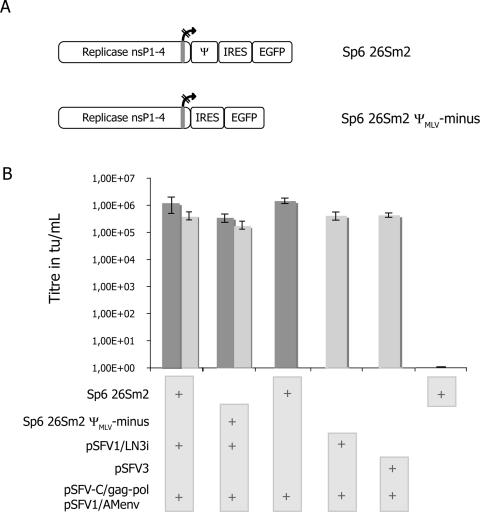
FIG. 1.
FIG. 1.
(A) Schematic representation of the two full-length GFP vectors. For details, see the text and reference . IRES, internal ribosome entry site. (B) Transmobilization of full-length SFV replicon by retrovirus particles. BHK-21 cells were cotransfected by a mix of RNAs. Supernatants from transfected cells were harvested to transduce 293T cells. Titers are expressed in transducing units per milliliter. Each column in the graph is associated with a specific mix of plasmids identified by plus symbols in light gray boxes. Within the graph, titers in dark gray represent GFP mobilization, while light gray columns reflect LacZ titers. GFP titers obtained with the 26Sm2 construct, in the presence or absence of a competitive LacZ SFV vector, were in the same order of magnitude. 26Sm2 ΨMLV-minus vector was almost as efficiently packaged as 26Sm2, its Ψ-positive counterpart. pSFV3, a LacZ-expressing, ΨMLV-minus SFV vector harboring a functional 26S internal promoter, was also efficiently mobilized. Cell debris-releasing RNA or GFP do not support transfer, as proved by the absence of GFP-positive cells when using 26Sm2 alone. Altogether, these data indicated that retrovirus particles are a vehicle for SFV vectors. Titers are means of results from at least five independent experiments.
FIG. 2.
FIG. 2.
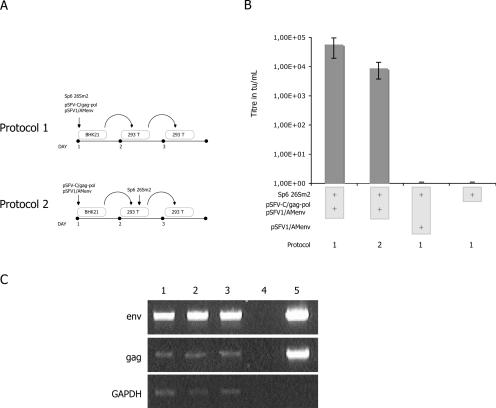
(A) Schematic representation of the transduction protocols. Two protocols were designed to challenge secondary mobilization. Protocol 1 was based on the harvesting of supernatant from transduced cells. After filtration, this supernatant served for the transduction of secondary cells. Constructs are indicated over the vertical upper arrow. In protocol 2, BHK-21 cells were transfected using pSFV-C/gag-pol and pSFV1/AMenv. One day later, supernatant was collected to transduce 293T cells. Five hours later, these cells were electroporated with 26Sm2 RNA. At day 3, the supernatant was harvested to transduce new 293T cells. (B) Efficiency of the secondary mobilization. Each column in the graph is associated with a specific mix of plasmids identified by plus symbols in light gray boxes. For protocol 1, we observed titers only 1 log lower compared to those of a simple transduction (B). For protocol 2, we still observed a GFP titer, confirming the secondary mobilization, as a result of the transfer of pSFV-C/gag-pol and pSFV1/AMenv replicons into target cells. A control panel was obtained using protocol 1: we observed no cell transduction with supernatant from 293T cells transfected with 26Sm2 alone or together with pSFV1/AMenv. This indicates that the SFV transfer needs retroviral functions, such as Env cytoplasmic cleavage. Results are means from three independent experiments. (C) RT-PCR analysis on total cellular RNA from secondary transduction. Primer localizations on vectors were chosen to detect the transcomplementing transgenes (Env and Gag). To confirm mobilization of transcomplementing sequences, we performed an RT-PCR on total RNAs extracted from secondary transduced cells (protocol 1). Lanes 1 to 3, RNAs from secondary cells from three independent experiments; lane 4, H2O-negative control; lane 5, amplification on a mix of 10 ng/ml of pSFV1/AMenv or pSFV-C/gag-pol plasmids. GAPDH, glyceraldehyde-3-phosphate dehydrogenase.
FIG. 3.
FIG. 3.
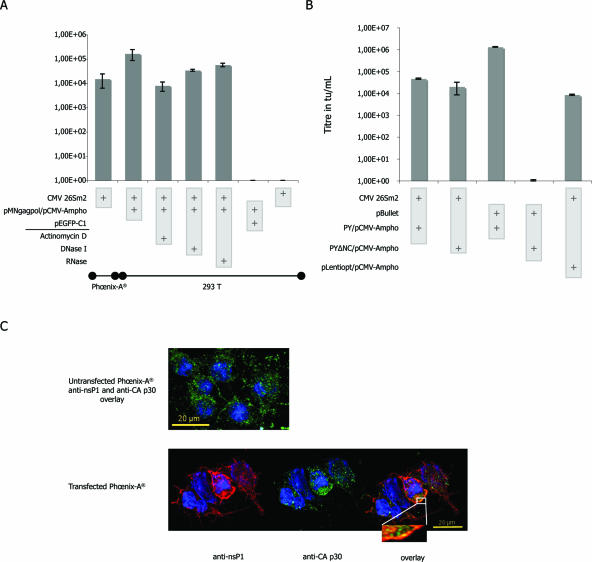
(A and B) Titers, means of results from five independent experiments, are expressed in transducing units per milliliter. Each column in the graphs is associated with a specific mix of plasmids identified by plus symbols in light gray boxes. For these experiments, we used the CMV-driven 26Sm2 SFV-derived vector. (A) Titers obtained using an RNA Pol II system for retroviral transcomplementation. Phœnix-A packaging cells were transfected using CMV 26Sm2. Tritransfection experiments were performed as described in the text. A series of controls was performed to eliminate passive transfer of plasmid or RNA: Pol II-driven transcription in transduced cells was inhibited through addition of actinomycin D; GFP detection titer at 104 tu/ml confirmed SFV-driven expression; supernatants were also treated with DNase I (125 IU) and RNase A (10 μg) before transduction with no effect on titers (columns 4 and 5, respectively); finally, the absence of titer obtained with pEGFP-C1 or 26Sm2 alone confirmed SFV retroviral mobilization. (B) Exploring the molecular requirement for SFV retroviral mobilization. The 26Sm2 replicon was mobilized using a retroviral transcomplementation system harboring a wild-type NC or a deleted NC (ΔNC). As opposed to what is observed using a classical GFP-expressing retroviral vector, pBullet (columns 3 and 4 of the graph), deletion of the NC had no effect on SFV mobilization (first two columns). In the last column, the lentiviral mobilization was tested with a Rev-independent Gag-PolHIV expression system (pLentiopt). The Gag-PolHIV titers were comparable to those obtained with the MLV system. Results are means from five independent experiments. (C) Cellular localization of MLV Gag and nsP1. Phœnix-A cells were transfected with the nsP1-expressing CMV 26Sm2 plasmid. Specific antibodies for MLV CA p30 and nsP1 were used to determine the cellular localization of the two proteins. Pictures are superpositions of six 0.25-μm-wide slices. (Upper panel) Overlay for control Phœnix-A cells not transfected but incubated with the two antibodies: only the green CA p30 signal is observed. (Lower panel) Pictures of transfected Phœnix-A cells: detection of nsP1 (in red), CA p30 (in green). The presence of several yellow dots on the overlay suggested the vicinity of the two proteins.
FIG. 4.
FIG. 4.
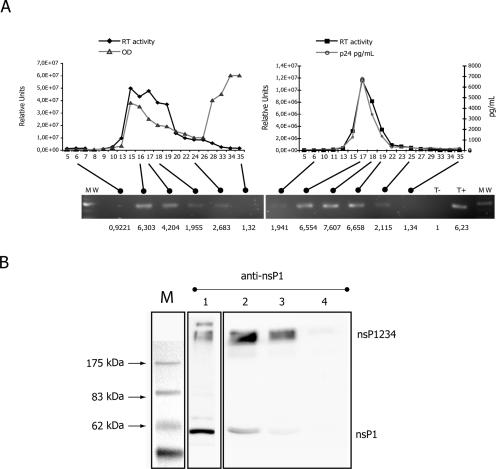
(A) Purification of chimerical particles. Particles were purified using a sucrose gradient. Supernatant from 293T cells transfected with pMN gag-pol or pLentiopt, pCMV-Ampho, and CMV 26Sm2 was deposited on a continuous sucrose gradient, 20% to 60%, in 35-ml tubes. Tubes were centrifuged at 100,000 × g for 2 h using an SW 28 swinging rotor. Fractions were collected using a Pharmacia collector equipped with a 260-nm UV detector for protein detection (optical density [OD]). Each fraction was checked for RT activity using rA/dT oligonucleotides in the presence of αdATP32. Black lozenges and squares represent RT activity for MLV and lentivirus vectors, respectively. For HIV-based vectors, we also measured the CA p24 concentration in each fraction (gray dots on the right panel). In the indicated fractions, we detected the presence of SFV genome by RT-PCR. Primer localization on vectors was chosen to detect full-length RNA by targeting the nsP1. MW, molecular weight marker. The lower panel gives a densitometric measurement of PCR fragment signal in arbitrary units. (B) Western blot detection of nsP1 in vectors. Vector proteins were extracted after ultracentrifugation on a sucrose cushion of supernatant harvested from producing tritransfected BHK-21 cells. Proteins were separated on sodium dodecyl sulfate-polyacrylamide gels. nsP1-specific antibody recognized the two forms of the protein, the uncleaved precursor and the free cleaved protein. Lane 1, supernatant from pSFV1/AMenv-transfected BHK-21 cells; lane 2, supernatant from pSFV1/AMenv- and pSFV-C/gag-pol-transfected BHK-21 cells; lane 3, supernatant from pSFV1/AMenv-, pSFV-C/gag-pol-, and 26Sm2-transfected BHK-21 cells; lane 4, negative control, supernatant from 293T cells transfected with pMN gag-pol, pCMV-Ampho, and pBullet. Only vectors produced using the SFV system contained both the uncleaved and cleaved forms of nsP1, as shown by the detection in lanes 1 to 3 of 250-kDa and 61-kDa bands, respectively.

References

    1. Berglund, P., M. Sjoberg, H. Garoff, G. J. Atkins, B. J. Sheahan, and P. Liljestrom. 1993. Semliki Forest virus expression system: production of conditionally infectious recombinant particles. Biotechnology (NY) 11:916-920. - PubMed
    1. Bushman, F. 2002. Targeting retroviral integration? Mol. Ther. 6:570-571. - PubMed
    1. Cornetta, K., R. A. Morgan, and W. F. Anderson. 1991. Safety issues related to retroviral mediated gene transfer in humans. Hum. Gene Ther. 2:5-14. - PubMed
    1. Cosset, F.-L., Y. Takeuchi, J. L. Battini, R. A. Weiss, and M. K. L. Collins. 1995. High-titer packaging cells producing recombinant retroviruses resistant to human serum. J. Virol. 69:7430-7436. - PMC - PubMed
    1. Diatta, A., E. Piver, C. Collin, P. Vaudin, and J. C. Pages. 2005. Semliki Forest virus-derived virus-like particles: characterization of their production and transduction pathways. J. Gen. Virol. 86:3129-3136. - PubMed

Publication types

MeSH terms

LinkOut - more resources