. 2007 Jan;87(1):149-58.
doi: 10.1016/j.nlm.2006.08.003. Epub 2006 Sep 18.

Hippocampal Mek/Erk signaling mediates extinction of contextual freezing behavior

Affiliations

Hippocampal Mek/Erk signaling mediates extinction of contextual freezing behavior

Andre Fischer et al. Neurobiol Learn Mem. 2007 Jan.

Abstract

Fear memories elicit multiple behavioral responses, encompassing avoidance, or behavioral inhibition in response to threatening contexts. Context-specific freezing, reflecting fear-induced behavioral inhibition, has been proposed as one of the main risks factors for the development of anxiety disorders. We attempted to define the key hippocampal mediators of extinction in a mouse model of context-dependent freezing. Nine-week-old male C57BL/6J mice were trained and tested for contextual fear conditioning and extinction. Freezing behavior scored by unbiased sampling, was used as an index of fear. Proteomic, immunoblot, and immunohistochemical approaches were employed to identify, verify, and analyze the alterations of the hippocampal extracellular signal-regulated kinases 1 and 2 (Erk-1/2). Targeted pharmacological inhibition of the Erk-1/2 activating kinase, the mitogen activated and extracellular signal-regulated kinase (Mek), served to establish the role of Mek/Erk signaling in extinction. When compared to acquisition, extinction of contextual freezing triggered a rapid activation of Erk-1/2 showing a distinctive time-course, nuclear localization, and subcellular isoform distribution. These differences suggested that the upstream regulation and downstream effects of this pathway might be specific for each process. Dorsohippocampal injections of the Mek inhibitors U0126 (0.5 microg/site) and PD98059 (1.5 microg/site) immediately after the nonreinforced trials prevented Erk-1/2 activation and significantly impaired extinction. This effect was dissociable from potential actions on memory retrieval or reconsolidation. On the basis of these findings, we propose that hippocampal Mek/Erk signaling might serve as one of the key mediators of contextual fear extinction.


Figures
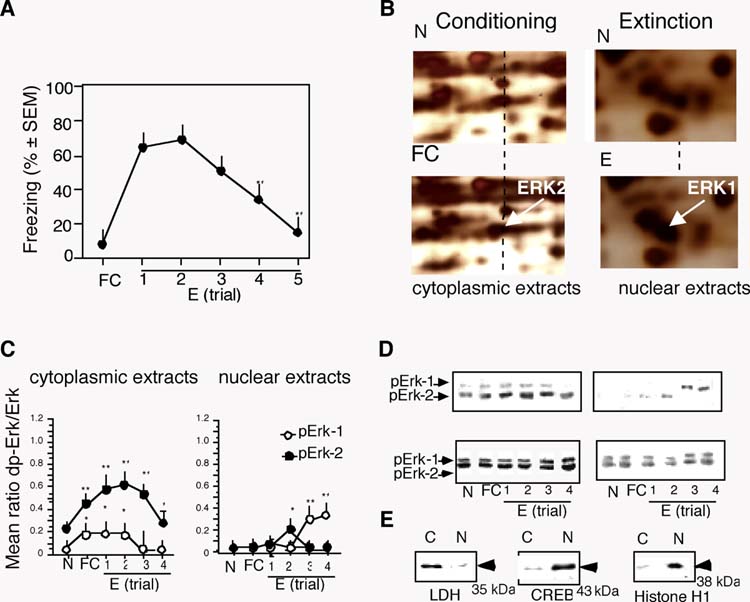
Fig. 1
Fig. 1
Up-regulation of hippocampal Erk-1 and Erk-2 during fear conditioning and extinction. (A) Time course of fear extinction revealed by decrease of freezing after nonreinforced contextual exposures. (B) Representative proteomic scans of cytoplasmic extracts obtained 1 hr after training (left), demonstrating increased phosphorylation of pErk-2; and nuclear extracts obtained 1 hr after the 4th extinction trial (right) demonstrating nuclear accumulation of Erk-1. (C) The levels of cytoplasmic pErk-1 and pErk-increased significantly after conditioning and extinction (left panel). Nuclear pErk-1 increased significantly after the 3th and 4th extinction trial (right panel). (D) Representative immunoblots. (E) The quality of nuclear extracts was examined by immunoblot experiments with antibodies detecting the nuclear proteins CREB and histone H1 and cytoplasmic protein LDH. Enrichment of the nucleoproteins was observed only in the nuclear extracts. The number of mice per group was 5. Statistically significant differences obtained by one-way ANOVA followed by the Scheffés test for multiple comparisons: *p < 0.01 vs N group; **p < 0.001 vs N group.
Fig. 2
Fig. 2
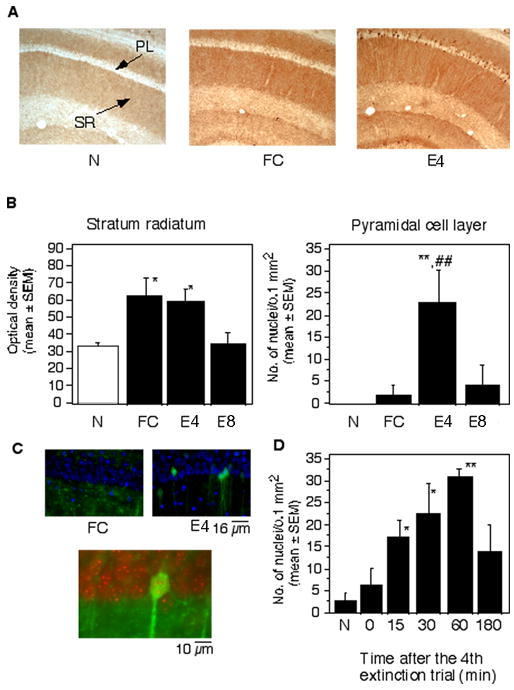
Localization of pErk-1/2 after conditioning and extinction. (A) Representative photomicrographs demonstrating the level of pErk-1/2 in the CA1 hippocampal area of mice of the N, FC and E groups. (B) Mean density of pErk-1/2 immunoreactivity in the stratum radiatum of the experimental groups (left). Mean number of cells per CA1 hippocampal area of the experimental groups (right). Statistically significant differences obtained by one-way ANOVA followed by the Scheffés test for multiple comparisons: *p < 0.01 vs N; **p < 0.001 vs N and T. PL, pyramidal cell layer; SR, Stratum radiatum. (C) Nuclear pErk-1/2 was not observed in mice exposed to training (upper left), whereas extinction triggered a significant increase of nuclear pErk-1/2 in hippocampal pyramidal neurons (upper right), as revealed by merged images with DAPI (blue) and pErk-1/2 (green). Below: DAPI digitized red and pErk-1/2 green show yellow overlapping signals. The mean percentage of Erk-1/2 positive nuclei in the extinction and training groups was 15.4 ± 7.8 and 0.5 ± 1.2, respectively. The number represents a mean ratio of Erk-/2 positive of a total of 200 nuclei counted in a single focal plane in 5 randomly chosen sections of the dorsal hippocampus/mouse. (D) The time course of pErk-1/2 up-regulation after the 4th extinction trial revealed a significant activation already after 15 min whereas 3 hr later the activated kinase was not detectable. Statistically significant differences were revealed by one-way ANOVA followed by Scheffés test : *p < 0.01, **p < 0.001 vs group sacrificed immediately after the extinction trial (0 min). The number of mice per group was 6 for each experiment.
Fig. 3
Fig. 3
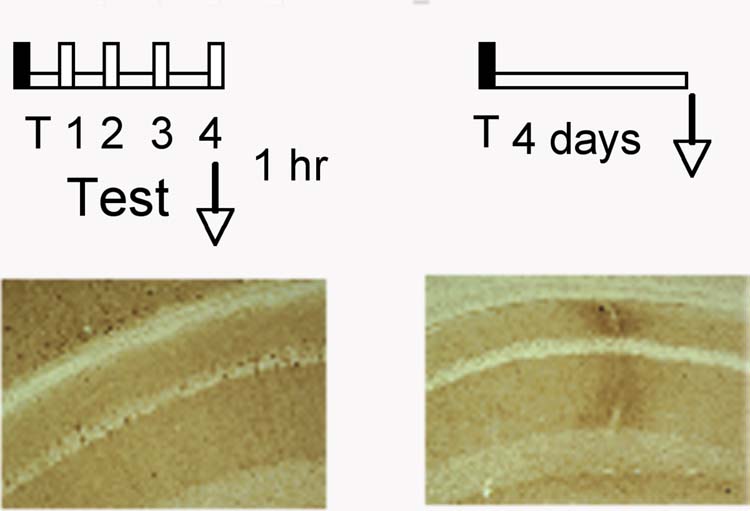
Increased pErk-1/2 after extinction is unrelated to the conditioning experience. Above: experimental design. Below: pErk-1/2 was observed in hippocampi of mice 1 hr after the exposure to the 4th extinction trial but not in trained mice without nonreinforced contextual exposures.
Fig. 4
Fig. 4
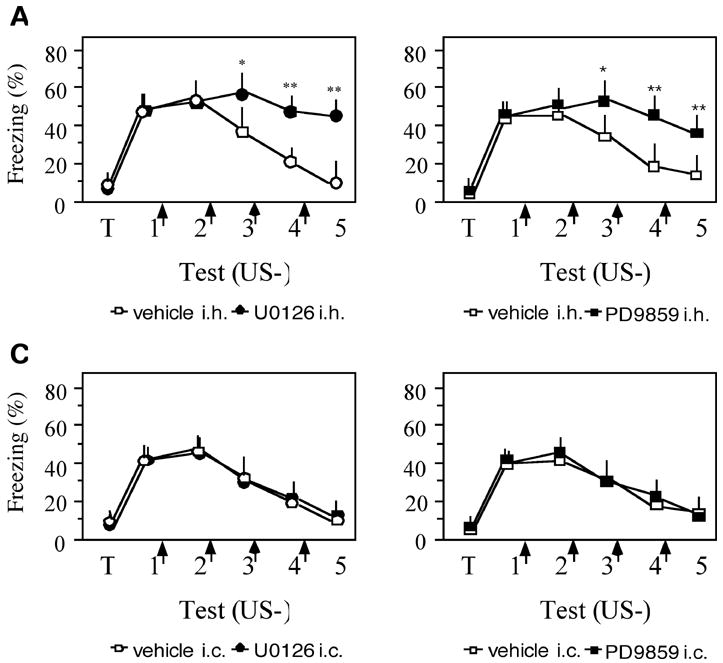
Mek inhibitors impair contextual fear extinction. (A) U0126 injected i.h. immediately after individual extinction trials prevented extinction as indicated by significantly higher freezing of U0126-injected mice when compared to their vehicle controls (p < 0.001). (B) PD9859 injected in the same fashion also impaired extinction (p < 0.001). (C) Injection of U0126 3 into the adjacent somatosensory cortex did not affect extinction when compared to the vehicle-injected control. (D) Similarly, PD9859 was ineffective after i.c. injection. No. of mice/group was 10–15. Statistically significant differences were revealed by one-way ANOVA followed by Scheffés test : *p < 0.01, **p < 0.001 vs vehicle control.
Fig. 5
Fig. 5
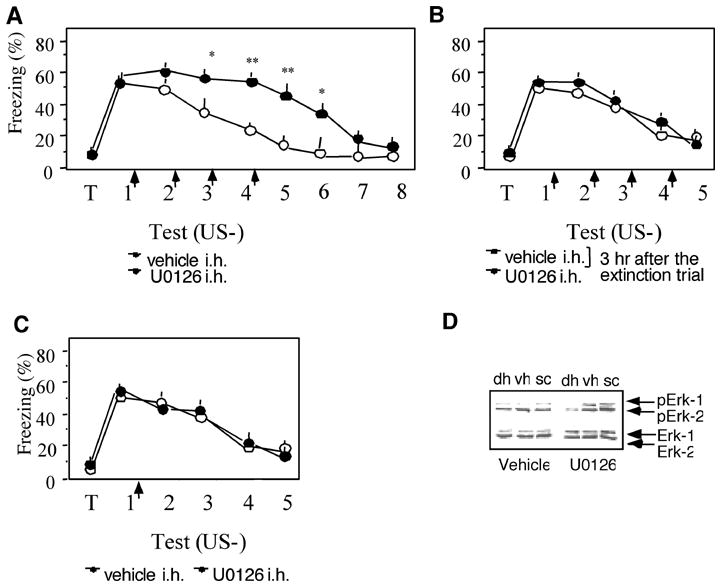
The effects of U0126 are reversible, specific and localized. (A) After cessation of i.h. treatment with U0126, mice rapidly extinguish the fear response, as revealed by similarly low freezing levels of U0126- and vehicle-injected mice. (B) Injection of U0126 3 hr after the extinction trial did not affect extinction when compared to the vehicle-injected control. (C) A single injection of U0126 after the first nonreinforced trial did not affect extinction. No. of mice/group was 8–11.(D) U0126 selectively reduced the levels of pErk-1/2 in total lysates of the dorsal hippocampus (DH), but not ventral hippocampus (VH) or somatosensory cortex (SC). The number of mice per group was 5.

References

    1. Atkins CM, Selcher JC, Petraitis JJ, Trzaskos JM, Sweatt JD. The MAPK cascade is required for mammalian associative learning. Nature Neuroscience. 1998;1:602–609. - PubMed
    1. Bhat RV, Engber TM, Finn JP, Koury EJ, Contreras PC, Miller MS, Dionne CA, Walton KM. Region-specific targets of p42/p44MAPK signaling in rat brain. Journal of Neurochemistry. 1998;70:558–571. - PubMed
    1. Buckley CT, Caldwell KK. Fear conditioning is associated with altered integration of PLC and ERK signaling in the hippocampus. Pharmacology Biochemistry and Behavior. 2004;79:633–640. - PubMed
    1. Buss KA, Davidson RJ, Kalin NH, Goldsmith HH. Context-specific freezing and associated physiological reactivity as a dysregulated fear response. Developmental Psychology. 2004;40:583–594. - PubMed
    1. Cannich A, Wotjak CT, Kamprath K, Hermann H, Lutz B, Marsicano G. CB1 cannabinoid receptors modulate kinase and phosphatase activity during extinction of conditioned fear in mice. Learning and Memory. 2004;11:625–632. - PMC - PubMed

Publication types

Substances