. 2006 Sep 26;103(39):14542-7.
doi: 10.1073/pnas.0604650103. Epub 2006 Sep 18.

Vibrio cholerae virulence regulator-coordinated evasion of host immunity

Affiliations

Vibrio cholerae virulence regulator-coordinated evasion of host immunity

Ansel Hsiao et al. Proc Natl Acad Sci U S A. .

Abstract

To successfully propagate and cause disease, pathogenic bacteria must modulate their transcriptional activities in response to pressures exerted by the host immune system, including secreted immunoglobulins such as secretory IgA (S-IgA), which can bind and agglutinate bacteria. Here, we present a previously undescribed flow cytometry-based screening method to identify bacterial genes expressed in vitro and repressed during infections of Vibrio cholerae, an aquatic Gram-negative bacterium responsible for the severe diarrheal disease cholera. We identified a type IV mannose-sensitive hemagglutinin (MSHA) pilus that is repressed specifically in vivo. We showed that bacteria that failed to turn off MSHA biosynthesis were unable to colonize the intestines of infant mice in the presence of S-IgA. We also found that V. cholerae bound S-IgA in an MSHA-dependent and mannose-sensitive fashion and that binding of S-IgA prevented bacteria from penetrating mucus barriers and attaching to the surface of epithelial cells. The ability of V. cholerae to evade the non-antigen-specific binding of S-IgA by down-regulating a surface adhesin represents a previously undescribed mechanism of immune evasion in pathogenic bacteria. In addition, we found that repression of MSHA was mediated by the key virulence transcription factor ToxT, indicating that V. cholerae is able to coordinate both virulence gene activation and repression to evade host defenses and successfully colonize intestines.


Conflict of interest statement

The authors declare no conflict of interest.

Figures

Fig. 1.
Fig. 1.
V. cholerae msh expression is repressed during infection. (A) FACS analysis of strains contain PLtetO-1-gfp and either Pmsh-tetR or Plac-tetR grown in vitro and in vivo. Bacteria were grown in LB at 37°C or incubated in 5-day-old infant mice for 12 h and were analyzed by flow cytometry. (B) Real-time PCR analysis of msh transcription in vitro and in vivo. RNA isolated from in vitro growth and in vivo growth was normalized against 16S RNA, and the ratio of in vivo to in vitro expression was presented. The results are representative of three experiments ± SD, and representative fields are shown.
Fig. 2.
Fig. 2.
Constitutive expression of MSHA (mshC) impairs colonization of infant mice. Infant WT and S-IgA knockout mice were infected intragastrically with mixed suspensions of WT and mshC bacteria and were either isolated from their mother or allowed to suckle. The symbols indicate mutant/WT output ratios for individual mice (n = 3–6). Output ratios have been normalized to input ratios.
Fig. 3.
Fig. 3.
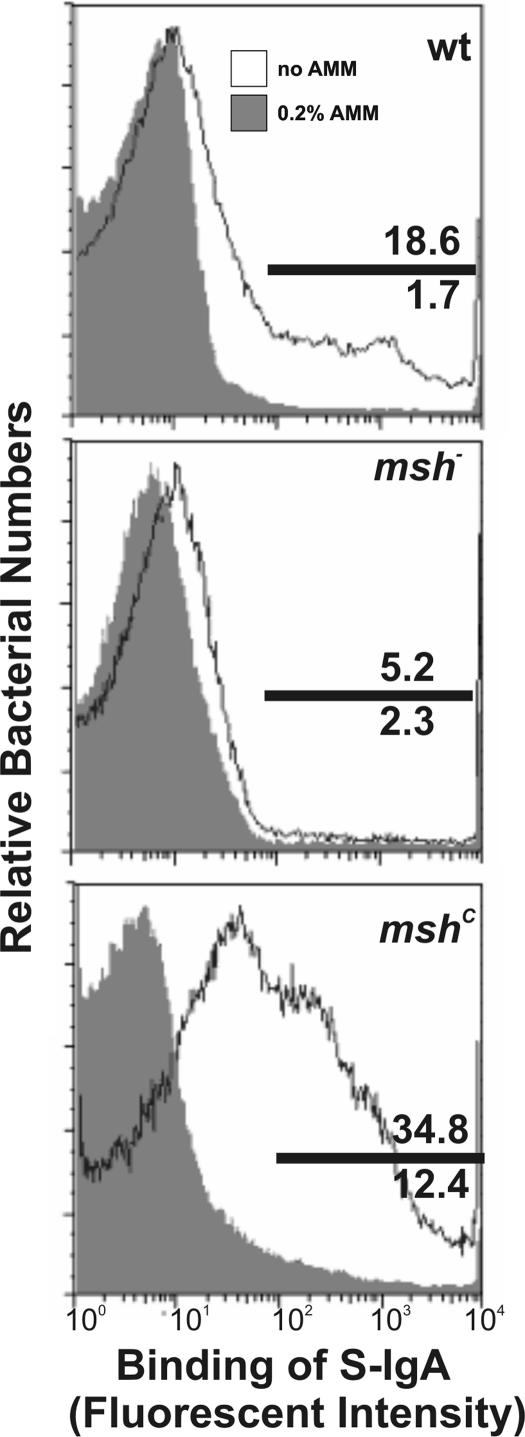
S-IgA binding to V. cholerae is MSHA-dependent and mannose-sensitive. Mid-log V. cholerae strains were incubated with or without S-IgA for 1 h. Samples then were stained with FITC-conjugated IgG fraction anti-S-IgA in the absence (open histogram) or presence (filled histogram) of α-methyl-mannoside (AMM) and analyzed by flow cytometry. Binding of S-IgA is represented as the fluorescent intensity. Representative FACS plots are shown.
Fig. 4.
Fig. 4.
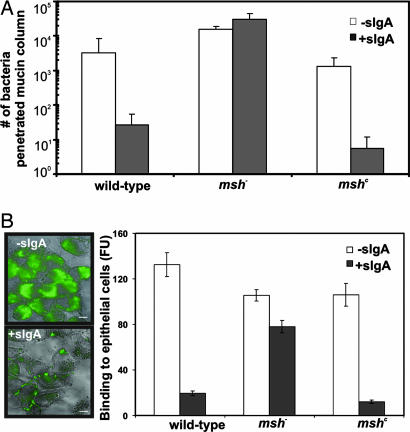
The effects of S-IgA binding on V. cholerae. (A) S-IgA inhibits passage of V. cholerae through mucous barriers. V. cholerae strains with or without S-IgA treatment were loaded on top of 500-μl mucin columns for 20 min. Fractions were collected from the bottom of the column after 20 min, and bacteria were quantified by serial dilution. (B) S-IgA inhibits binding of V. cholerae to HEp-2 epithelial cells. V. cholerae strains expressing GFP were treated with or without S-IgA and added to confluent HEp-2 cell culture grown on coverslips at multiplicity of infection = 100. Cells were then washed of unbound bacteria and examined by fluorescence microscopy. Cells also were lysed, and GFP fluorescence was measured by using a plate reader. FU, arbitrary fluorescence unit. The results are representative of three experiments ± SD; representative fields are shown.
Fig. 5.
Fig. 5.
ToxT represses msh expression. (A) In vitro virulence-inducing conditions lead to loss of mannose-sensitive hemagglutination. V. cholerae strains were grown in LB or AKI medium and assayed for MSHA production by hemagglutination and TcpA production by a Western blot. Two-fold dilutions of mid-log cultures of bacteria (left to right on each image) were assayed for their ability to agglutinate washed sheep erythrocytes. Assay was repeated three times, and representative results are shown. (B) ToxT mediates repression of msh transcription. V. cholerae containing msh-lacZ transcriptional fusions were grown in LB and AKI and assayed for β-gal activity. The results are representative of three experiments ± SD. (C) ToxT represses the msh promoter in E. coli. E. coli strains harboring plasmids containing msh-lacZ and either PBAD-toxT (17) or the vector control (18) were incubated in the absence or in the presence of 0.1% arabinose until stationary phase and assayed for β-gal activity. The results are representative of three experiments ± SD.

References

    1. Faruque SM, Albert MJ, Mekalanos JJ. Microbiol Mol Biol Rev. 1998;62:1301–1314. - PMC - PubMed
    1. Reidl J, Klose KE. FEMS Microbiol Rev. 2002;26:125–139. - PubMed
    1. Woof JM, Kerr MA. J Pathol. 2006;208:270–282. - PubMed
    1. Lee SH, Hava DL, Waldor MK, Camilli A. Cell. 1999;99:625–634. - PubMed
    1. Krukonis ES, DiRita VJ. Curr Opin Microbiol. 2003;6:186–190. - PubMed

Publication types

MeSH terms

LinkOut - more resources