. 2006 Sep 26;103(39):14349-54.
doi: 10.1073/pnas.0603748103. Epub 2006 Sep 18.

Hydroxymalonyl-acyl carrier protein (ACP) and aminomalonyl-ACP are two additional type I polyketide synthase extender units

Affiliations

Hydroxymalonyl-acyl carrier protein (ACP) and aminomalonyl-ACP are two additional type I polyketide synthase extender units

Yolande A Chan et al. Proc Natl Acad Sci U S A. .

Abstract

Combinatorial biosynthesis of type I polyketide synthases is a promising approach for the generation of new structural derivatives of polyketide-containing natural products. A target of this approach has been to change the extender units incorporated into a polyketide backbone to alter the structure and activity of the natural product. One limitation to these efforts is that only four extender units were known: malonyl-CoA, methylmalonyl-CoA, ethylmalonyl-CoA, and methoxymalonyl-acyl carrier protein (ACP). The chemical attributes of these extender units are quite similar, with the exception of the potential hydrogen bonding interactions by the oxygen of the methoxy moiety. Furthermore, the incorporated extender units are not easily modified by using simple chemical approaches when combinatorial biosynthesis is coupled to semisynthetic chemistry. We recently proposed the existence of two additional extender units, hydroxymalonyl-ACP and aminomalonyl-ACP, involved in the biosynthesis of zwittermicin A. These extender units offer unique possibilities for combinatorial biosynthesis and semisynthetic chemistry because of the introduction of free hydroxyl and amino moieties into a polyketide structure. Here, we present the biochemical and mass spectral evidence for the formation of these extender units. This evidence shows the formation of ACP-linked extender units for polyketide synthesis. Interestingly, aminomalonyl-ACP formation involves enzymology typically found in nonribosomal peptide synthesis.


Conflict of interest statement

The authors declare no conflict of interest.

Figures
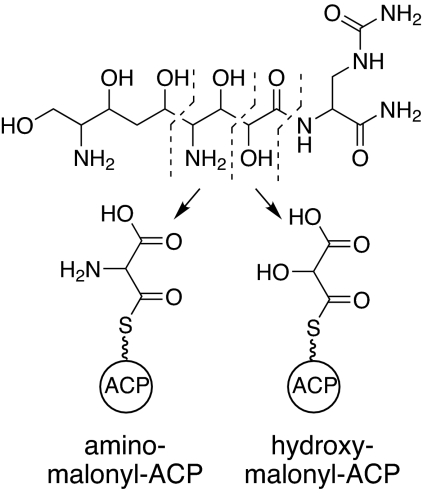
Fig. 1.
Fig. 1.
Chemical structures of ZMA (Upper) and the proposed ACP-linked type I PKS extender units (Lower). Dashed lines in ZMA structure delineate the ethanolamine and glycolyl moieties. These moieties are derived from aminomalonyl-ACP and hydroxymalonyl-ACP, respectively.
Fig. 2.
Fig. 2.
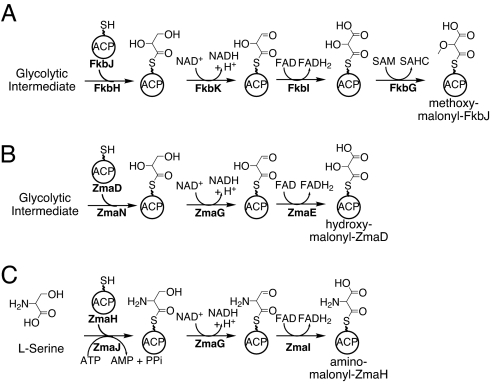
Proposed pathways for ACP-linked PKS extender units. (A) MM-ACP formation during FK520 biosynthesis. (B) HM-ACP formation during ZMA biosynthesis. (C) AM-ACP formation during ZMA biosynthesis. The squiggle denotes the 4′ Ppant prosthetic groups of the ACPs. For correlating previous Orf names (3) to those shown above: ZmaD, Orf3; ZmaE, Orf1; ZmaG, Orf4; ZmaH, Orf5; ZmaI, Orf6; ZmaJ, Orf7.
Fig. 3.
Fig. 3.
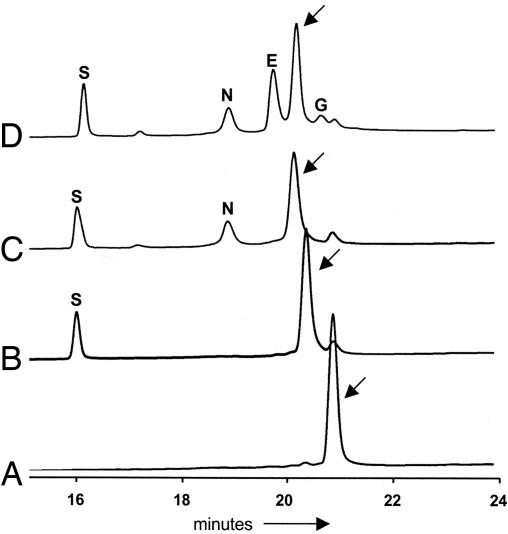
HPLC analysis of ZmaD. Representative HPLC traces of reaction mixtures containing apo-ZmaD (A); apo-ZmaD, Sfp (B); apo-ZmaD, Sfp, ZmaN (C); apo-ZmaD, Sfp, ZmaN, ZmaG, ZmaE (D). Protein elution was monitored at 220 nm. Arrows identify the peak associated with ZmaD derivatives, which were collected and analyzed by MS. The letters above absorbance peaks identify the elution of a protein from the reaction mixture: S, Sfp; N, ZmaN; E, ZmaE; G, ZmaG.
Fig. 4.
Fig. 4.
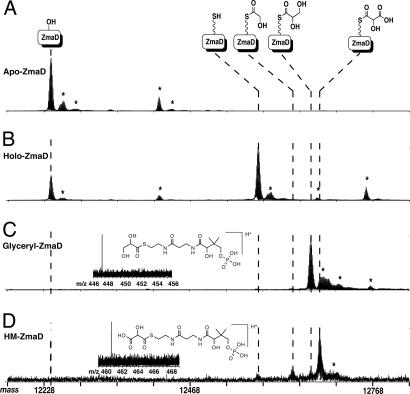
ESI-FT-ICR-MS spectra of the intermediates in HM-ZmaD formation. The top of the figure depicts ZmaD intermediates of interest [from left to right: apo-, holo- (+340 Da), glycolyl- (+398 Da), glyceryl- (+428 Da), and HM-ZmaD (+442 Da)] and alignment to the representative peaks in the mass spectra as indicated by vertical dashed lines. Shown are the loading and corresponding mass shifts (1,015–1,070 m/z, +12 ions converted to mass scale) of apo-ZmaD (A), holo-ZmaD (B), glyceryl-ZmaD (C), and HM-ZmaD (D); asterisks indicate signals arising from artifactual adduction: sodium (+22 Da), potassium (+38 Da), phosphate (+98 Da), and oxidation of Met/Cys residues (+16 Da). (Insets) Mass spectra and structures of 4′ Ppant elimination product.
Fig. 5.
Fig. 5.
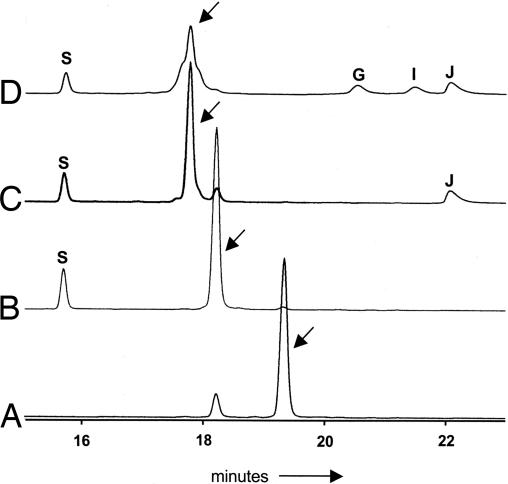
HPLC analysis of ZmaH. Representative HPLC traces of reaction mixtures containing apo-ZmaH (A); apo-ZmaH, Sfp (B); apo-ZmaH, Sfp, ZmaJ (C); and apo-ZmaH, Sfp, ZmaJ, ZmaG, ZmaI (D). Each reaction also contained the required cofactors and substrates. Protein elution was monitored at 220 nm. Arrows identify the peak associated with ZmaH derivatives, which were collected and analyzed by MS. The letters above peaks identify the elution of a protein in the reaction mixture: S, Sfp; G, ZmaG; I, ZmaI; J, ZmaJ.
Fig. 6.
Fig. 6.
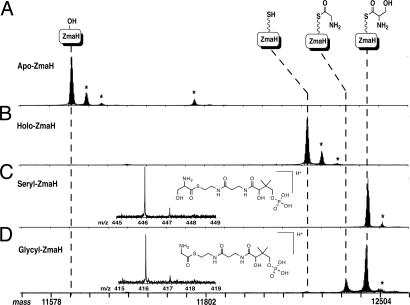
ESI-FT-ICR-MS spectra of the intermediates in AM-ZmaH formation. The top of the figure depicts ZmaH intermediates of interest [from left to right: apo-, holo- (+340 Da), glycyl- (+397 Da), seryl-ZmaH (+427 Da)], and alignment to the representative peaks in the mass spectra are as indicated by vertical dashed lines. Shown are the loading and corresponding mass shifts (825–865 m/z, +14 ions converted to mass scale) of apo-ZmaH (A), holo-ZmaH (B), seryl-ZmaH (C), and glycyl-ZmaH (D); asterisks indicate signals arising from artifactual adduction: sodium (+22 Da), potassium (+38 Da), phosphate (+98 Da), and oxidation of Met/Cys residues (+16 Da). (Insets) Mass spectra and structures of 4′ Ppant elimination product.

References

    1. Rawlings BJ. Nat Prod Rep. 2001;18:231–281. - PubMed
    1. McDaniel R, Thamchaipenet A, Gustafsson C, Fu H, Betlach M, Ashley G. Proc Natl Acad Sci USA. 1999;96:1846–1851. - PMC - PubMed
    1. Emmert EAB, Klimowicz AK, Thomas MG, Handelsman J. Appl Environ Microbiol. 2004;70:104–113. - PMC - PubMed
    1. Wu K, Chung L, Revill WP, Katz L, Reeves CD. Gene. 2000;251:81–90. - PubMed
    1. Rascher A, Hu Z, Viswanathan N, Schirmer A, Reid R, Nierman WC, Lewis M, Hutchinson CR. FEMS Microbiol Lett. 2003;218:223–230. - PubMed

Publication types

MeSH terms

Associated data

LinkOut - more resources