


Combinations of biomarkers predictive of later life mortality
- PMID: 16983099
- PMCID: PMC1599928
- DOI: 10.1073/pnas.0606215103
Combinations of biomarkers predictive of later life mortality
Abstract
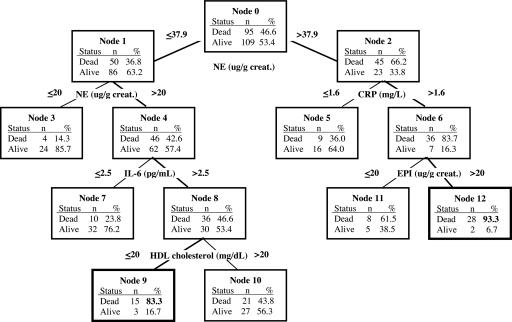
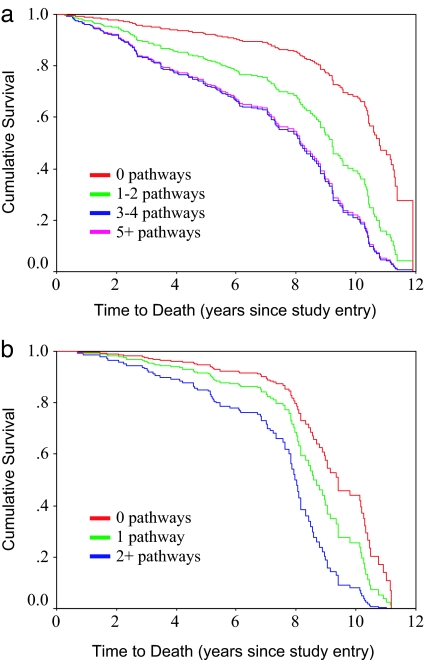
A wide range of biomarkers, reflecting activity in a number of biological systems (e.g., neuroendocrine, immune, cardiovascular, and metabolic), have been found to prospectively predict disability, morbidity, and mortality outcomes in older adult populations. Levels of these biomarkers, singly or in combination, may serve as an early warning system of risk for future adverse health outcomes. In the current investigation, 13 biomarkers were examined as predictors of mortality occurrence over a 12-year period in a sample of men and women (n = 1,189) 70-79 years of age at enrollment into the study. Biomarkers examined in analyses included markers of neuroendocrine functioning (epinephrine, norepinephrine, cortisol, and dehydroepiandrosterone), immune activity (C-reactive protein, fibrinogen, IL-6, and albumin), cardiovascular functioning (systolic and diastolic blood pressure), and metabolic activity [high-density lipoprotein (HDL) cholesterol, total to HDL cholesterol ratio, and glycosylated hemoglobin]. Recursive partitioning techniques were used to identify a set of pathways, composed of combinations of different biomarkers, that were associated with a high-risk of mortality over the 12-year period. Of the 13 biomarkers examined, almost all entered into one or more high-risk pathways although combinations of neuroendocrine and immune markers appeared frequently in high-risk male pathways, and systolic blood pressure was present in combination with other biomarkers in all high-risk female pathways. These findings illustrate the utility of recursive partitioning techniques in identifying biomarker combinations predictive of mortal outcomes in older adults, as well as the multiplicity of biological pathways to mortality in elderly populations.
Conflict of interest statement
The authors declare no conflict of interest.
Figures
References
-
- Danesh J, Collins R, Appleby P, Peto R. J Am Med Assoc. 1998;279:1477–1482. - PubMed
-
- Harris TB, Ferrucci L, Tracy RP, Corti MC, Wacholder S, Ettinger WH, Jr, Heimovitz H, Cohen HJ, Wallace R. Am J Med. 1999;106:506–512. - PubMed
-
- Seeman TE, Gruenewald TL. In: Medical and Psychiatric Comborbidity over the Course of Life, Eaton WW, editor. Washington, DC: American Psychiatric Publishing; 2006. pp. 179–196.
-
- Seeman TE, Crimmins E, Singer B, Bucur A, Huang M, Gruenewald TL, Berkman LF, Reuben DB. Soc Sci Med. 2004;58:1985–1997. - PubMed
-
- McEwen BS. Metabolism. 2003;52:10–16. - PubMed
Publication types
MeSH terms
Substances
Grants and funding
LinkOut - more resources
Full Text Sources
Other Literature Sources
Research Materials
