Review
. 2006 Oct;97(10):977-83.
doi: 10.1111/j.1349-7006.2006.00299.x.

Molecular functions and biological roles of hepatitis B virus x protein

Affiliations
Review

Molecular functions and biological roles of hepatitis B virus x protein

Hong Tang et al. Cancer Sci. 2006 Oct.

Abstract

Chronic infection of hepatitis B virus (HBV) is one of the major causes of hepatocellular carcinoma (HCC) in the world. Hepatitis B virus X protein (HBx) has been long suspected to be involved in hepatocarcinogenesis, although its oncogenic role remains controversial. HBx is a multifunctional regulator that modulates transcription, signal transduction, cell cycle progress, protein degradation pathways, apoptosis, and genetic stability by directly or indirectly interacting with host factors. This review focuses on the biological roles of HBx in HBV replication and cellular transformation in terms of the molecular functions of HBx. Using the transient HBV replication assay, ectopically expressed HBx could stimulate HBV transcription and replication with the X-defective replicon to the level of those with the wild one. The transcription coactivation is mainly contributing to the stimulatory role of HBx on HBV replication although the other functions may affect HBV replication. Effect of HBx on cellular transformation remains controversial and was never addressed with human primary or immortal cells. Using the human immortalized primary cells, HBx was found to retain the ability to overcome active oncogene RAS-induced senescence that requires full-length HBx. At least two functions of HBx, the coactivation function and the ability to overcome oncogene-induced senescence, may be cooperatively involved in HBV-related hepatocarcinogenesis.


Figures
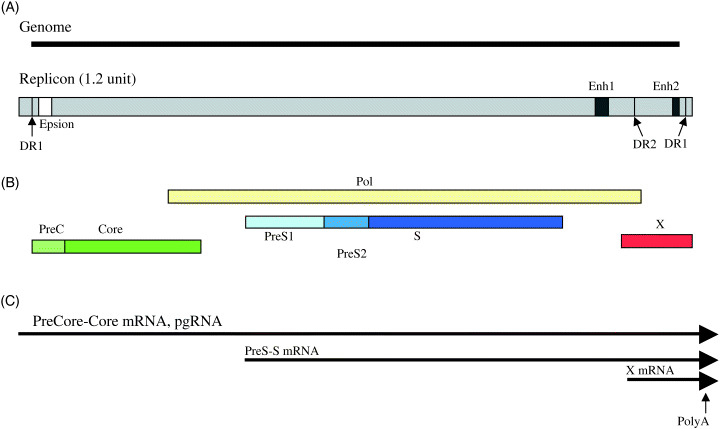
Figure 1
Figure 1
The HBV replication unit and genome structure. (A) Top is the linealized HBV genome. Bottom is the 1.2 genome‐unit of HBV DNA that is enough to synthesize pregenome (pg)RNA and DNA replication. DR1 and DR2 are the direct repeats, and the epsilon stem and loop structure in pgRNA is critical for the initiation of DNA replication. (B) The open reading frames of four genes are shown.( 1 ) (C) Major transcripts of HBV are shown. Enh1 positively regulates three transcripts, and Enh2 mainly contributes to transcription of pgRNA and PreC‐C mRNA.( 9 )
Figure 2
Figure 2
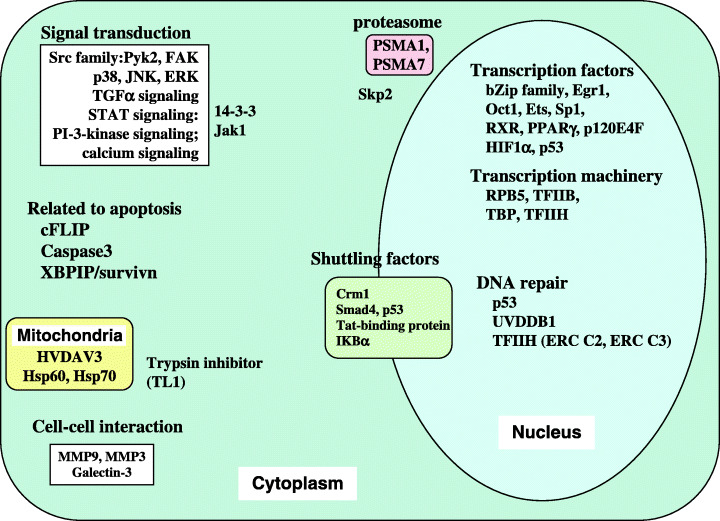
Host factors and functions modulated by HBx. The reported HBx‐interacting factors are shown. The functions and the targets shown in the white box are modulated by HBx. No HBx‐interacting partner related to these factors has been specified and HBx augments transcription of the factors. Some factors are described in previous reviews,( 2 , 3 ) and the HBx‐interacting proteins Skp2, p120E4F, and cFLIP were recently reported.( 70 , 71 , 72 )
Figure 3
Figure 3
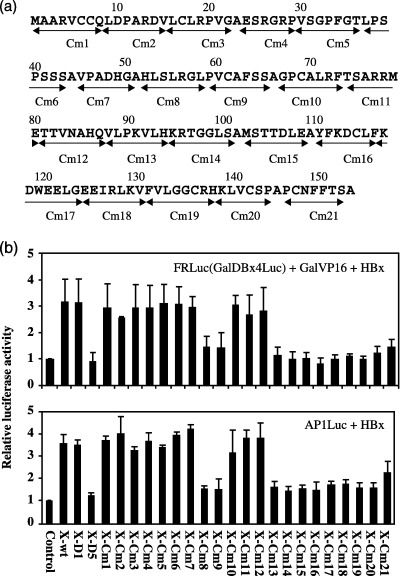
Mapping of the HBx sequences necessary for coactivation and ‘transactivation’. (a) The amino acid sequence of HBx and a library of the clustered alanine substitution mutants (Cm1–Cm21) are shown. Each HBx‐Cm mutant harbors six or seven amino acid substitutions in a row.( 27 ) Transient expression of the HBx‐Cm mutants was similar to that of the wild HBx.( 27 ) (b) Transcription assay in vivo using luciferase reporters. Top is the coactivation assay. HepG2 cells were transiently introduced by pGalVP16 expressing the transactivator, pFR‐luc harboring the DNA‐binding sites for Gal4 and the luciferase gene, and the HBx expression plasmid. Control is the vacant plasmid, HBx‐D1 (aa 51–154) harbors the coactivation domain, and HBx‐D5 (aa 1–50) includes the negative regulatory domain. Bottom is the ‘transactivation’ assay using AP1‐Luc reporter and the HBx expression plasmid. A series of mutants, X‐Cm1 to X‐Cm21, are shown in (a). The results were according to the report by Tang et al.( 27 )
Figure 4
Figure 4
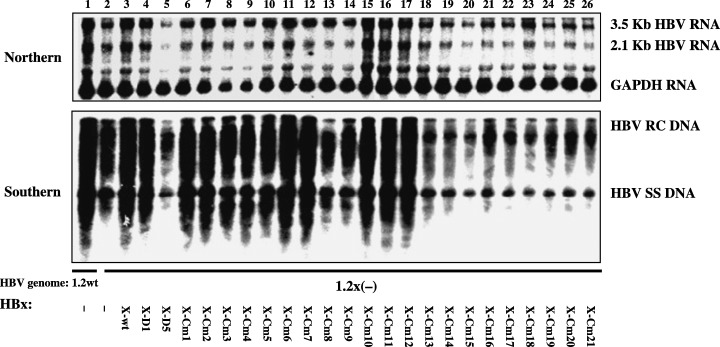
Mapping of the HBx sequences required for the stimulation effect on HBV transcription and replication. HepG2 cells were transiently transfected with the wild‐type HBV construct payw1.2 (1.2wt, lane 1) or the HBx‐minus HBV construct payw 7 (1.2X(–), lanes 2–26) plus empty vector control (–, lanes 1 and 2), full‐length HBx expression vector (X‐wt, lane 3), different truncated HBx expression vectors (X‐D1, lane 4; X‐D5, lane 5), or a series of clustered mutated HBx expression vectors (X‐Cm1 to X‐Cm21, lanes 6–26, respectively). Top is RNA (Northern) hybridization analysis of HBV transcripts. The glyceraldehyde 3‐phosphate dehydrogenase (GAPDH) transcript was used as an internal control for RNA loading per lane. Bottom is DNA (Southern) hybridization analysis of HBV replication intermediates. HBV RC DNA, HBV relaxed circular DNA; HBV SS DNA, HBV single‐stranded DNA. The results were according to the report by Tang et al.( 27 )

References

    1. Arbuthnot P, Kew M. Hepatitis B virus and hepatocellular carcinoma. Int J Exp Pathol 2001; 82: 77–100. - PMC - PubMed
    1. Murakami S. Hepatitis B Virus X protein: structure, function biology. Intervirol 1999; 42: 82–99. - PubMed
    1. Murakami S. Hepatitis B Virus X protein: a multifunctional regulatory protein. J Gastroenterol 2001; 36: 651–60. - PubMed
    1. Kajino K, Aoki H, Hino O. Genomic instability involved in virus‐related hepatocarcinogenesis. Intervirol 1995; 38: 170–2. - PubMed
    1. Chisari FV. Hepatitis B virus transgenic mice: models of viral immunobiology and pathogenesis. Curr Top Microbiol Immunol 1996; 206: 149–73. - PubMed

Publication types

MeSH terms

Substances