


Botulinum toxin: poisoning the spastic bladder and urethra
- PMID: 16985657
- PMCID: PMC1475967
Item in Clipboard
Botulinum toxin: poisoning the spastic bladder and urethra
Rev Urol.
2002 Spring.
Abstract
Botulinum toxin has proven to be a safe and effective therapy for a variety of somatic and autonomic motor disorders. Urologists are now finding clinical success with urethral and bladder injection of this fascinating toxin for detrusor sphincter dyssynergia, conditions of pelvic floor spasticity, and overactive bladder. One cannot deny the ingenuity of man in transforming the lethal toxin of Clostridium botulinum into a modern day therapeutic medicine.
Figures
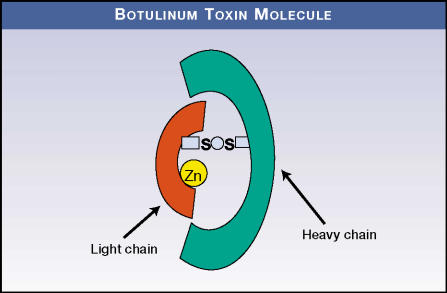
Illustration of the active, dichain polypeptide form of botulinum toxin. The parent chain is cleaved into a heavy chain (~100 kDa) connected by a disulfide bond to a light chain (~50kDa) with an associated zinc (Zn) atom.
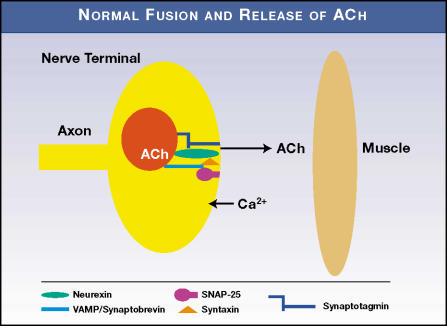
Schematic diagram of a nerve terminal indicating the normal fusion of the synaptic vesicles with the plasma membrane. ACh, acetylcholine; VAMP, vesicle-associated membrane protein; SNAP-25, synaptosome-associated protein 25 KDa.
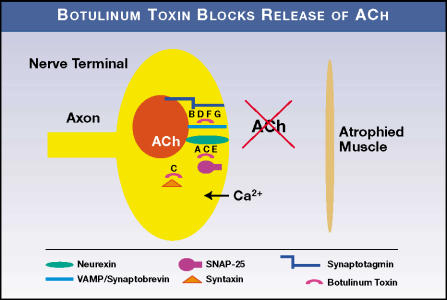
Schematic diagram of a nerve terminal indicating the blocking effect of botulinum toxin on normal fusion of the synaptic vesicles with the plasma membrane. Note after blocking of the vesicle transport by botulinum toxin, no acetylcholine (ACh) release occurs, leading to muscle atrophy. VAMP, vesicle-associated membrane protein; SNAP-25, synaptosome-associated protein 25 KDa.
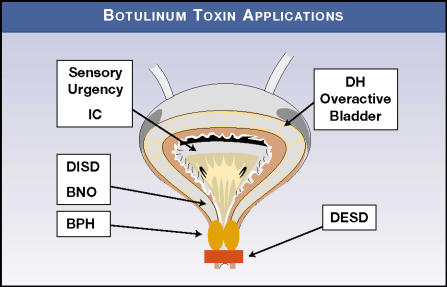
Current and potential future targets for botulinum toxin within the lower urinary tract. IC, interstitial cystitis; DH, detrusor hyperreflexia; DISD, detrusor internal sphincter dyssynergia; BNO, bladder neck obstruction; BPH, benign prostatic hyperplasia; DESD, detrusor external sphincter dyssynergia.
References
-
- Ueber einen neuen anaeroben Bacillus and seine Beziehungen zum Botulisms. Ztsch Hyg Infekt. 1987;26:1–56. (Ger).
-
- Grazko MA, Polo KB, Jabbari B. Botulinum toxin A for spasticity, muscle spasms, and rigidity. Neurology. 1995;45:712–717. - PubMed
-
- Petit H, Wiart E, Gaujard E, et al. Botulinum A toxin treatment for detrusor-sphincter dyssynergia in spinal cord disease. Spinal Cord. 1998;36:91–94. - PubMed
-
- Dykstra DD, Sidi A. Treatment of detrusor-sphincter dyssyngeria with botulinum A toxin: a double blind study. Arch Phys Med Rehabil. 1990;71:24–26. - PubMed
LinkOut - more resources
Full Text Sources