Review
. 2006 Oct 15;15 Spec No 2(SPEC):R253-61.
doi: 10.1093/hmg/ddl180.

Challenges and opportunities in dystrophin-deficient cardiomyopathy gene therapy

Affiliations
Review

Challenges and opportunities in dystrophin-deficient cardiomyopathy gene therapy

Dongsheng Duan. Hum Mol Genet. .

Abstract

The last decade has evidenced unprecedented progress in gene therapy of Duchenne and Becker muscular dystrophy (DMD and BMD) skeletal muscle disease. Cardiomyopathy is a leading cause of morbidity and mortality in both patients and carriers of DMD, BMD and X-linked dilated cardiomyopathy. However, there is little advance in heart gene therapy. The gene, the vector, vector delivery, the target tissue and animal models are five fundamental components in developing an effective gene therapy. Intensive effort has been made in optimizing gene transfer vectors and methods. Systemic and/or local delivery of recombinant adeno-associated viral vector have resulted in widespread transduction in the rodent heart. The current challenge is to define other parameters that are essential for a successful gene therapy such as the best candidate gene(s), the optimal expression level and the target tissue. This review focuses on these long-ignored aspects and points out future research directions. In particular, we need to address whether all or only some of the recently developed mini- and microgenes are protective in the heart, whether partial correction can lead to whole heart function improvement, whether over-expression is hazardous and whether correcting skeletal muscle disease can slow down or stop the progression of cardiomyopathy. Discussion is also made on whether the current mouse models can meet these research needs.


Figures
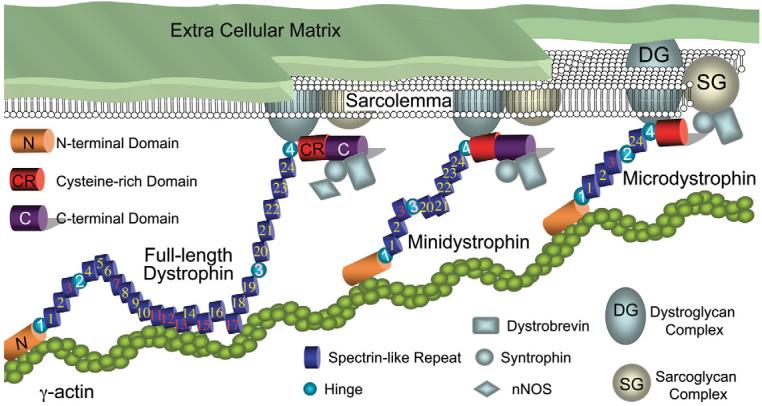
Figure 1
Figure 1
Schematic outline of full-length dystrophin, minidystrophin and microdystrophin and their interaction with other cellular proteins. Spectrin-like repeats are numbered from 1 to 24 (positively charged repeats are in red color, other repeats are in yellow color). Proline-rich hinges are numbered from 1 to 4. Hinge 3 is in pink color to indicate that it can be cleaved by viral protease. Hinge 2 to repeat 19 are deleted in minidystrophin. Repeat 4–23 and the C-terminal domain are deleted in microdystrophin. Not drawn to scale.
Figure 2
Figure 2
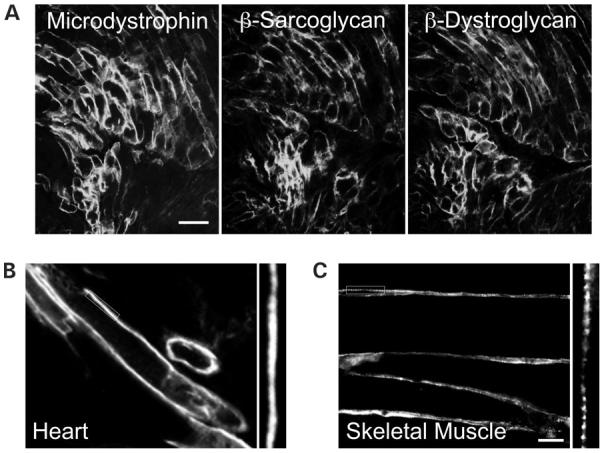
Microdystrophin restores the DGC and displays a no-interrupted expression pattern along the sarcolemma in the mdx heart. Microdystrophin was delivered to the neonatal mdx heart by AAV vector. Transgene expression was examined when mice were 10-month-old. (A) Serial sections showing co-localization of microdystrophin with two other major components of the DGC, β-sarcoglycan and β-dystroglycan. Scale bar: 50 μm. Adapted from Yue et al. (2003) Circulation, 108, 1626. (B) Continuous labeling of microdystrophin along the sarcolemma in the heart. (C) To study microdystrophin expression in skeletal muscle, an AAV virus carrying the microgene was injected into the limb muscle in 2-month-old mdx mice. Immunofluorescence staining was performed 3 months later. Microdystrophin displays a punctate staining pattern in skeletal muscle. Scale bar: 20 μm (this bar also applies to B). In B and C, high magnification photomicrographs of the boxed areas are highlighted in the sides, respectively.
Figure 3
Figure 3
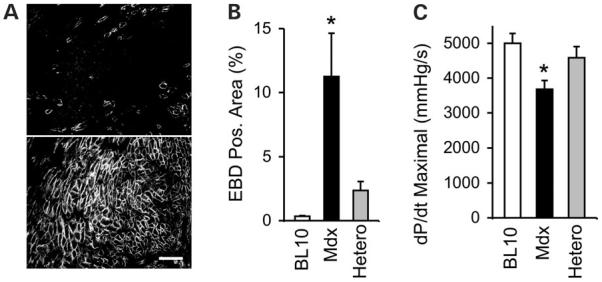
Mosaic dystrophin expression in heterozygous mdx mice protects the heart from stress-induced cardiomyopathy. (A) Dystrophin expression in the heart of heterozygous female mice. Top and bottom panels depict regions of low and high dystrophin expression, respectively. Scale bar: 100 μm. (B) Quantification of sarcolemma damage (EBD positive area) in the hearts of different mouse strains following β-isoproterenol challenge. (C) Correction of hemodynamic defect in heterozygous mice. Bar graph shows the dP/dt maximal. Asterisk denotes results in mdx were significantly different from these in BL10 or heterozygous mice. EBD, Evans blue dye; Hetero, heterozygous mice. Adapted from Yue et al. (2004) Hum. Mol. Genet., 13, 1669.
Figure 4
Figure 4
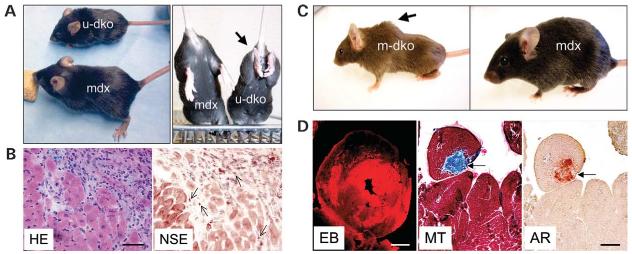
Utrophin/dystrophin (u-dko) and myoD/dystrophin (m-dko) double knock-out mice recapitulate the clinical phenotype in DMD patients. (A) U-dko mice are significantly smaller than age and sex-matched mdx mice (left panel). U-dko mice also display abnormal hind limb contracture (arrow, right panel). (B) Inflammation in the heart of a 2-month-old Grady strain u-dko mouse. HE, hematoxylin–eosin stain; NSE, non-specific esterase stain for macrophage. Arrows, macrophage. Scale bar: 50 μm. (C) Scoliosis (arrow) is a common feature in 5-month-old m-dko mice, but it is absent in age- and sex-matched mdx mice. (D) Representative heart pathology in m-dko mice. EBD uptake in 4-month-old m-dko heart; scale bar: 1 mm. MT and AR, Masson trichrome (for fibrosis, arrow) and Alizarin red (for calcification, arrow) stain, respectively; scale bar: 100 μm.

References

    1. Campbell KP, Kahl SD. Association of dystrophin and an integral membrane glycoprotein. Nature. 1989;338:259–262. - PubMed
    1. Petrof BJ. The molecular basis of activity-induced muscle injury in Duchenne muscular dystrophy. Mol. Cell Biochem. 1998;179:111–123. - PubMed
    1. Rando TA. The dystrophin-glycoprotein complex, cellular signaling, and the regulation of cell survival in the muscular dystrophies. Muscle Nerve. 2001;24:1575–1594. - PubMed
    1. Beggs AH, Hoffman EP, Snyder JR, Arahata K, Specht L, Shapiro F, Angelini C, Sugita H, Kunkel LM. Exploring the molecular basis for variability among patients with Becker muscular dystrophy: dystrophin gene and protein studies. Am. J. Hum. Genet. 1991;49:54–67. - PMC - PubMed
    1. Hoffman EP. Genotype/phenotype correlations in Duchenne/ Becker dystrophy. Mol. Cell Biol. Hum. Dis. Ser. 1993;3:12–36. - PubMed

Publication types

MeSH terms