


Culture-independent analyses of temporal variation of the dominant fecal microbiota and targeted bacterial subgroups in Crohn's disease
- PMID: 16988018
- PMCID: PMC1698357
- DOI: 10.1128/JCM.00312-06
Culture-independent analyses of temporal variation of the dominant fecal microbiota and targeted bacterial subgroups in Crohn's disease
Erratum in
- J Clin Microbiol. 2007 May;45(5):1671
Abstract
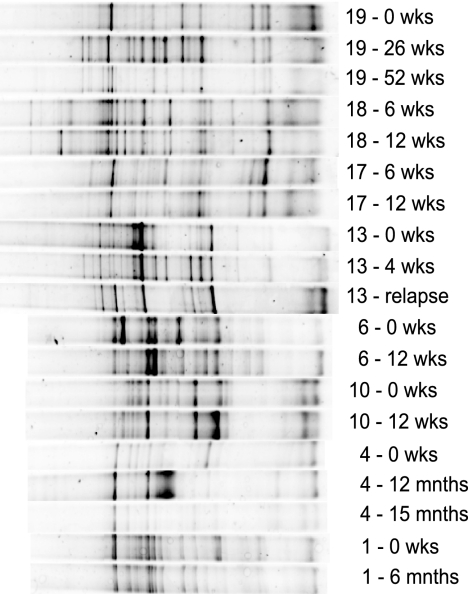
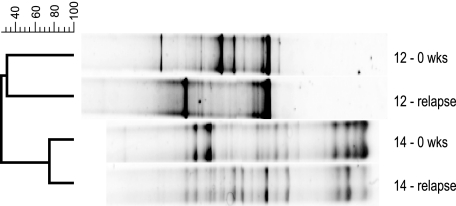
Gut microbiota shows host-specific diversity and temporal stability and significantly contributes to maintenance of a healthy gut. However, in inflammatory bowel disease, this microbiota has been implicated as a contributory factor to the illness. This study compared bacterial dynamics in Crohn's disease patients to those in a control group using a culture-independent method to assess the temporal stability, relative diversity, and similarity of the dominant fecal microbiota, Clostridium spp., Bacteroides spp., Bifidobacterium spp., and lactic acid bacteria spp. (LAB) for all individuals. Fecal samples were collected over several time points from individuals with Crohn's disease who were in remission (n = 11), from Crohn's disease patients who relapsed into an active Crohn's disease state (n = 5), and from a control group (n = 18). Denaturing gradient gel electrophoresis profiles were generated for the different microbial groups by specifically targeting different regions of the 16S rRNA gene and were compared on the basis of similarity and diversity. The temporal stability of dominant species for all Crohn's disease patients was significantly lower (P < 0.005) than that for the control group. Analysis of group-specific profiles for Bifidobacterium spp. found that they were similar in all samples, while the diversity of the LAB varied significantly between the groups, but temporal stability was not significantly altered. We observed significant changes in two functionally important mutualistic groups of bacteria, viz., Clostridium and Bacteroides spp., which may have implications for the host's gut health, since some genera are involved in production of short-chain fatty acid, e.g., butyrate.
Figures
References
-
- Bäckhed, F., R. E. Ley, J. L. Sonnenburg, D. A. Peterson, and J. I. Gordon. 2005. Host-bacterial mutualism in the human intestine. Science 307:1915-1920. - PubMed
-
- Blaut, M., M. D. Collins, G. W. Welling, J. Dore, J. van Loo, and W. de Vos. 2002. Molecular biological methods for studying the gut microbiota: the EU human gut flora project. Br. J. Nutr. 87:S203-S211. - PubMed
Publication types
MeSH terms
LinkOut - more resources
Full Text Sources
Other Literature Sources
Medical
Miscellaneous
