


Reversible deficiency of antimicrobial polypeptides in bacterial vaginosis
- PMID: 16988245
- PMCID: PMC1594936
- DOI: 10.1128/IAI.00524-06
Reversible deficiency of antimicrobial polypeptides in bacterial vaginosis
Abstract
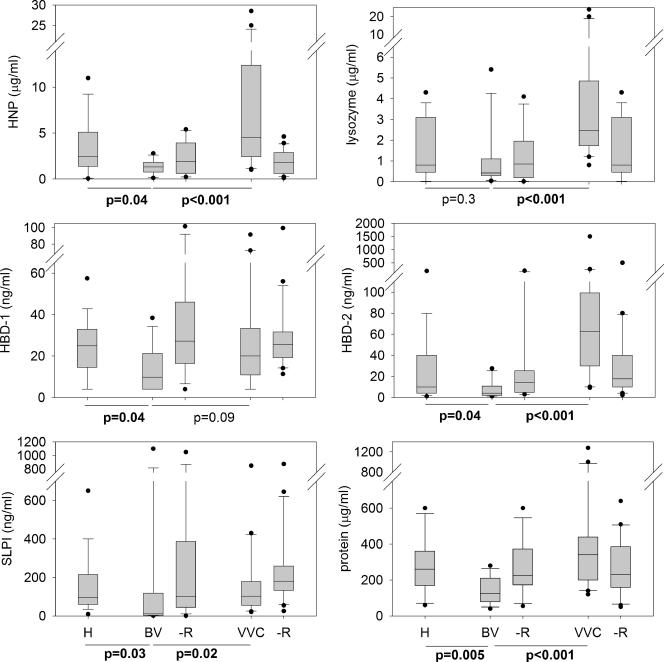
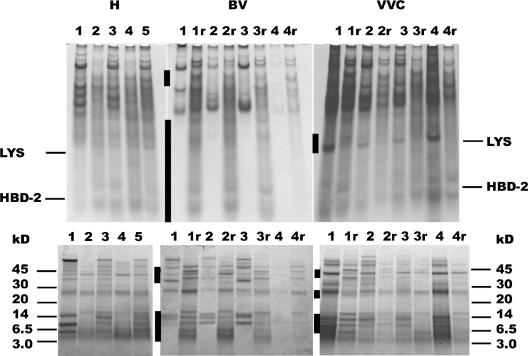
Bacterial vaginosis is a common condition associated with increased risk of sexually transmitted diseases, including human immunodeficiency virus infections. In contrast, vulvovaginal candidiasis has a much weaker association with sexually transmitted diseases. We found that vaginal lavage fluid from women with bacterial vaginosis is deficient in antimicrobial polypeptides and antimicrobial activity compared to fluid from healthy women or women with vulvovaginal candidiasis. Effective treatment normalized the concentrations of antimicrobial polypeptides in both bacterial vaginosis and in vulvovaginal candidiasis, suggesting that the abnormalities were a result of the diseases. Unlike in vulvovaginal candidiasis, the neutrophil attractant chemokine interleukin-8 (IL-8) was not increased in bacterial vaginosis, accounting for low concentrations of neutrophil-derived defensins in vaginal fluid. In organotypic cultures of human vaginal epithelium containing dendritic cells, treatment with Lactobacillus jensenii, a typical vaginal resident, induced the synthesis of IL-8 mRNA and the epithelial human beta-defensin-2 mRNA, but a typical bacterial vaginosis pathogen, Gardnerella vaginalis, had no effect. When the two bacteria were combined, Gardnerella vaginalis did not interfere with the immunostimulatory effect of Lactobacillus jensenii. The loss of normal immunostimulatory flora in bacterial vaginosis is thus associated with a local deficiency of multiple innate immune factors, and this deficiency could predispose individuals to sexually transmitted diseases.
Figures



References
-
- Amsel, R., P. A. Totten, C. A. Spiegel, K. C. Chen, D. Eschenbach, and K. K. Holmes. 1983. Nonspecific vaginitis: diagnostic criteria and microbial and epidemiologic associations. Am. J. Med. 74:14-22. - PubMed
-
- Ashcroft, G. S., K. Lei, W. Jin, G. Longenecker, A. B. Kulkarni, T. Greenwell-Wild, H. Hale-Donze, G. McGrady, X. Y. Song, and S. M. Wahl. 2000. Secretory leukocyte protease inhibitor mediates non-redundant functions necessary for normal wound healing. Nat. Med. 6:1147-1153. - PubMed
-
- Brandtzaeg, P., T. O. Gabrielsen, I. Dale, F. Muller, M. Steinbakk, and M. K. Fagerhol. 1995. The leucocyte protein L1 (calprotectin): a putative nonspecific defense factor at epithelial surfaces. Adv. Exp. Med. Biol. 371A:201-206. - PubMed
-
- Cauci, S., S. Guaschino, A. D. De, S. Driussi, S. D. De, P. Penacchioni, and F. Quadrifoglio. 2003. Interrelationships of interleukin-8 with interleukin-1beta and neutrophils in vaginal fluid of healthy and bacterial vaginosis positive women. Mol. Hum. Reprod. 9:53-58. - PubMed
Publication types
MeSH terms
Substances
Grants and funding
LinkOut - more resources
Full Text Sources
Other Literature Sources
Medical
Molecular Biology Databases
